TL;DR
- Greening your office isn’t a renovation. It’s a series of small, repeatable decisions.
- Most of the changes on this list cost nothing to start.
- Harvard research links green-certified buildings to a 26 percent boost in cognitive function.
- Start with energy and paper. They’re the cheapest wins with the fastest payback.
- Employees care 83 percent of millennials say they’d be more loyal to a company that helps them contribute to social and environmental issues.
A green office is a workplace that reduces its environmental footprint through energy efficiency, waste reduction, and employee health practices. That’s it. No solar panels required, no gut renovation, no budget approval from three departments.
So where do you start?
Right here. Below are 10 easy ways to green your office space, ranked by how much effort they take versus how much they actually move the needle. Some you can do this afternoon. A few take a bit of planning. All of them are worth doing.
What Actually Counts as a “Green” Office?
Here’s the truth nobody tells you: greening your office isn’t about how many plants you have on your desk.
It’s about resource efficiency. Energy, water, waste, and air quality, all working together instead of working against you. The US Environmental Protection Agency frames it the same way: sustainable workplaces use efficient practices and recycled materials to shrink their footprint while staying just as productive.
That last part matters. A green office isn’t a productivity tradeoff. Harvard T.H. Chan School of Public Health found that workers in green-certified buildings scored 26 percent higher on cognitive function tests, with 30 percent fewer sick-building symptoms, compared to those in non-certified buildings. You’re not sacrificing performance for principle. You’re getting both.
Quick stats before we dive in:
- Workers in green-certified buildings score 26 percent higher on cognitive function tests than those in non-certified buildings, per Harvard’s COGfx Study.
- 83 percent of millennials say they’d be more loyal to a company that helps them contribute to social and environmental issues, per Cone Communications.
- 77 percent of employers report rising employee demand for workplaces with a positive environmental impact.
- Energy-efficient lighting and smart thermostats routinely cut office energy bills by double digits, often with a payback period under two years.
Now let’s get into the list.
The 10 Changes, Starting With the Easiest Wins
No need to tackle all 10 at once. Here’s where to begin.
1. Audit Your Energy Use Before You Change Anything
Here’s where most offices go wrong. They buy new light bulbs before they know what’s actually draining power.
Do this first: run a free energy audit through ENERGY STAR or your utility provider. Most utilities offer this at no cost. It tells you exactly where your energy is going, which is usually HVAC, lighting, and equipment left running overnight, in that order.
Why it works: You can’t fix what you haven’t measured. An audit turns “we should be greener” into a prioritized to-do list.
Cost: Free to low-cost.
Do this: Book the audit this week. It’s the single highest-leverage first step on this entire list.
2. Kill Phantom Energy Draw
Energy vampires are real, and they’re probably running in your office right now.
Chargers, monitors, printers, coffee makers. Anything with a standby light is pulling power even when nobody’s using it. Left unchecked, that phantom draw can account for a meaningful slice of your monthly bill.
How to fix it:
- Plug shared devices into smart power strips that cut power after hours
- Set computers and monitors to auto-sleep after 10 minutes of inactivity
- Unplug chargers and small appliances at the end of the day, not just turn them off
Cost: Under $50 for a few smart strips.
Payback: Weeks, not months.
3. Switch to LED and Occupancy-Sensor Lighting
Fluorescent lighting is still standard in a lot of offices. It shouldn’t be.
LED bulbs use a fraction of the energy fluorescents do and last years longer, which means fewer replacements and less waste going to landfill. Pair them with occupancy sensors in meeting rooms, bathrooms, and storage areas, and you stop paying to light empty spaces.
How to fix it:
- Swap bulbs room by room, starting with the highest-traffic areas
- Install occupancy sensors in spaces that sit empty most of the day
- Add daylight sensors near windows so lights dim automatically when natural light is enough
If you want to see where this kind of automation is headed, it’s worth a look at some of the green tech innovations making offices smarter and more efficient every year.
Cost: Low to moderate upfront, but this is one of the fastest-paying-back changes on the list.
4. Go Paperless by Default, Not by Policy
A “please recycle” sign never stopped anyone from printing a 40-page deck. What actually works is making paperless the default, not the ask.
How to fix it:
- Change printer defaults to double-sided
- Share meeting agendas and decks digitally instead of printing them
- Use e-signature tools for contracts and approvals
- Keep a scrap paper box by every printer for internal notes
The simple fix? Don’t ask people to print less. Make it slightly harder to print at all, and slightly easier not to.
Cost: Free. This is a habits change, not a hardware change.
5. Build a Real Recycling and Composting System
Most offices have a recycling bin. Fewer offices have a recycling system.
The difference matters. A single bin in a corner gets ignored. Clearly labeled bins near desks, printers, and break rooms, with signage showing exactly what goes where, actually get used.
How to fix it:
- Place recycling and compost bins in every high-traffic area, not just one central spot
- Label each bin with specific examples, not just “recyclable”
- Add a compost stream for the break room if you have any food waste to speak of
- Track and share progress. People engage more when they can see the impact
The break room is usually where this system breaks down fastest, so it’s worth borrowing a few zero waste kitchen tips to keep that space on track too.
Cost: Low. Bins and signage, mostly.
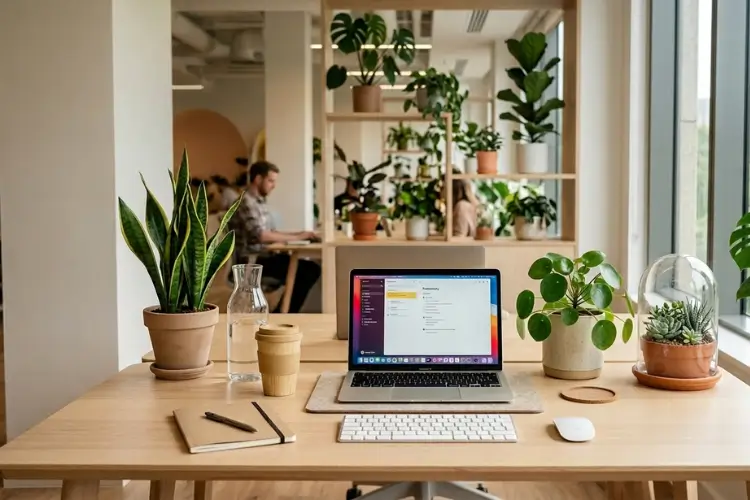
6. Bring in Office Plants (and Pick Ones That Actually Work)
Plants aren’t just decoration. Certain species genuinely help filter indoor air and take in carbon dioxide, and there’s real research behind the mood and stress benefits too.
But not every plant pulls its weight. Skip anything high-maintenance and stick to species that thrive on neglect.
Best low-maintenance options:
- Peace lily
- Snake plant
- Pothos
Deloitte has gone all-in on this idea, with over 6,000 plants across its London headquarters. You don’t need that many. A few well-placed pots near desks and communal areas is enough to make a real difference.
Cost: As little as $10 to $20 per plant.
7. Rethink Commuting: Hybrid, Carpool, Transit Incentives
A big chunk of your office’s real carbon footprint isn’t inside the building at all. It’s in how people get there.
How to fix it:
- Offer a hybrid schedule where roles allow it, cutting commute days directly
- Set up an internal carpool board for employees who live near each other
- Provide a bike rack or shower facilities to make cycling to work realistic
- Offer a transit subsidy instead of, or alongside, parking benefits
Why it works: Commuting emissions are invisible on your utility bill but very real in your total footprint. This is the tip most offices skip, and it’s often the biggest single lever available.
Cost: Ranges from free (carpool board) to a modest recurring transit subsidy.
8. Switch Cleaning Products and Vendors to Certified Green
Whoever cleans your office, whether it’s an in-house team or a contracted service, is using something. Make sure it’s not harsh chemicals going straight into the air your team breathes all day.
How to fix it:
- Look for cleaning products with a recognized third-party green certification
- Ask your cleaning vendor directly if they offer an eco-friendly product line. Many already do
- For everyday spills and wipe-downs, cleaning with vinegar and baking soda handles most of it without the harsh chemicals
- Switch break room and restroom supplies to recycled or biodegradable options. These zero waste bathroom swaps translate surprisingly well to a shared office bathroom
Why it works: Better indoor air quality isn’t just an environmental win. It directly supports the productivity and cognition gains mentioned earlier in this article.
Cost: Often the same as standard products, sometimes a small premium.
9. Green Your Digital Footprint
Here’s the one nobody thinks about: your website and cloud storage have a carbon footprint too.
Every server your business relies on consumes energy, and that energy has to come from somewhere. If your hosting provider runs on fossil fuels, your “green office” has an invisible asterisk on it.
How to fix it:
- Check if your web host runs on renewable energy sources. Many now do, often at no extra cost
- Clean up old cloud storage and unused files. Storage still draws power, even when it’s forgotten
- Choose devices with strong energy-efficiency ratings when it’s time to upgrade hardware
Cost: Often $0. Switching hosts frequently costs the same as staying put.
10. Make It a System, Not a One-Off
By the way: none of the nine tips above stick without this one.
A green office isn’t a single Earth Day initiative. It’s a system built on the same sustainable habits that make any change stick, checked, updated, and reinforced. The University of Houston’s sustainability model is a good template. It scores offices across seven categories: waste, purchasing, energy, water, indoor air quality, transportation, and involvement.
How to fix it:
- Designate one person (or a small team) to own sustainability efforts
- Use a simple checklist or self-assessment to track progress across categories
- Revisit the checklist every quarter and adjust
- Consider pursuing an actual Green Office Certification if one exists in your industry or region
Cost: Free. This is a structure change, not a purchase.
Cost vs. Impact: Which of These 10 to Do First
Not every tip deserves equal priority. Here’s how they stack up.
| Tip | Cost | Effort | Impact | Typical Payback |
| Energy audit | Free | Low | High | Immediate (informs everything else) |
| Kill phantom energy draw | Under $50 | Low | Medium | Weeks |
| LED + occupancy sensors | Low-Moderate | Medium | High | Under 2 years |
| Go paperless by default | Free | Low | Medium | Immediate |
| Real recycling system | Low | Low | Medium | Immediate |
| Office plants | $10-$20/plant | Low | Low-Medium | N/A (wellbeing gain) |
| Commuting changes | Free-Moderate | Medium | High | Ongoing |
| Green cleaning products | Low-None | Low | Medium | Immediate |
| Digital footprint | Free-Low | Low | Low-Medium | Immediate |
| Systemize it | Free | Medium | High | Compounds over time |
If you only do three things this month: the energy audit, killing phantom draw, and going paperless by default. All three are free or nearly free, and all three start paying back immediately.
What a Green Office Actually Saves You
The dollars matter, but they’re not the only return.
- Cost savings: Lower energy, paper, and supply spend, with potential tax benefits depending on your region
- Cognitive performance: A 26 percent boost in cognitive function test scores for workers in green-certified buildings, per Harvard’s COGfx Study
- Loyalty: 83 percent of millennials say they’d be more loyal to a company that helps them contribute to social and environmental issues, per Cone Communications
- Employer brand: 77 percent of employers already see rising demand from employees for greener workplaces, which means candidates are noticing too
When we started applying changes like this in our own workspace, the paperless switch alone cut printing costs noticeably within the first quarter. Small change, fast payoff.
Common Mistakes That Undo Green Office Efforts
The simple fix? Avoid these, and everything above sticks.
- Buying plants but ignoring HVAC: Plants look great, but they can’t offset a poorly maintained ventilation system. Fix the air quality fundamentals first.
- Going green without measuring anything: If you can’t point to a before-and-after number, you can’t tell what’s actually working, and neither can your team.
- Treating it as a one-time push: A single Earth Day cleanup doesn’t change a system. Ongoing structure does, which is why tip 10 on this list matters as much as it does.
- Skipping employee input: The people using the space every day usually know exactly where the waste is happening. Ask them.
Start Small. Start Today.
A sustainable office isn’t a renovation. It’s a series of small, repeatable decisions.
You don’t need to do all 10 of these at once. Pick the three at the top of the impact table, get them running this month, and build from there.
Your budget will notice. Your team will notice. And so will the planet.