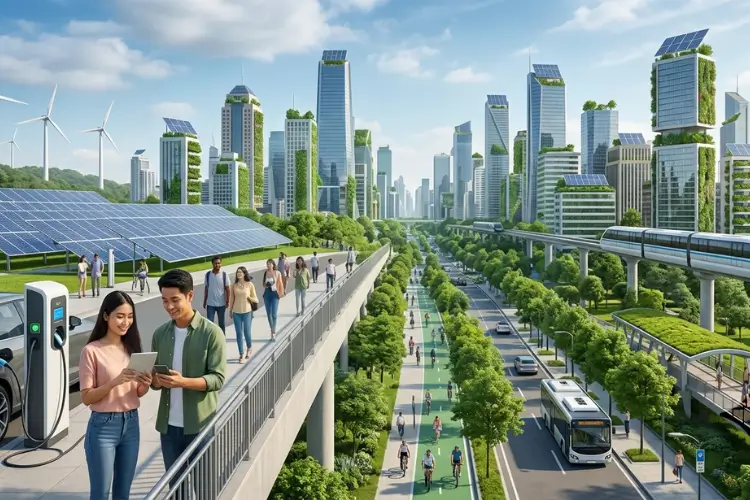
Green tech innovations changing the world in 2026 include perovskite-tandem solar cells, iron-air batteries, direct air capture, AI-optimized power grids, and carbon-negative concrete. Solar cells are hitting nearly 35% efficiency in the lab. Direct air capture costs have dropped below $500 a ton for the first time, down from over $1,000 just a few years ago.
This guide ranks the 10 innovations with the biggest real-world impact, from tech you can already buy into, to breakthroughs still a few years out.
Quick list:
- Perovskite-silicon tandem solar cells: next-gen solar efficiency
- Iron-air and sodium-ion batteries: cheap, long-duration storage
- Direct air capture: pulling CO2 straight from the sky
- AI-optimized smart grids: matching power supply to demand in real time
- Small modular reactors: compact, factory-built nuclear
- Carbon-negative concrete: building materials that trap CO2 instead of releasing it
- Electric, autonomous farm equipment: decarbonizing agriculture
- Green hydrogen: clean fuel for the hardest-to-electrify industries
- Circular materials: turning waste into new products
- AI-optimized, liquid-cooled data centers: cleaning up the internet’s power bill
I’ve spent the last few weeks pulling apart 2025 and 2026 industry reporting, lab results, and company disclosures to figure out which of these are real and which are still mostly hype. Here’s what I found.
What Counts as “Green Tech,” Really?
Green tech innovations are new technologies built to cut emissions, waste, or resource use, while still being viable to actually build and sell at scale.
That second part matters more than people think.
A brilliant lab breakthrough that never leaves the lab doesn’t change the world. It just makes a nice headline.
So that’s the filter I used for this list. Not “what’s the coolest idea,” but: is this actually shipping, or close to it?
If you want a broader primer on the renewable energy sources powering a lot of this, we’ve covered that here.
How I Picked These 10
I cross-checked 2025–2026 reporting from energy and climate-tech coverage against company announcements, lab efficiency records, and cost data. Where a technology is still purely experimental, I’ve said so. Where it’s already being deployed commercially, I’ve said that too.
Numbers in fast-moving fields like this change constantly. Treat the figures below as a snapshot, not gospel, and check primary sources (I’ve linked where I can) before you cite them yourself.
The 10 Green Tech Innovations, by Real-World Impact
Let’s get into it, starting with the one already reshaping every rooftop.
1. Perovskite-Silicon Tandem Solar Cells
Standard silicon solar panels have basically hit their ceiling, somewhere around 24–27% efficiency, depending on who you ask.
Perovskite-tandem cells blow past that. Layer a perovskite crystal structure on top of traditional silicon, and you capture a wider slice of the light spectrum. Recent manufacturer records have pushed tandem efficiency to roughly 33–35%.
That’s not a marginal gain. That’s close to a 40% jump over what’s on most rooftops today.
Why it matters: higher efficiency means fewer panels for the same output: less land, less material, lower installation cost per watt. Several manufacturers are now moving tandem cells from lab demos into first commercial production runs.
Readiness: early commercial. Expect to see it in premium panels within the next 1–3 years, mainstream shortly after.
2. Iron-Air and Sodium-Ion Batteries
Here’s the truth nobody tells you about the renewable energy transition: solar and wind are useless at 2am on a windless night unless you can store the power.
That’s the storage problem. And it’s finally getting solved, not with exotic materials, but with cheap, abundant ones.
Iron-air batteries use, well, iron and air. They’re heavier and slower to charge than lithium-ion, which makes them a bad fit for your phone, and a great fit for parking next to a solar farm for days-long backup power. Pilot projects are already proving multi-day storage on real grids.
Sodium-ion is the other half of this story. CATL, the world’s largest battery maker, is now producing sodium-ion cells at industrial scale. Sodium is roughly 1,000 times more abundant than lithium. That matters for cost, and it matters for not depending on a handful of lithium-producing countries.
Readiness: iron-air is in early grid pilots; sodium-ion is already shipping.
3. Direct Air Capture (DAC)
Even with aggressive emissions cuts, most climate scientists agree we’ll still need to physically pull carbon out of the atmosphere to hit net-zero targets.
That’s what direct air capture does. Giant fans pull in ambient air, run it through a chemical process, and either lock the CO2 underground or turn it into something useful.
The simple fix? It used to be wildly expensive: over $1,000 per ton, as recently as 2023. The cost curve is finally moving: the first verified operational facility broke below $500 per ton in early 2026, and more DAC plants are coming online every year.
That’s the real story here: DAC is shifting from science-fair project to actual infrastructure.
Readiness: early commercial, scaling fast. Still not cheap enough to solve climate change alone, but it doesn’t need to. It needs to keep getting cheaper, and it is.
4. AI-Optimized Smart Grids
Power grids were designed for a world where electricity flowed one direction: from a big plant, to your house.
Solar panels on rooftops and batteries in garages broke that model. Power now flows every which way, and it needs to be balanced in real time.
AI-driven grid management systems handle that balancing act: predicting demand spikes, rerouting power, and squeezing more capacity out of existing infrastructure without building a single new power line. That’s a big deal, because new transmission lines can take a decade to permit and build.
Readiness: already deployed by major utilities, expanding fast.
5. Small Modular Reactors (SMRs)
Nuclear power has an image problem. It doesn’t have a physics problem; it’s one of the densest, most reliable zero-emission power sources we have.
Small modular reactors fix the economics. Instead of a massive, custom-built plant that takes 15 years and blows its budget, SMRs are factory-built in standardized pieces and assembled on-site. Cheaper. Faster. Safer, by design, than older reactor generations.
Companies like Kairos Power are moving these through regulatory approval right now, driven partly by an unexpected customer: AI data centers, which need enormous, always-on power and are increasingly turning to nuclear to get it.
Readiness: in regulatory approval and early construction, realistically 3–7 years from meaningful scale.
6. Carbon-Negative Concrete
Concrete is one of the most quietly destructive materials on Earth. Traditional cement production alone accounts for a huge chunk of global emissions, and buildings overall are responsible for roughly 37% of global greenhouse gas output.
By the way: that number should stop you for a second. More than a third of global emissions come from buildings and construction.
New concrete formulations flip the script. Instead of releasing CO2 during production, they actually absorb and lock it into the material as it cures, turning a building’s foundation into a small carbon sink.
Readiness: commercially available in select markets, gaining traction as construction firms compete on sustainability metrics.
7. Electric, Autonomous Farm Equipment
Agriculture is responsible for around a quarter of global greenhouse gas emissions. It’s also one of the hardest sectors to decarbonize: tractors are heavy, work long hours, and operate far from charging infrastructure.
Monarch Tractor’s MK-V is the clearest proof this is solvable: the world’s first fully electric, driver-optional smart tractor, built to replace diesel machinery entirely. It uses onboard AI for autonomous precision farming, which means less wasted fuel, fewer passes over the field, and lower emissions per acre.
Readiness: commercially available now, scaling with adoption.
8. Green Hydrogen
Some industries are brutal to electrify directly. Steel, cement, shipping, aviation: they need concentrated, portable energy that batteries can’t easily provide.
Green hydrogen, made by splitting water using renewable electricity, fills that gap. New production methods are also making it possible to produce ammonia (the backbone of synthetic fertilizer) without fossil fuels, which matters because traditional fertilizer production is a massive, under-discussed emissions source.
Readiness: early commercial for shipping and industrial use, still expensive relative to fossil alternatives.
9. Circular Materials and Waste-to-Resource Tech
Plastic pollution isn’t a “someday” problem. It’s a right-now problem, and green tech is starting to close the loop.
UBQ Materials is a good example: they convert household waste (the stuff that would otherwise sit in a landfill for centuries) into a genuinely new, sustainable plastic material. Combine that with 3D printing (which enables on-demand production instead of mass overproduction) and a growing wave of upcycling platforms, and you get a manufacturing model that doesn’t depend on constantly extracting new raw material.
Readiness: commercially available, expanding into more product categories every year.
If circular living interests you beyond the industrial scale, our beginner’s guide to zero waste is a good next read.
10. AI-Optimized, Liquid-Cooled Data Centers
Here’s an uncomfortable fact: the AI boom is power-hungry, and it’s not slowing down.
So the data centers running it are undergoing their own green transformation. Liquid cooling systems replace energy-intensive air conditioning. Renewable-powered operations and carbon-aware workload scheduling shift heavy computing to times and places where clean power is abundant. Distributed cloud networks reduce the energy lost moving data over long distances.
Readiness: actively being deployed by major cloud providers right now, and this one’s moving fast because the cost savings, not just the emissions savings, make it an easy call.
Green Tech Innovations Compared
| Innovation | Deployment Stage | Timeline to Mainstream | Primary Impact | Notable Company |
| Perovskite-tandem solar | Early commercial | 1–3 years | Higher solar efficiency | Multiple manufacturers |
| Iron-air / sodium-ion batteries | Pilot / early commercial | 2–5 years | Cheap long-duration storage | Form Energy / CATL |
| Direct air capture | Early commercial | 3–7 years | Atmospheric CO2 removal | Carbon Engineering |
| AI-optimized smart grids | Commercial | Now–2 years | Grid efficiency, fewer new power lines | Major utilities |
| Small modular reactors | Regulatory / construction | 3–7 years | Reliable zero-emission baseload power | Kairos Power |
| Carbon-negative concrete | Early commercial | 2–5 years | Emissions cut in construction | Select regional suppliers |
| Electric farm equipment | Commercial | Now–3 years | Ag decarbonization | Monarch Tractor |
| Green hydrogen | Early commercial | 5–10 years | Fuel for hard-to-electrify industry | Multiple producers |
| Circular materials | Commercial | Now | Waste-to-resource, less landfill | UBQ Materials |
| Green data centers | Commercial | Now–2 years | Lower AI/cloud emissions | Major cloud providers |
Real Impact: What the Data Actually Says
Numbers, not vibes:
- Perovskite-tandem solar cells have reached roughly 33–35% efficiency in the lab, compared to about 22–24% for standard silicon. (source)
- Direct air capture costs have fallen below $500 per ton for the first time in 2026, down from over $1,000 just a few years ago. (source)
- Buildings account for around 37% of global greenhouse gas emissions, more than transportation. (source)
- Agriculture, forestry, and land use contribute somewhere between 20–25% of global emissions, depending on the methodology used. (source)
- Solar PV costs dropped about 82% between 2010 and 2019, and the curve hasn’t flattened much since. (source)
- Clean energy sources made up close to 40% of global electricity generation as of 2023, with that share projected to keep climbing. (source)
Does Green Tech Actually Reduce Emissions, or Is It Hype?
Fair question. And the honest answer is: it depends.
Academic research on this is more nuanced than the marketing copy suggests. A widely cited economics idea called the Jevons paradox points out that efficiency gains can backfire: when something gets cheaper or more efficient, people sometimes just use more of it, wiping out the environmental gain.
Peer-reviewed panel studies looking at green technology and CO2 emissions across dozens of countries have found something similar: a single green innovation, on its own, often doesn’t move the needle much. It’s the combination of technologies (cleaner energy plus efficiency plus better materials, deployed together) that actually bends the emissions curve.
So no, buying one smart thermostat isn’t going to fix climate change.
But that’s not really the point of this list. The point is that we now have a genuinely broad toolkit (solar, storage, carbon capture, cleaner materials, cleaner agriculture) deployed at the same time, for the first time. That’s what makes this moment different from the last twenty years of incremental progress.
Ready Now vs. Still a Few Years Out
Not everything on this list is something you can act on today. Here’s the honest breakdown.
Already deployable, right now:
- AI-optimized smart grids (utility-level)
- Electric, autonomous farm equipment
- Circular materials and waste-to-plastic products (start small with these zero waste swaps)
- AI-optimized, liquid-cooled data centers
Early commercial, expect real availability in 1–3 years:
- Perovskite-tandem solar panels
- Carbon-negative concrete
- Direct air capture (at scale, not just pilots)
Still mostly emerging, 3–10 years from mainstream:
- Iron-air grid-scale batteries
- Small modular reactors
- Green hydrogen for heavy industry
From Lab Talk to Real Infrastructure
Here’s what stands out after going through all of this: the gap between “promising research” and “actually deployed” has gotten a lot smaller.
Four or five years ago, most of this list would’ve been lab talk. Now, more than half of it is either commercially available or in active construction.
That’s the real headline. Not any single breakthrough: it’s the sheer number of them landing at the same time.
Keep an eye on direct air capture cost curves and iron-air battery pilots especially. Those two, more than anything else on this list, are the ones to watch move from “emerging” to “everywhere” over the next few years.