Every year brings a new wave of “game changing” green tech headlines. Most of them fade.
So how do you tell which technologies will actually matter, and which are just good PR?
When I dug into the numbers behind these headlines, several of the flashiest claims didn’t hold up. So this list is built differently. Every technology below has real testing or deployment behind it, and I’ve flagged where the hype runs ahead of the evidence.
Here are 10 technologies worth watching, what they do, and how close each one really is to changing your daily life.
What Counts as a “Future” Green Technology?
A future green technology is one that works in pilot or early commercial form but hasn’t gone mainstream yet.
That rules out standard rooftop solar and hybrid cars. Those are already here.
It also rules out pure theory. If nobody has built a working version, it’s not on this list.
The bar for inclusion: real-world testing, measurable results, and a credible path to scale.
Quick Answer: The 10 Technologies at a Glance
| Technology | What It Does | Our Estimate to Mainstream |
| Perovskite-silicon tandem solar | Squeezes more power from every solar panel | 5+ years |
| Solid-state EV batteries | Faster charging, longer range, safer chemistry | 3 to 6 years |
| Green hydrogen from seawater | Zero-emission fuel for shipping and aviation | 8+ years |
| Direct air capture | Pulls CO2 straight out of the air | 8+ years |
| Floating solar farms | Solar power on reservoirs and lakes | Already scaling |
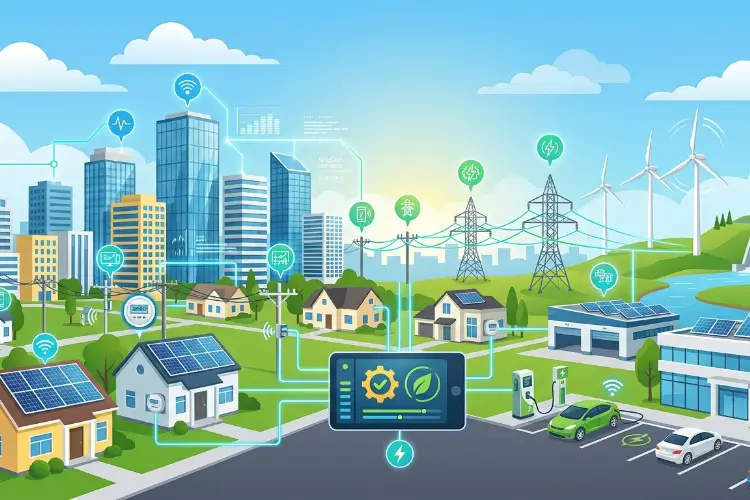
| AI-optimized smart grids | Cuts waste by balancing supply and demand | 2 to 4 years |
| Carbon-absorbing concrete | Building material that locks away CO2 | 4 to 7 years |
| Precision fermentation | Animal-free dairy and protein | 3 to 5 years |
| Engineered methane-eating microbes | Neutralizes a potent greenhouse gas | 8+ years |
| Commercial fusion power | Clean, steady power from fusing atoms | 10+ years |
These timelines are my own estimates, not forecasts from a published source.
Why These Technologies Matter Right Now
Here’s the truth nobody tells you: green tech isn’t just an environmental story. It’s an economic one, and a political one.
Funding decides which technologies make it from the lab to your life. And funding is shifting.
In the US, the One Big Beautiful Bill Act, signed in July 2025, phased out many clean energy tax credits from the Inflation Reduction Act, including those for new solar and wind projects and EV purchases.1
That doesn’t kill these technologies. But it changes who pays for them, and how fast they scale.
Keep this in mind as you read: a brilliant invention with no capital behind it goes nowhere. Watch the money as closely as the science.
The 10 Future Green Technologies Worth Watching
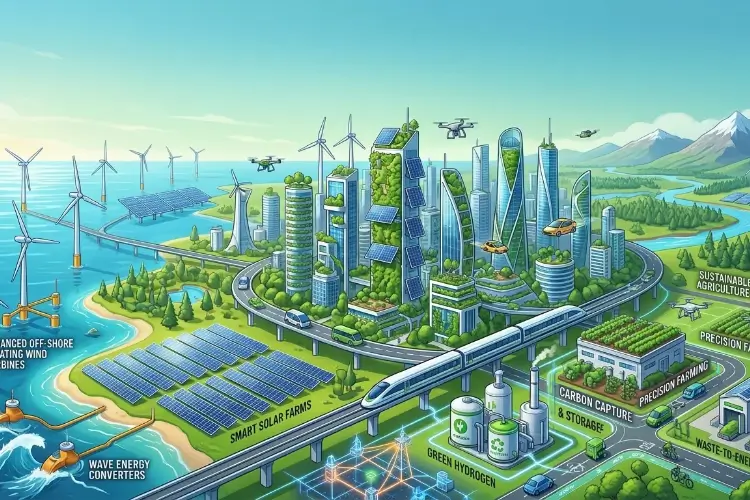
Here are the 10 future green technologies worth watching, from next-generation solar cells to commercial fusion power.
1. Perovskite-Silicon Tandem Solar Cells
If you’re new to how solar energy works, here’s the key number: silicon solar cells have a theoretical efficiency ceiling of about 33.7%.
Tandem cells stack a perovskite layer on top of silicon to capture more of the sun’s light. And they’ve already broken through that ceiling. In July 2026, LONGi reported a certified lab cell at 35.5%.
Why does it matter? More power from the same rooftop means lower costs over time.
The catch: that record came from a laboratory device, not a commercial panel. Larger commercial-size tandem cells have reached 33%, and the first tandem modules sit around 31%. But the company has said it has no active mass-production plan for these cells yet.
So this one is real, but it’s not on your roof tomorrow.
2. Solid-State EV Batteries
If you’ve ever weighed electric vs hybrid cars and balked at the charging time, this is the one to watch.
Solid-state batteries replace the liquid electrolyte in today’s lithium-ion cells with a solid material. QuantumScape reports its test cells can charge from 10 to 80% in about 15 minutes, and that the design could deliver up to 80% longer range than today’s batteries.
They’re also expected to be safer, since there’s no flammable liquid inside.
But: those are company-reported results from test cells, not production cars. Manufacturing solid-state cells at scale is the hard part. The chemistry works in the lab. Millions of vehicles is a different problem.
3. Green Hydrogen from Seawater Electrolysis
Hydrogen has a water problem. Making it through electrolysis usually needs purified fresh water, which isn’t abundant everywhere.
Seawater electrolysis aims to skip that bottleneck by splitting hydrogen directly from seawater.
Why care? Hydrogen is one of the few realistic options for sectors that batteries can’t easily power, like long-haul shipping and aviation.
The honest take: this is still early-stage. Pilot projects exist, but I couldn’t find solid, independent cost data for seawater-based hydrogen at scale. Treat bold price predictions with caution.
4. Direct Air Capture
Trees capture carbon, which is one of the reasons why forests are important. But they’re slow and need land.
Direct air capture machines pull CO2 straight from the air using chemical filters, then store it underground or turn it into products. Climeworks runs the world’s largest plant in Iceland.
Now the reality check. IEA analysis puts current costs at roughly $600 to $1,000 per ton of CO2 removed. Most experts see about $100 per ton as the point where this becomes truly viable.
The encouraging part? Climeworks reported that operating costs at its Mammoth plant fell by more than 50% in a year.
Bottom line: promising, expensive, and not a substitute for cutting emissions in the first place.
5. Floating Solar Farms
This one is already moving from “future” to “now.”
Floating panels sit on reservoirs and lakes instead of land. That means no competition with farms or housing, and less water lost to evaporation.
Many sources say the water cools the panels and boosts output. But how much? That’s debated. A 2023 peer-reviewed review found reported gains ranging from under 1% to around 31%, and described the cooling effect as poorly documented.
So the safe claim is this: floating solar saves land, and it may squeeze out some extra power. Don’t trust any single big number.
For crowded regions where land is scarce, it’s quickly becoming a practical choice.
6. AI-Optimized Smart Grids
A lot of clean power never reaches a useful purpose. It gets curtailed, meaning wasted, because the grid can’t handle it at the right moment.
So what is a smart grid? It’s an electricity network that uses digital tools to balance supply and demand in real time.
AI helps by forecasting demand and renewable output far more precisely than older systems. Better forecasts mean fewer surprises, fewer blackouts, and more clean power actually used.
The simple fix? Better prediction. A sudden cloud bank over a solar farm is a problem when you don’t see it coming. It’s a manageable event when you do.
This is one of the nearest-term technologies on the list, because it’s mostly software added to grids that already exist.
7. Carbon-Absorbing Concrete
Cement production causes about 8% of global CO2 emissions, according to Chatham House. That’s more than most people realize.
Carbon-absorbing concrete tries to flip the script. Some versions lock CO2 into the material as it cures, so the building itself stores carbon.
Think about that for a second. The walls of a building could act as a small, permanent carbon sink.
The hurdle: construction is cautious, and cement is cheap. Like other sustainable building materials, it has to prove it’s as strong, safe, and affordable as the old stuff before builders switch.
8. Precision Fermentation for Animal-Free Protein
You don’t need a cow to make milk protein anymore. That’s precision fermentation in one sentence.
Microorganisms are programmed to produce proteins identical to dairy and egg proteins, with no livestock involved. That can mean far less land and water use. So what is sustainable food, and does this count? Using fewer resources is a big part of it.
Company studies report big emissions cuts compared with conventional dairy protein. But independent researchers have found the results depend heavily on the electricity and sugar used in production, and some found impacts in the same range as dairy.7
What that means for you: the technology is real and already in products, but “much greener” depends on how and where it’s made.
9. Engineered Methane-Eating Microbes
Methane traps about 80 times more heat than CO2 over a 20-year period, according to the UN Environment Programme.
That makes it one of the highest-impact targets in climate tech. Cut methane, and you slow warming faster than almost any other move.
Researchers are engineering microbes that consume methane and convert it into other compounds. The most promising uses are farms, landfills, and waste sites, which are major methane sources.
The honest take: this is early-stage science. I couldn’t find reliable, independently verified performance figures, so I’m leaving the big percentages out. It’s one to watch, not one to count on yet.
10. Commercial Fusion Power
Fusion has been “20 years away” for decades. That’s the joke, anyway.
But real money is now behind it. Helion Energy has a contract to deliver 50 megawatts to Microsoft, and has begun building its Orion plant in Washington state.
Here’s the part headlines skip. Helion has softened its own wording, shifting a key prototype goal from “net electricity” to simply demonstrating electricity from fusion. And its contract requires grid connection and operation by the end of 2028, though it’s unclear whether that means delivering power.
No one has yet delivered grid electricity from fusion. Many experts say serious hurdles remain.
This is the longest shot on the list. But if it works, it changes the conversation about clean, steady power.
Comparison Table: Where Each Technology Stands
| Technology | Where It Stands Today | Biggest Hurdle | Our Estimate to Mainstream |
| Perovskite-silicon tandem solar | Lab record of 35.5%, early commercial cells | Mass production and durability | 5+ years |
| Solid-state batteries | Test cells with strong company-reported results | Manufacturing at scale | 3 to 6 years |
| Green hydrogen (seawater) | Early pilots | Cost and scale | 8+ years |
| Direct air capture | Operating plants, roughly $600 to $1,000 per ton | Cost | 8+ years |
| Floating solar | Already deployed worldwide | Proving real output gains | Already scaling |
| AI-optimized grids | Early deployment | Utility adoption | 2 to 4 years |
| Carbon-absorbing concrete | Pilot and early commercial use | Cost and builder trust | 4 to 7 years |
| Precision fermentation | In some products today | Production cost and energy source | 3 to 5 years |
| Methane-eating microbes | Research stage | Proven real-world performance | 8+ years |
| Commercial fusion | First plant under construction | Basic technical proof | 10+ years |
Technologies That Almost Made the List
Not everything promising made the cut. Here’s what I left off, and why.
- Osmotic power from saltwater mixing. Clean and real, but limited to coastal areas with the right geography.
- Vertical wind turbines. Great for cities because of their small footprint, but their output still trails traditional turbines.
- Cell-based lab-grown meat. Different from precision fermentation. Progress is real, but costs are high and approvals are patchy.
How to Track These Technologies
You don’t need to be a climate scientist to keep up. You just need a system.
- Follow the funding, not just the headlines. Grants and major investment rounds are a better early signal than press releases.
- Watch for the jump from pilot to commercial plant. That’s the real turning point, not the first lab announcement.
- Check whether costs are falling. Cost per ton, per kilowatt-hour, or per vehicle is the clearest sign a technology is scaling.
No Silver Bullet, But These Green Technologies Are Worth Watching
None of these technologies is a silver bullet. That’s the honest answer.
But together, they point to a very different energy and materials world than the one we live in today.
The ones to watch closest are those with real deployment behind them: floating solar, AI grids, and solid-state batteries.
The rest are longer bets. Worth following. Not worth betting your whole strategy on yet.