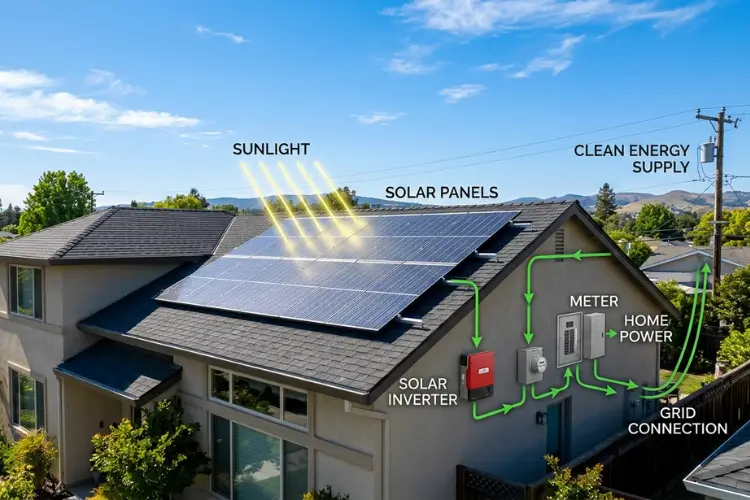
Solar energy works by converting sunlight directly into electricity through solar panels. When photons of sunlight strike a solar cell, they knock electrons loose, creating a flow of direct current (DC) electricity. An inverter then converts that DC power into the alternating current (AC) electricity that powers your home.
That’s the whole idea in one breath.
But here’s the truth nobody tells you: solar panels don’t create energy. They convert it. The sun is already doing the hard work, 93 million miles away. Your panels just catch it.
So let’s break down exactly how that happens, step by step, with no jargon left unexplained.
Quick summary:
- Sunlight hits a solar panel and knocks electrons loose inside a silicon cell.
- That movement creates direct current (DC) electricity.
- An inverter converts DC into the alternating current (AC) your home actually uses.
- Extra power gets stored in a battery or sent back to the grid.
Where Solar Energy Actually Comes From
Every bit of solar energy you’ll ever use started as a nuclear reaction, which is part of why solar sits at the top of the list of renewable energy sources we actually have access to today.
The sun is, at its core, a giant fusion reactor. It’s been fusing hydrogen into helium for about 4.6 billion years, and in the process it throws off staggering amounts of light and heat. That energy travels through space as photons, tiny packets of light, and takes about 8 minutes to reach Earth.
Here’s how much of it actually arrives:
Solar energy by the numbers:
- Global solar capacity hit roughly 2,392 GW by the end of 2025, after the world added 510 GW in a single year, the largest annual capacity addition ever recorded for any energy technology (IRENA, 2026).
- Solar generated about 2,800 TWh globally in 2025, over 8% of the world’s electricity (IEA, 2026).
- The average global cost of utility-scale solar power fell to about $0.043 per kWh, a 90% drop since 2010 (IRENA, 2024).
- The U.S. installed about 43.2 GW of solar capacity in 2025 alone (EIA, 2026).
The sun sends the Earth more energy in about an hour than the entire planet uses in a year. We just don’t have the infrastructure to capture more than a sliver of it yet. That’s the real story of solar energy right now. Not “will it work,” but “how much of this free energy can we actually catch.”
How Solar Panels Turn Sunlight Into Electricity, Step by Step
Here’s the part most explainers rush through. Let’s not.
Step 1: Sunlight hits the panel
A solar panel is really just a grid of individual solar cells, wired together and sealed under glass. When sunlight lands on that surface, photons, those tiny packets of light energy, strike the semiconductor material inside each cell.
The takeaway: nothing happens until light physically hits the cell. No sun, no reaction. That’s why direction, tilt, and shade all matter so much for real-world performance.
Step 2: The photovoltaic effect frees electrons
Inside each cell is a wafer of silicon, split into two layers. One layer is treated to have extra electrons. The other is treated to have fewer. That imbalance creates an electric field between them, like a wall with pressure built up on one side.
When a photon hits an atom in that silicon wafer with enough force, it knocks an electron loose. This is called the photovoltaic effect, and it’s the reason sunlight becomes electricity at all.
The takeaway: the “magic” of solar power isn’t magic. It’s physics. Light knocks electrons loose, and the built-in electric field pushes them in one direction.
Step 3: Electrons form a direct current (DC)
Once those electrons are freed and pushed in a single direction by the electric field, you get movement. Movement of electrons is, by definition, electric current.
Wires attached to the positive and negative sides of each cell capture that current and carry it out of the panel. This is direct current, or DC electricity, the same basic type of current stored in a battery.
The takeaway: every solar panel is, at its core, a very simple electron pump.
Step 4: The inverter converts DC to AC
Here’s the problem. Your home doesn’t run on DC electricity. It runs on alternating current, or AC, the type that flows through your outlets.
That’s where the inverter comes in. It sits between your solar panels and your home’s electrical panel, and its whole job is to flip DC power into AC power your appliances can actually use.
Think of an inverter as the translator between what a panel makes and what your home can use.
Step 5: Power reaches your home, battery, or the grid
Once that power is converted to AC, it has three possible destinations. It can power whatever’s running in your home right now. It can charge a home battery, if you have one. Or, if you’re producing more than you’re using, it can flow back out to the electric grid.
That last option is where things like net metering come in, and we’ll get to that shortly.
What’s Actually Inside a Solar Panel
Not all solar panels are built the same way, and the differences actually matter for cost, efficiency, and lifespan.
| Type | How it’s made | Efficiency | Cost | Best for |
| Monocrystalline | Cut from a single silicon crystal | Highest (typically 20-22%) | Highest | Limited roof space, maximum output |
| Polycrystalline | Made from melted silicon fragments | Moderate (typically 15-17%) | Lower | Budget installs with more available space |
| Thin-film | Layers of photovoltaic material on a flexible base | Lowest (typically 10-13%) | Lowest upfront | Large-scale or flexible/portable installs |
Why does silicon show up in almost every version? Because silicon is a semiconductor. It sits in that useful middle zone between a conductor (like copper, which lets electricity flow freely) and an insulator (like rubber, which blocks it). That in-between behavior is exactly what lets engineers control how and when electrons move, which is the entire trick behind the photovoltaic effect.
Solar Photovoltaic (PV) vs. Solar Thermal: What’s the Difference
Most people say “solar panels” and mean one specific thing. There are actually two distinct technologies out there, and they do very different jobs.
| Solar PV | Solar Thermal | |
| What it produces | Electricity | Heat |
| How it works | Photovoltaic effect converts light directly to electric current | Sunlight heats a liquid or air directly, like a radiator in reverse |
| Common use | Powering homes, businesses, devices | Heating water, pools, buildings |
| Where you’ll see it | Rooftop panels, solar farms | Water heating systems, large-scale concentrating solar plants |
Concentrating solar-thermal power (CSP) takes this a step further at utility scale. Giant mirror arrays focus sunlight onto a central receiver, generating enough heat to drive a turbine and produce electricity that way, instead of through the photovoltaic effect at all.
So when someone asks “how does solar energy work,” there are technically two correct answers, depending on whether they mean electricity or heat. This guide is focused on the electricity side, since that’s what’s on most homeowners’ roofs.
What Happens on Cloudy Days or at Night
This is the question everyone asks eventually. So let’s just answer it directly.
Solar panels still generate power on cloudy days, just less of it. Clouds scatter and block some sunlight, but they don’t stop it completely. A typical panel might produce anywhere from 10% to 25% of its normal output on a heavily overcast day.
At night, it’s different. No sunlight means no photovoltaic effect, which means no generation. Panels simply don’t produce power after dark.
The simple fix? Battery storage and grid connection. Most home solar systems aren’t designed to work in isolation. They’re designed to work alongside the existing electric grid, or alongside a battery, precisely so nighttime and heavy cloud cover don’t leave you without power.
How Excess Solar Power Is Stored or Sold Back
On a sunny afternoon, most home solar systems generate more electricity than the house is using in that exact moment. That extra power has to go somewhere.
Two main paths:
- Battery storage: A home battery captures the extra electricity during the day and releases it at night, or during an outage. This is the most direct way to actually use your own solar power around the clock, though it adds meaningful upfront cost.
- Net metering: In many U.S. states, extra power flows back onto the electric grid, and your utility credits your account for it. Later, when your panels aren’t producing enough (at night, for example), you draw power back from the grid and use those credits to offset the cost. Effectively, the grid acts as a giant, shared battery.
Net metering policies vary a lot by state and utility, so it’s worth checking your specific local rules before assuming this applies to you exactly the way it’s described here.
A Real Home Solar System, Start to Finish
Rooftop panels have become one of the most common eco home design ideas for homeowners who want to cut both their bills and their carbon footprint. Here’s what that actually looks like on an average sunny day, from sunrise to sunset.
Morning: Panels start generating small amounts of DC electricity as the sun rises. Output climbs steadily through the morning as the sun gets higher and more direct.
Midday: This is peak production. The inverter is working at full capacity, converting DC to AC as fast as the panels are generating it. The house draws what it needs in real time. Anything left over heads to the battery or back to the grid.
Afternoon into evening: Output starts declining as the sun lowers. The system may start pulling from stored battery power, or from the grid, to fill any gap between what’s being generated and what the house is using.
Night: No generation at all. The home runs entirely on battery power, grid power, or a mix of both, depending on the system.
This daily rhythm, according to DOE data on residential solar performance, is exactly why storage and grid connection are treated as core parts of a solar system, not optional extras. A panel alone only tells half the story.
How Much Solar Panels Actually Save You
This is the part everyone actually cares about. So let’s put real, sourced numbers next to it.
| Factor | What it typically looks like |
| Average residential system size | 7-8 kW |
| Installed cost before incentives | $2.55-$3.45 per watt, roughly $20,400-$27,600 for an 8 kW system (EnergySage 2026 marketplace data, cross-checked against NREL cost benchmarks) |
| Federal tax credit | The 30% federal Residential Clean Energy Credit expired December 31, 2025. Systems installed in 2026 or later no longer qualify for it |
| State/utility incentives | Still vary significantly by location, some states and utilities offer their own credits, rebates, or net metering programs |
| Typical payback period (2026 installs) | Roughly 8-14 years nationally, without the federal credit factored in |
| Panel lifespan | 25-30 years |
| Annual output decline | Roughly 0.5% per year |
Here’s the truth nobody tells you: the math on solar changed in 2026. For years, that 30% federal credit was the number every savings estimate leaned on. It’s gone now for new installs, which means today’s payback period runs longer than the figures you’ll find in older articles.
Solar savings still depend heavily on where you live, your local electricity rate, and whatever state or utility incentives are currently on the table. A system in a high-electricity-cost state can still pay for itself in under a decade. Somewhere with cheap grid power, it’ll take longer.
There’s no single national number that’s honest to quote here without those caveats attached, and you should be skeptical of any article that gives you one without them. This isn’t financial advice, just the current state of the numbers, so run your own numbers against your actual electric bill and local incentives before deciding anything.
Is Solar Energy Actually Renewable and Clean?
Short answer: yes, with a few honest caveats.
Why it’s renewable: the sun isn’t running out anytime soon. As long as it keeps shining, and it will for billions more years, the fuel source never depletes the way fossil fuels do.
Why it’s clean, mostly: solar panels produce no direct emissions while generating electricity. There’s no combustion, no exhaust, nothing burning.
The honest caveat: manufacturing panels does require mining silicon and other materials, and that process has a real environmental footprint. But once installed, a panel typically produces the emissions equivalent of its own manufacturing footprint within just a couple of years, then generates clean power for another 20+ years after that.
A few more numbers worth knowing:
- Panels typically last 25-30 years, with output declining by only about 0.5% per year.
- Solar’s lifecycle carbon footprint is dramatically lower than coal or natural gas, even accounting for manufacturing.
- Panel recycling programs are expanding as the first large wave of installed panels starts reaching end of life.
Solar is a big move, but it works even better alongside smaller sustainable habits around the rest of the house.
Solar Works. Here’s What to Ask Next
Solar energy isn’t complicated once you see the whole chain. Sunlight hits a panel. A silicon cell converts that light into electricity. An inverter makes it usable. Your home runs on it, and whatever’s left over gets stored or shared.
That’s it. That’s the entire system.
Solar is part of a much bigger wave of green tech innovations reshaping how we power everything, and the technology keeps getting cheaper and more efficient every year. It’s already the fastest-growing source of new electricity on the planet.
If you’re weighing whether it makes sense for your own home, the next real question isn’t “does solar work.” It clearly does. The next question is what it actually costs where you live, and what incentives are on the table right now.