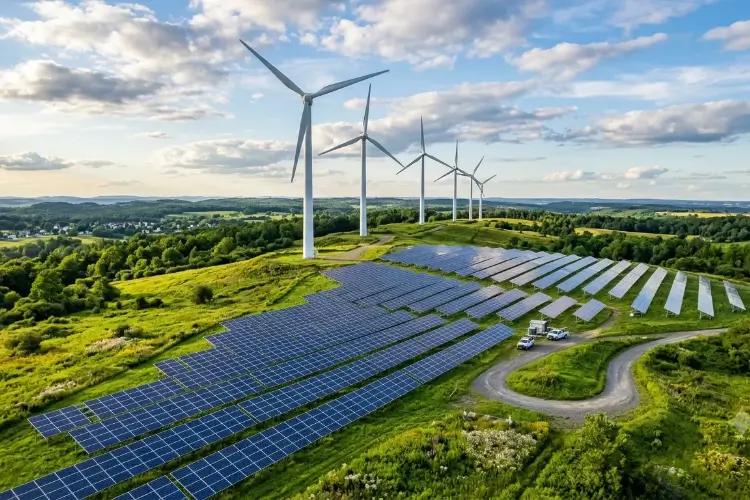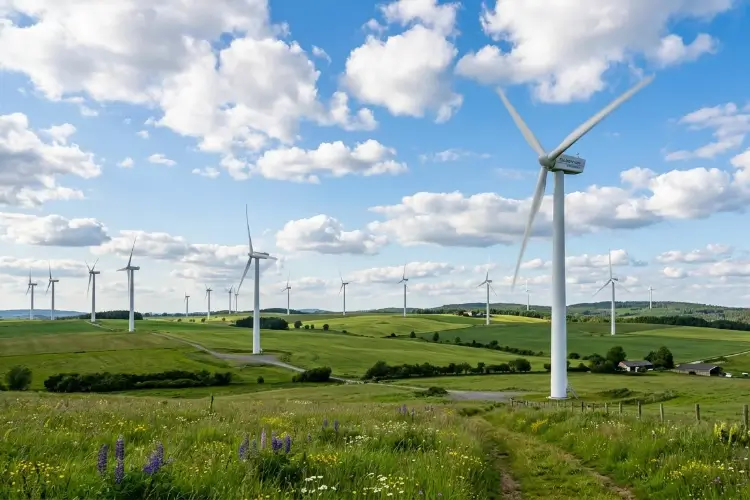
Wind energy is electricity made from moving air.
That’s it. That’s the whole concept, stripped down to its simplest form.
But here’s what most explainers get wrong: they either drown you in physics or oversimplify it into a Sunday-school analogy about pinwheels. I want to do neither. By the end of this guide, you’ll know exactly how wind becomes the electricity that powers your home, why it’s grown faster than almost any other energy source on the planet, and where it still falls short.
So let’s start with the basics.
What Is Wind Energy?
Wind energy is a renewable power source that converts the kinetic energy of moving air into electricity, using wind turbines to spin a generator.
It’s classified as renewable because wind never runs out. The sun keeps heating the atmosphere unevenly, air keeps moving to balance that out, and turbines keep catching it. No mining, no drilling, no combustion required.
In 2025, wind supplied about 10.5% of total U.S. utility-scale electricity generation, according to the U.S. Energy Information Administration (EIA). That makes it the single largest source of renewable electricity in the country, ahead of hydropower and solar.
Quick definition to remember: wind energy = moving air → spinning turbine → electricity.
How Is Wind Created? (The Science in Plain English)
Wind starts with the sun.
Here’s the chain reaction. The sun heats the earth’s surface unevenly, because oceans, deserts, forests, and mountains all absorb heat at different rates. Warm air rises. Cooler air rushes in to take its place.
That rush of air is wind.
The bigger the temperature difference between two areas, the stronger the wind. Think of it like a balloon. Untie the neck and the air doesn’t trickle out, it blasts out, because pressure wants to equalize as fast as possible.
Add in the earth’s rotation and its tilt, and you get the large-scale wind patterns that blow consistently across coastlines, plains, and mountain passes. That’s exactly why wind farms cluster in specific places: Texas, Iowa, and Oklahoma didn’t get lucky. They sit in corridors where this pressure-equalizing process happens reliably, day after day.
Curious where wind blows hardest? Here are the windiest places in the world.
How Does Wind Energy Work? (Step-by-Step)
A wind turbine works like a fan in reverse.
A regular fan uses electricity to create wind. A wind turbine uses wind to create electricity. Here’s exactly how that happens, in four steps.
Step 1: Wind turns the blades
Wind flows across the turbine’s blades, which are shaped like airplane wings. That shape creates lift, and lift makes the blades spin around a central hub, called the rotor.
Step 2: The rotor spins a shaft
The rotor is connected to a shaft that runs into the nacelle, the housing sitting at the top of the tower. As the rotor turns, so does the shaft.
Step 3: The generator makes electricity
Inside the nacelle, that spinning shaft drives a generator, converting the mechanical energy of the rotation into electrical energy. This is the exact same principle used in most power plants. Wind just replaces the steam.
Step 4: Electricity moves to the grid
The electricity generated travels down the tower to a transformer, which boosts the voltage to match the transmission grid. From there, it flows through power lines to homes, schools, and businesses, sometimes hundreds of miles away.
Wondering how utilities route all that power? It starts with understanding what is a smart grid.
Four steps. Wind in, electricity out.
A Brief History of Wind Power
We didn’t invent wind power. We just kept finding new ways to use it.
As early as 5000 BC, Egyptians were using wind to propel boats along the Nile. By around 200 BC, simple windmills in China were pumping water, and vertical-axis windmills in Persia were grinding grain.
Windmills later spread to Europe, and that same basic mechanical idea, wind spinning a shaft, eventually evolved into the modern turbine.
The real shift came when engineers figured out how to connect a spinning rotor to an electrical generator instead of a millstone.
From boats and millstones to gigawatt-scale power plants. Same wind, completely different job.
Types of Wind Energy
Not all wind energy looks the same. It generally falls into three categories.
Onshore Wind
Onshore wind turbines sit on land, usually clustered together in what’s called a wind farm. This is the most common and least expensive type of wind energy to build, which is why it still makes up the majority of installed wind capacity in the U.S.
Offshore Wind
Offshore wind turbines are installed in bodies of water, typically oceans, where wind tends to blow harder and more consistently than on land. Because of that stronger, steadier wind, offshore turbines generally generate more electricity per turbine than onshore ones. They’re also more expensive to install and maintain.
Distributed (Small) Wind
Not every turbine is part of a massive farm. Distributed wind refers to smaller, standalone turbines that power a single home, farm, or small business, often paired with net metering so excess electricity can be sold back to the grid.
Onshore vs. Offshore Wind
Choosing between them isn’t really a choice most people make. Utilities and governments decide it based on geography, cost, and grid access. But understanding the tradeoffs helps explain why the energy mix looks the way it does.
| Factor | Onshore Wind | Offshore Wind |
| Wind consistency | Moderate, variable | High, steady |
| Cost to build | Lower | Higher |
| Electricity output per turbine | Lower | Higher |
| Land/visual impact | Higher (visible, near communities) | Lower (out at sea) |
| Current U.S. share | Majority of installed capacity | Small but growing |
Wind Energy vs. Solar Energy
Wind and solar get lumped together constantly. They’re not the same, and they don’t behave the same way on the grid.
| Factor | Wind Energy | Solar Energy |
| Energy source | Moving air | Sunlight |
| Peak output timing | Often stronger at night/off-peak | Only during daylight |
| 2025 U.S. generation | ~464,000 GWh | ~296,000 GWh (utility-scale) |
| 2025 growth vs. 2024 | +3% | +34% |
| Best suited to | Open plains, coastlines, offshore | Rooftops, deserts, sunny regions |
Here’s the truth nobody tells you: wind and solar are complementary, not competing. Wind often peaks when solar can’t (at night, in winter storms), which is exactly why grid planners want both.
Wind Energy Statistics in 2026
Numbers change fast in this industry. Here’s where things stand right now, based on the EIA’s most current data.
- In 2025, U.S. wind turbines generated about 464,000 gigawatt-hours (GWh) of electricity, a 3% increase over 2024.
- Wind supplied roughly 10.5% of total U.S. utility-scale electricity generation in 2025.
- Combined, wind and solar reached a record 17% of U.S. electricity generation in 2025, up from less than 1% two decades earlier.
- Globally, installed wind generation capacity grew from 7.5 gigawatts in 1997 to over 1,131 gigawatts by 2024, according to IRENA.
- In 2023, wind turbines generated 59% of Iowa’s electricity, the highest wind share of any state, according to the EIA.
By the way: these numbers get updated every year in EIA’s Electric Power Monthly report. If you’re citing wind statistics anywhere, always check the publication date first.
Advantages of Wind Energy
It doesn’t burn anything: Wind turbines produce electricity without releasing the air pollutants or emissions that come from burning fossil fuels.
It’s gotten remarkably cheap: Decades of technology improvements and manufacturing scale have pushed the cost of wind-generated electricity down dramatically, making it competitive with, and often cheaper than, new fossil fuel power plants in many regions.
It supports energy independence: Wind is a domestic resource. Once a turbine is built, there’s no fuel to import, extract, or transport.
It coexists with other land uses: Unlike a coal plant or an oil field, the land between turbines on an onshore wind farm can still be used for farming or grazing.
It’s creating jobs: According to the U.S. Department of Energy, utility-scale wind plants operate in 41 states and have created more than 100,000 jobs for Americans.
Disadvantages and Challenges of Wind Energy
Wind isn’t perfect. No energy source is. Let’s be honest about the tradeoffs.
It’s intermittent: Wind doesn’t blow at a constant rate, which means turbines don’t produce electricity at a constant rate either. That variability is why wind is usually paired with other generation sources or battery storage.
It poses risks to wildlife: Birds and bats can be injured or killed if they fly into turbine blades. The wind industry and the U.S. government are researching ways to reduce this, but it remains a real concern.
It can face local opposition: Some communities push back on new turbines over noise, shadow flicker, or changes to the landscape near homes.
It requires new transmission infrastructure: The windiest places aren’t always near the cities that need the electricity, which means new power lines often have to be built to connect them.
The simple fix? None of these challenges are dealbreakers on their own. They’re engineering and planning problems, and the industry has spent two decades chipping away at every one of them.
Is Wind Energy Renewable?
Yes. Wind energy is renewable because its source, moving air, is continuously replenished by the sun’s heating of the atmosphere and will not run out on any human timescale.
That puts it in the same category as other renewable energy sources like solar, hydropower, and geothermal, and firmly outside the category of finite resources like coal, oil, and natural gas.
Real-World Examples of Wind Energy
Gansu Wind Farm, China. Described by McKinsey as the largest wind farm in the world, with around 7,000 turbines in northwest China.
Hornsea 2, United Kingdom. A 1.3 GW offshore wind farm with 165 turbines, located 89 km off the Yorkshire coast. Ørsted says it can help power over 1.4 million UK homes.
Iowa, United States. A striking domestic example: in 2023, wind generated 59% of the state’s electricity, the highest wind share of any state, per the EIA.
These aren’t pilot projects or proof-of-concept demos anymore. This is infrastructure operating at national scale.
Key Takeaways
- Wind energy converts the kinetic energy of moving air into electricity using turbines.
- The process happens in four steps: blades spin, a rotor turns a shaft, a generator produces electricity, and power flows to the grid.
- Wind is renewable and, as of 2025, supplies about 10.5% of total U.S. electricity generation.
- Onshore wind is cheaper to build, offshore wind generates more per turbine.
- Wind’s biggest challenge isn’t the technology, it’s intermittency and the infrastructure needed to move electricity from windy places to population centers.
Wind Energy Is Already Powering America, and It’s Still Growing
Wind energy isn’t a futuristic concept anymore. It’s already the backbone of America’s renewable electricity supply, and it’s still growing.
Understanding how it works, from a gust of air to a spinning generator to the outlet in your wall, makes it a lot easier to understand where the energy grid is headed next. And if today’s guide left you curious about solar vs wind energy, or how turbines actually get engineered to survive a hurricane, that’s exactly where we’re headed next.