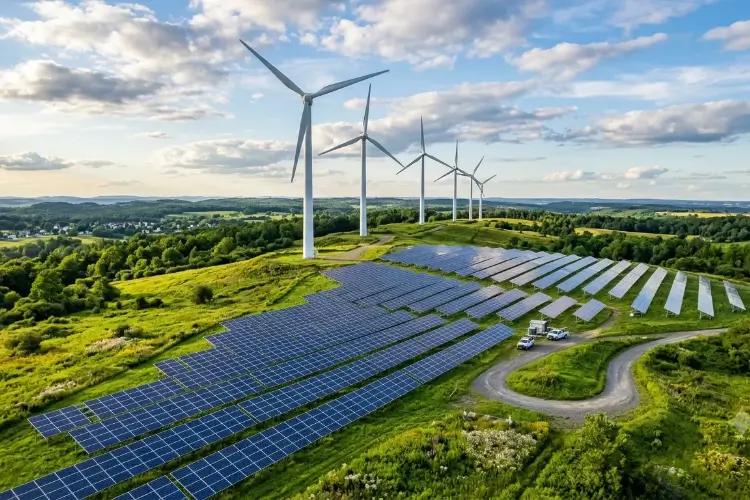
Solar wins for most homes. Wind often wins at utility scale.
That’s the honest, unsatisfying, actually-useful answer. Solar panels convert roughly 15 to 23% of sunlight into electricity. Wind turbines convert closer to 35 to 45% of the wind that passes through them, with a much higher capacity factor overall.
So which one should you care about?
That depends on whether you’re thinking about your roof or a utility contract. Let’s break down the real numbers, because the internet is full of vague “it depends” articles that never actually tell you what it depends on.
Quick answer, if you’re short on time:
- Solar is almost always the better call for homes, condos, and small properties.
- Wind pulls ahead at utility scale, especially in windy regions like the U.S. plains and coasts.
- Cost per kWh is now close between the two at utility scale.
- Wind has a slightly lower lifecycle carbon footprint than solar, but both are dramatically cleaner than fossil fuels.
- The “right” choice depends on your location, your scale, and your goals, not on which one sounds cooler.
How Solar and Wind Energy Actually Work
They’re more related than most comparisons let on.
Wind is technically a form of solar energy. The sun heats the earth unevenly, hot air rises, cool air rushes in to replace it, and that pressure difference is what you feel as wind. Solar panels just skip the middleman and capture sunlight directly.
How solar panels generate electricity
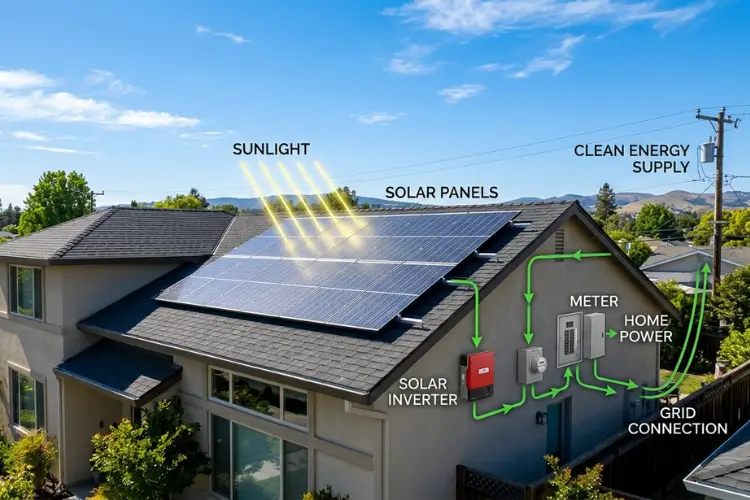
Solar panels use photovoltaic (PV) cells to absorb sunlight and convert it directly into an electric current. No moving parts. No mechanical wear. Just sunlight hitting silicon and electrons starting to flow.
That simplicity is a big part of why solar panels need so little maintenance. If you want the full walkthrough of how solar energy works panel by panel, that’s worth a closer look.
How wind turbines generate electricity
Wind turbines work the old-fashioned way. Wind spins the blades, the blades spin a rotor, and the rotor drives a generator that converts that mechanical motion into electricity.
More moving parts means more things that can eventually need repair. But it also means wind turbines can keep generating around the clock, day or night, as long as the wind is blowing.
Efficiency: Which Converts More Energy?
Here’s where people get tripped up.
Efficiency isn’t the same thing as output. A wind turbine converting more of the energy that hits it doesn’t automatically mean it produces more usable electricity for your situation. Location and scale matter just as much as the technology itself.
The stats, side by side:
- Solar panel efficiency: typically 15 to 23% of sunlight converted to electricity
- Wind turbine efficiency: typically 35 to 45% of available wind energy converted to electricity
- Solar capacity factor: roughly 15 to 25%, since panels only generate at full output during peak sun hours
- Wind capacity factor: roughly 25 to 45%, since turbines can keep spinning through the night and in overcast weather
So why doesn’t wind just win outright?
Because capacity factor tells you what percentage of a turbine’s maximum possible output it actually delivers over a year, and that number depends heavily on how consistent your local wind is. A turbine sitting somewhere with unreliable wind will underperform its efficiency rating badly. A solar panel in a sunny, unobstructed location will hit its numbers reliably, every single day, rain or shine (mostly).
The simple takeaway? Wind wins on raw conversion efficiency. Solar wins on predictability. Both matter, depending on what you’re optimizing for.
Cost Comparison: Solar vs Wind in 2026
This is the number everyone actually wants.
According to Lazard’s 2026 Levelized Cost of Energy report, unsubsidized utility-scale solar now runs roughly $0.038 to $0.078 per kWh, while onshore wind runs roughly $0.037 to $0.086 per kWh. At utility scale, they’re essentially neck and neck.
But residential scale tells a completely different story.
| Solar (residential) | Wind (residential/small) | |
| Typical cost per kWh | $0.06 to $0.14 | $0.18 to $0.42 |
| Installed cost | ~$0.80 to $2.19 per watt | ~$1.50 to $4.00+ per watt |
| Maintenance | Low, no moving parts | Higher, mechanical wear |
| Best-fit property | Most rooftops | Large rural land only |
Why the gap at home scale? Small wind turbines suffer badly from low hub heights, turbulent air near buildings, and expensive towers and permitting. A residential solar array just doesn’t have those obstacles.
Here’s the truth nobody tells you: a backyard wind turbine sounds appealing, but unless you own several acres in a genuinely windy, open area, it almost never pencils out financially compared to solar.
Environmental Impact: Carbon Footprint Compared
Both are dramatically cleaner than fossil fuels. That part isn’t in dispute.
Coal produces somewhere around 820 to 1,050 grams of CO2 equivalent per kWh once you count the full lifecycle. Solar and wind are nowhere close to that.
Lifecycle emissions, gCO2e per kWh:
- Wind: roughly 4 to 14 g on the low end of recent studies, with a wider meta-analysis average closer to 34 g
- Solar: roughly 6 to 50 g depending on the study and panel type, with sunnier locations pushing the number down toward single digits
Wind generally comes out slightly ahead here. Its main carbon cost is steel and concrete for towers and foundations. Solar’s main carbon cost is the mining and manufacturing of the panels themselves.
Both technologies pay off that manufacturing carbon debt fast.
Most solar installations become carbon-neutral within one to three years of operation. Wind often pays it back even faster, sometimes in under a year.
After that? Decades of nearly emission-free electricity.
Space, Location, and Practicality
The simple fix for figuring out which one fits your property? Think about scale first, technology second.
Solar needs a clear, unobstructed surface. That’s it. Rooftops, carports, open fields, even parking lot canopies all work.
Wind needs open space with consistent, unobstructed airflow, and it needs a lot of it. Local zoning ordinances often restrict residential wind installations entirely, because turbines are tall, loud enough to matter, and genuinely disruptive to a neighborhood skyline.
- Urban and suburban properties: solar is almost always the practical choice.
- Large rural land with strong, consistent wind: wind becomes genuinely competitive.
- Cloudy or low-sun regions: solar still usually works, just at reduced output. Battery storage helps close the gap.
- Coastal and offshore locations: wind has a real structural advantage here, which is why offshore wind is expanding fast in places like the U.S. Northeast and the North Sea. It’s no accident that some of the windiest places in the world also host the biggest wind farms.
Reliability: Intermittency and Grid Considerations
Neither one runs 24/7. Let’s just say that plainly.
Solar only generates during daylight. Wind only generates when the wind is blowing, and that can vary hour to hour.
But: This is exactly why battery storage and grid-scale planning have become such a big part of the renewable energy conversation. Pairing either technology with storage smooths out the gaps. Pairing solar and wind together smooths things out even further, since they tend to be strong at different times.
Solar vs Wind for Homeowners
If you’re deciding for your own home, this section is for you.
Solar wins here, decisively, for most people. It’s cheaper to install, easier to permit, dramatically lower maintenance, and it works on almost any home that gets reasonable daylight.
A well-known real-world test backs this up. A utility in the Pacific Northwest, Inland Power & Light, installed both a solar array and a small wind turbine at its own headquarters to settle the debate for its customers. Over 14 months, the solar panels produced about five times as much electricity as the wind turbine did, at that specific site.
That’s not a knock on wind as a technology. It’s a reminder that residential wind needs very specific conditions to make sense, and most suburban and urban properties simply don’t have them.
When would residential wind actually make sense?
- You own several acres of open, unobstructed rural land.
- Your average local wind speed is consistently above 12 mph.
- Local zoning actually permits a turbine of meaningful height.
- You’re comfortable with a longer payback period and more ongoing maintenance.
If all four of those are true, wind becomes a real option. If even one isn’t, solar is almost certainly the better use of your money.
Once solar is on the roof, it also pairs naturally with other eco home design ideas, from better insulation to smarter appliance choices, that stretch that clean energy even further.
Solar vs Wind at Utility Scale
Flip over to the utility and investor side, and the picture changes.
Wind power currently generates more electricity than solar does in the United States overall, and it has for years. At scale, in the right regions, wind turbines are extraordinarily productive. A single utility-scale turbine can generate as much electricity as thousands of residential solar panels combined.
Why utility-scale wind competes so well?
Because land constraints matter less, tower height can keep increasing to reach stronger high-altitude winds, and a handful of large turbines can serve what would otherwise require acres of panels.
Solar still holds real advantages at scale too. It deploys faster, permits faster, and works in far more geographic locations than wind does. Utility-scale solar farms can go from planning to operation in a fraction of the time a comparable wind project takes.
The honest utility-scale summary? Wind edges out solar on raw output-per-project in the best wind regions. Solar edges out wind on deployment speed and geographic flexibility. Most large energy portfolios end up using both, for exactly this reason, alongside a broader mix of renewable energy sources depending on what their region can support.
Can You Combine Solar and Wind? (Hybrid Systems)
Here’s the option most comparison articles skip entirely.
You don’t actually have to choose one winner. Hybrid solar-wind systems are a growing category, especially at the community and utility level, because the two technologies naturally complement each other.
Solar tends to peak during the day. Wind often picks up in the evening and overnight. Put them together, and you get a more consistent generation profile across a full 24-hour cycle than either technology delivers alone.
For homeowners, a true hybrid system is usually only realistic on larger rural properties. But if you’re in that situation, it’s worth seriously considering instead of picking just one, especially as more green tech innovations make small-scale hybrid setups easier to manage.
Solar vs Wind: Side-by-Side Comparison
| Factor | Solar | Wind |
| Conversion efficiency | 15 to 23% | 35 to 45% |
| Capacity factor | 15 to 25% | 25 to 45% |
| Residential cost per kWh | $0.06 to $0.14 | $0.18 to $0.42 |
| Utility-scale LCOE | $0.038 to $0.078 | $0.037 to $0.086 |
| Lifecycle emissions (gCO2e/kWh) | ~6 to 50 | ~4 to 34 |
| Maintenance | Low | Moderate to high |
| Space needed | Small (roof or lot) | Large, open land |
| Best setting | Homes, urban/suburban, sunny regions | Utility scale, rural land, windy or coastal regions |
| Deployment speed | Fast | Slower, longer permitting |
Which Is Right for You? A Decision Framework
Skip the guesswork. Walk through this instead.
- Are you deciding for a home or small property? If yes, solar is very likely your answer. Move to step 2 only if you own significant rural land.
- Do you have consistent average wind speeds above 12 mph on your property? If not, wind won’t perform well enough to justify the cost.
- Is your roof or land clear of major obstructions and reasonably sun-exposed? If yes, solar will work well even in moderately cloudy climates.
- Are you deciding for a utility-scale or community project instead of a single property? If yes, compare local wind resource maps against solar irradiance maps for your specific region, because the “better” option flips based purely on geography at this scale.
- Do you want maximum consistency over maximum output? A hybrid system may outperform either technology alone.
By the way: none of this needs to be a permanent, all-or-nothing decision. Plenty of people start with solar, since it’s the lower-risk, faster-payback option, and consider wind later if their situation genuinely calls for it.
Solar or Wind? The Answer Was Never That Simple
For your home, solar wins in the overwhelming majority of cases. It’s cheaper, simpler, faster to install, and works almost anywhere with decent daylight.
For utility-scale projects, especially in windy regions, wind genuinely competes and often wins on raw output.
The real answer was never “solar is better” or “wind is better.” It was always “better for what, and better for whom.” Now you actually know how to answer that for your own situation, instead of guessing.