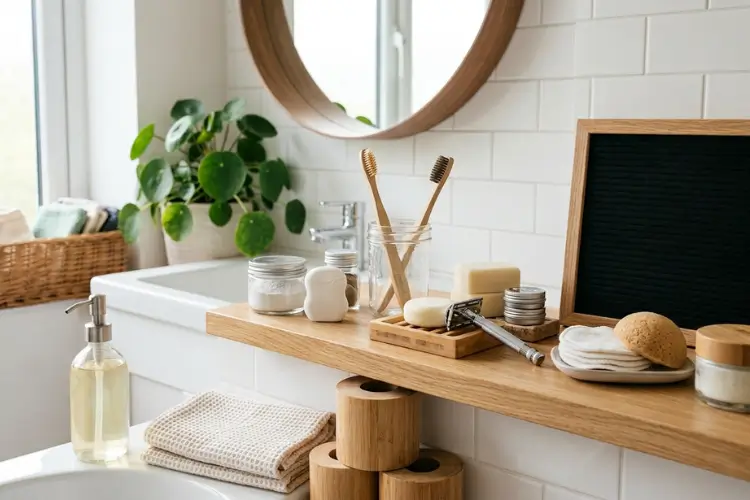
Your bathroom is probably the most plastic-heavy room in your house. Shampoo bottles. Razor cartridges. Toothpaste tubes. Cotton rounds you use once and toss.
None of it feels like much on its own. Add it up over a year, and it’s a lot.
Zero waste bathroom swaps are simple: you replace single-use plastic personal care products with reusable or biodegradable ones. That’s it. No perfection required, no guilt trip attached.
If you want the whole-house version of this, check out our full guide to zero waste swaps first. Otherwise, here’s what you’ll get in this guide:
- The 20 swaps that actually hold up, ranked from easiest to most involved
- A real cost breakdown, not just “it’s better for the planet” hand-waving
- Which swaps to do first, and honestly, which ones you can skip
- A simple way to start without throwing out stuff you already own
I’ve made most of these swaps myself over the past few years. Some were easy. A couple were genuinely annoying at first. I’ll tell you which is which.
What “Zero Waste Bathroom” Actually Means (And What It Doesn’t)
Let’s clear something up first.
Zero waste doesn’t mean zero plastic, overnight, forever. Nobody manages that, and if you’ve ever felt discouraged by the idea, our post on zero waste myths breaks down exactly why that all-or-nothing version isn’t realistic for anyone.
It means reducing what you throw away, one product at a time. If you’re brand new to the concept, our zero waste beginner guide and our post on what a zero waste lifestyle actually looks like are good starting points before you dive into swaps room by room.
So where do you start? You start with what runs out next. Not with a trash bag full of half-used products you’re tossing to feel virtuous.
The simple fix? Use up what you have. Swap when it’s gone. That’s the whole system.
How Much Plastic Waste Does Your Bathroom Actually Produce?
Here’s the truth nobody tells you: the bathroom is one of the biggest sources of hidden plastic in your home, and most of it isn’t obvious.
A few numbers worth sitting with:
- Liquid shampoo is typically 70-80% water by weight. You’re paying to ship and throw away plastic bottles full of mostly water.
- A single shampoo bar typically lasts as long as two to three plastic bottles of liquid shampoo.
- Bamboo reaches maturity in 3 to 5 years, compared to 30 to 40 years for hardwood trees, and stores a comparable amount of carbon to tree plantations while growing far faster.[1]
- The average person who menstruates uses more than 11,000 disposable period products across their lifetime, nearly all of it single-use plastic.[2]
None of that means you need to swap everything today. But it explains why this room, more than almost any other, rewards small changes.
The 20 Bathroom Swaps
I’ve grouped these roughly by how easy they are to make. Start at the top. Work down as things run out.
1. Toilet paper → Bamboo or recycled toilet paper
This is the single highest-impact swap on this list, and it’s the one you already buy constantly, so it’s the fastest place to shift your spending.
Conventional toilet paper comes from virgin wood pulp, and independent estimates put global production at roughly 1 million trees felled every day, with some analyses running as high as 1.9 million depending on how much recycled fiber is factored in.[3] The manufacturing process also burns through a lot of water, energy, and bleach. Bamboo toilet paper sidesteps most of that, since bamboo regrows fast and needs no replanting or pesticides.
Cost note: Usually a small premium per roll versus store-brand. Basically zero premium versus name-brand.
2. Plastic toothbrush → Bamboo or replaceable-head toothbrush
Easy. Cheap. No adjustment period.
A bamboo toothbrush has a compostable handle instead of plastic. A replaceable-head toothbrush keeps the handle and swaps only the part that actually wears out.
Cost note: About the same as a regular toothbrush, sometimes less over time with the replaceable-head version.
3. Bottled shampoo → Shampoo bars
This is the swap that gets the most resistance and deserves the least.
I was skeptical too. A bar of shampoo sounded like it would leave my hair a mess. It didn’t. It took maybe two washes to figure out how much product to use, and after that it was just… shampoo.
One bar can replace two to three bottles. The only real trick is keeping it dry between uses so it doesn’t turn to mush.
Cost note: Higher sticker price, lower cost per wash.
4. Bottled body wash → Bar soap
Same idea as shampoo, and honestly the easiest swap on this entire list. Bar soap is sold in nearly every drugstore, no special sourcing needed.
What to watch for: Some bar soaps still come wrapped in plastic, and some use palm oil linked to deforestation. Check the label.
5. Plastic razor → Safety razor
This one has a real learning curve, so I’ll be honest about it.
A safety razor uses a single metal blade instead of a plastic cartridge with four or five blades glued into it. The blade lasts for years, so you only ever replace a cheap metal insert.
The first few shaves take some getting used to. After that, most people report a closer shave with less irritation, not more.
Cost note: Bigger upfront cost, then pennies per blade for years. This is the best long-term savings on the whole list.
6. Toothpaste tube → Toothpaste tablets
You chew a small tablet, it turns to paste, and you brush like normal.
This eliminates the plastic tube entirely, and toothpaste tubes are notoriously hard to recycle since they’re made from mixed materials most facilities won’t touch.
Cost note: Roughly the same per use as regular toothpaste.
7. Plastic dental floss → Bamboo charcoal or silk floss
Floss is easy to overlook, but the plastic container adds up over a lifetime of daily use.
Bamboo charcoal or silk floss comes in a refillable glass container, so you’re buying floss refills instead of new plastic every time. It’s the same idea behind reusing glass at home in general, like the ideas in our post on what to do with old candle jars.
Cost note: Small premium, mostly offset once you’re just buying refills.
8. Disposable cotton rounds → Reusable cotton or bamboo rounds
Store-bought cotton balls and rounds come wrapped in plastic, and a lot of them are treated with pesticides.
Reusable rounds wash with your regular laundry and last for years.
Cost note: One of the fastest payback periods on this list, since you stop buying a disposable product entirely.
9. Plastic Q-tips → Reusable or bamboo-stem swabs
Standard cotton swabs usually have a plastic stick at the core, and those sticks are a real threat to marine life once they end up in waterways.
Bamboo-stem swabs solve the stick problem. A reusable silicone swab solves it completely.
Cost note: Bamboo swabs cost about the same as plastic ones. A reusable swab pays for itself fast since you never buy another box.
10. Aerosol or plastic-tube deodorant → Deodorant balm or refillable deodorant
Deodorant balms come in recyclable tins or refillable applicators, so there’s no single-use plastic tube involved, and most are aluminum-free without losing effectiveness.
What to watch for: If you’re used to a hard antiperspirant stick, the balm texture takes some adjusting to.
11. Disposable pads and tampons → Menstrual cup, period underwear, or cloth pads
This is a bigger decision than most swaps on this list, so give yourself time to figure out what actually works for your body.
A menstrual cup can last for years, holds more than a tampon, and dramatically cuts down on what you’re throwing away every month. Period underwear and cloth pads are lower-commitment alternatives if a cup isn’t for you.
Cost note: Highest upfront cost on this list by far. Also the highest long-term savings, since you’re replacing a recurring monthly purchase entirely.
12. Makeup wipes → Reusable cloth rounds + oil cleanser
Disposable makeup wipes are usually made from synthetic fibers that don’t break down, ever.
A reusable cloth round with a basic oil or balm cleanser does the same job, then goes in the wash.
Cost note: Cheap swap, quick payback.
13. Bottled moisturizer and serum → Refillable skincare
This one’s more about brand choice than product type. Look for brands offering refillable pouches or bulk refill options instead of a new plastic pump every time.
What to watch for: Not every skincare brand offers this yet. If yours doesn’t, this is a lower-priority swap, not a moral failing.
14. Plastic or microfiber hair towel → Bamboo hair towel
A bamboo hair towel dries hair just as fast as a microfiber one, and it comes with a bonus most people don’t expect: natural antibacterial properties that make it gentler on sensitive scalps.
Cost note: Similar price to a quality microfiber towel. This is a “when it wears out” swap, not an urgent one.
15. Plastic bath mat → Bamboo bath mat
Straightforward one-for-one swap. No behavior change required, just a different material next time yours needs replacing.
16. Chemical cleaning sprays → DIY vinegar and baking soda cleaner
Most bathroom cleaners are chemical-heavy and come in plastic spray bottles you eventually throw away.
Vinegar and baking soda handle most bathroom cleaning jobs, and you keep reusing the same spray bottle indefinitely. For exact ratios and recipes, our guide to cleaning with vinegar and baking soda covers what works for different surfaces.
Cost note: Genuinely cheaper than store-bought cleaner, not just “eco-cheaper.”
17. Plastic trash bags → Compostable liners (or skip the liner)
Compostable trash bags break down instead of sitting in a landfill for decades. If your bathroom bin is small, you can often skip a liner altogether and just rinse the bin.
Cost note: Small premium over standard trash bags, if you use them at all.
18. Plastic-bottled bath soak → Loose Epsom salts + essential oils
If you’re a bath person, this is an easy one. Buy Epsom salts in bulk, add your own essential oils, and skip the plastic bottle of pre-mixed bath soak entirely.
19. Wet wipes → Washable cloths or a bidet attachment
Here’s one people underestimate. Most wet wipes contain plastic fibers, don’t break down in sewage systems, and are a major cause of pipe-clogging “fatbergs.”
A washable cloth handles most of what a wipe does. A bidet attachment goes a step further and cuts your toilet paper use too.
Cost note: A bidet attachment is a bigger upfront cost but pays back fast if you use a lot of toilet paper or wipes.
20. Buying individually packaged products → Buying in bulk or from refill stations
Not every swap here is about swapping the product. Sometimes it’s about swapping how you buy it.
Bigger packages mean less packaging per unit, and that applies to nearly everything in your bathroom, from toilet paper to soap to cotton products. The same thinking applies beyond the bathroom too, our post on eco-friendly alternatives to plastic bags is a good next step if packaging waste is what bothers you most.
Zero Waste Bathroom Swaps on a Budget: What to Buy First, What Can Wait
Not every swap deserves the same urgency. Here’s how I’d sequence spending if you’re doing this on a real budget.
| Swap | Upfront cost | Payback speed | Do this… |
| Bar soap | Same or less than bottled | Immediate | First |
| Reusable cotton rounds | Low | Fast | First |
| Toilet paper (bamboo/recycled) | Roughly the same | N/A, ongoing | First |
| Bamboo toothbrush | Same as regular | N/A, ongoing | First |
| Shampoo bar | Slightly higher | A few months | Next restock |
| Toothpaste tablets | About the same | N/A, ongoing | Next restock |
| Safety razor | Higher | 6-12 months | When budget allows |
| Bidet attachment | Higher | 6-12 months | When budget allows |
| Menstrual cup / period underwear | Highest | 6-12 months | When budget allows |
| Refillable skincare | Depends on brand | Slow | Lowest priority |
Here’s the truth nobody tells you: the “buy everything at once” version of zero waste is expensive and unnecessary. The cheap swaps above cost you nothing extra and add up fast. The expensive swaps save the most money over time, but only if you can absorb the upfront cost. Do them when you can, not because you feel behind.
How to Start Without Wasting What You Already Own
You don’t need a plan this complicated, but here’s the short version:
- Use up what you have. Don’t throw out a half-full bottle of shampoo to replace it with a bar. That’s not zero waste, that’s just extra waste with better branding.
- Swap at the next restock. When something runs out, that’s your natural window. Replace it with the zero waste version instead of grabbing the same product again.
- Start with the cheap, easy swaps. Bar soap, reusable cotton rounds, a bamboo toothbrush. Build confidence before you commit to a safety razor or a menstrual cup.
- Reassess after 30 days. Some swaps will stick immediately. A couple might not work for you, and that’s fine. Adjust, don’t quit.
- Save the big-ticket swaps for when the budget allows. A safety razor or menstrual cup pays off, but only if the upfront cost doesn’t wreck your month.
That’s the whole system. One swap at a time, on your own schedule.
Start With One Swap, Not Twenty
Zero waste isn’t about a perfect bathroom. It’s about which plastic leaves it first.
Start with the swaps that cost you nothing extra. Let the pricier ones happen naturally, when you can afford them and when what you’re already using runs out.
Twenty swaps sounds like a lot. You don’t need to do them this week. You just need to do the next one.
If the bathroom felt manageable, the kitchen is next, check out our zero waste kitchen tips for the same room-by-room approach. And if someone in your life is curious about all this, our zero waste gift ideas guide is an easy way to introduce them without a lecture.