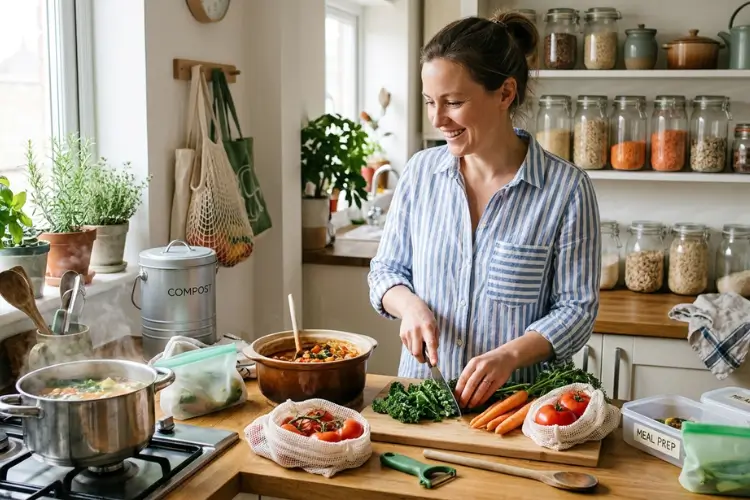
The easiest sustainable cooking tips are to plan meals before you shop, store food so it lasts, eat less beef, cook with scraps, and use efficient appliances like induction or a pressure cooker.
Cutting food waste matters most.
The average American spends about $762 a year on food that gets thrown away (ReFED, 2026).
Quick answer: the 10 tips, ranked by impact
- Plan meals before you shop
- Store food so it actually lasts
- Swap high-footprint proteins a few nights a week
- Cook root to stem
- Turn leftovers into planned meals
- Use the most efficient appliance for the job
- Put a lid on it
- Cook with less water
- Cook with the seasons
- Compost scraps and ditch single-use wrap
Biggest win: stop throwing food away. It saves more money and more emissions than any gadget you can buy.
What Is Sustainable Cooking?
Sustainable cooking is the practice of buying, storing, preparing, and disposing of food in ways that reduce waste, energy use, and greenhouse gas emissions.
That’s it.
No special diet. No expensive kitchen remodel.
It comes down to three things:
- What you cook (your ingredients have a carbon footprint, and our guide on what is sustainable food explains why)
- How you cook (your stove and habits use energy)
- What you throw away (wasted food wastes everything that went into it)
When I first started trying to cook greener, I thought it meant buying organic everything and fancy bamboo utensils.
Here’s the truth nobody tells you:
Most of those swaps barely move the needle. The sustainable habits that matter are boring, free, and happen before you ever turn on the stove.
Which Sustainable Cooking Habits Matter Most?
Food choices and food waste matter far more than packaging or where your food came from. This table ranks all 10 tips by effort and impact so you can start where it counts.
| Tip | Effort | Climate Impact | Money Saved | Start Time |
| 1. Plan meals | Low | Very high | Very high | Tonight |
| 2. Store food well | Low | High | High | Tonight |
| 3. Swap proteins | Medium | Very high | Medium | This week |
| 4. Root-to-stem cooking | Low | Medium | Medium | Next meal |
| 5. Planned leftovers | Low | Medium | High | This week |
| 6. Efficient appliances | Low to High | Medium | Medium | Varies |
| 7. Lids and burner size | Very low | Low | Low | Next meal |
| 8. Less water | Very low | Low | Low | Next meal |
| 9. Seasonal cooking | Low | Low to medium | Medium | This week |
| 10. Compost + reusables | Medium | Medium | Low | This month |
So where do you start?
At the top. Always.
The 10 Sustainable Cooking Tips
Here are the 10 tips, starting with the habits that make the biggest difference.
1. Plan Meals Before You Shop
Planning your meals before you shop is the single most effective sustainable cooking habit, because it stops food waste before it starts.
Most food waste doesn’t happen in the kitchen.
It happens in the grocery aisle, when we buy food we won’t get to. A simple zero waste shopping guide fixes most of that.
And the cost adds up fast. The EPA estimates an average household of four spends $2,913 a year on wasted food, more than 11% of its annual food budget.
Here’s the simple system I use:
- Shop your fridge first. Check what’s already there before writing anything down.
- Plan 4 to 5 dinners, not 7. Leave room for leftovers, takeout, and life.
- Write quantities on your list. “Spinach” becomes “1 bag spinach for Tuesday’s pasta.”
- Buy the awkward stuff in small amounts. If a recipe needs 2 tablespoons of buttermilk, find a swap.
By the way:
People are already getting better at this. U.S. household food waste dropped by about 950,000 tons in 2024, and ReFED links the drop to people managing their food more carefully while prices stayed high.
Proof that small habits scale.
2. Store Food So It Actually Lasts
Storing food correctly can make your produce last much longer, which means fewer rescue missions and fewer sad, slimy bags in the crisper drawer.
Most of us just shove groceries wherever they fit.
The simple fix?
Give everything a home.
Fridge Zones That Save Produce
Your fridge has different temperature zones, and using them properly keeps food fresh longer.
- Top shelves: leftovers, drinks, ready-to-eat foods
- Bottom shelf: raw meat and fish (coldest spot, and no drips onto other food)
- Crisper drawers: vegetables in one, fruit in the other
- Door: condiments only (it’s the warmest part of the fridge)
Keep these OUT of the fridge: tomatoes, potatoes, onions, garlic, bananas, and bread you’ll eat within a few days.
Freeze before it’s too late: bread, ripe bananas, cooked grains, fresh herbs in olive oil, and meat you won’t cook within two days.
Not sure how long something keeps? The free USDA FoodKeeper app gives storage times for hundreds of foods.
The “Eat First” Bin
An “eat first” bin is a small container in your fridge for anything that needs using in the next day or two.
This one habit changed my kitchen more than anything else.
Half-used onions, the last few strawberries, yesterday’s roasted veggies: they all go in the bin.
Before you cook, you check the bin.
Because: Food you can see is food you eat.
3. Swap High-Footprint Proteins a Few Nights a Week
Swapping beef for beans, lentils, or chicken a few nights a week is one of the biggest climate wins available in your kitchen.
You don’t need to go vegan.
But the numbers are hard to ignore.
| Food (per kg) | Emissions (kg CO2e) |
| Beef (beef herd) | 99.48 |
| Cheese | 23.88 |
| Poultry | 9.87 |
| Tofu | 3.16 |
| Other pulses (beans, lentils) | 1.79 |
| Peas | 0.98 |
Source: Our World in Data, based on Poore and Nemecek (2018)
Beef from beef herds produces close to 100 kg of CO2e per kilogram. Peas produce less than 1 kg.
That’s roughly 100 times the footprint.
Easy swaps that don’t feel like sacrifice:
- Tacos: half ground beef, half black beans or lentils
- Chili: swap beef for kidney beans and sweet potato
- Pasta sauce: red lentils cooked right into the tomato sauce
- Stir fry: tofu or chicken instead of steak
Start with two nights a week.
That’s it. Two nights.
4. Cook Root to Stem
Root-to-stem cooking means using the parts of vegetables most people throw away, like stems, leaves, and peels.
Most of these scraps are completely edible, and for the rest, try these creative ways to reuse food waste.
And some taste better than the “main” part.
Scraps you can cook with tonight:
- Broccoli stems: peel, slice thin, and stir fry
- Beet and carrot greens: blend into pesto or sauté like spinach
- Celery leaves: toss into salads or soups
- Herb stems: blend into sauces or dressings
- Potato skins: leave them on (more fiber anyway)
- Stale bread: croutons, breadcrumbs, or French toast
The Freezer Scrap Bag
Keep a large bag in your freezer and add onion ends, carrot peels, celery bottoms, and herb stems all week.
When it’s full, cover with water, simmer for an hour, and strain.
Free vegetable stock.
One tip I learned the hard way: skip broccoli, cabbage, and cauliflower scraps in stock. They turn it bitter.
5. Turn Leftovers Into Planned Meals
Planned leftovers are meals you cook on purpose to become a different meal later in the week.
Leftovers get a bad reputation because nobody wants the same dinner three nights in a row.
So don’t eat the same dinner.
Remix it.
Leftover remix ideas:
| Cook This | Turn It Into |
| Roast chicken | Chicken fried rice, then stock from the bones |
| Big pot of rice | Fried rice or rice bowls |
| Roasted vegetables | Frittata, pasta, or blended soup |
| Chili | Loaded baked potatoes or burrito bowls |
I now schedule one “remix night” every week.
It’s usually our best dinner.
6. Use the Most Efficient Appliance for the Job
The most energy-efficient way to cook depends on what you’re making, but smaller and faster appliances almost always beat a full-size oven or gas burner.
Your stove is a big part of your kitchen’s energy use.
And not all stoves are equal.
Induction vs Gas vs Electric
| Cooktop Type | Energy Reaching Your Food |
| Induction | About 85% |
| Standard electric | 75 to 80% |
| Gas | About 32% |
Source: ENERGY STAR
Induction is also fast. ENERGY STAR says it can boil water in close to half the time of gas, radiant, or coil burners.
Renting or not ready for a new stove?
A plug-in single induction burner costs far less than a new range and works on any counter. Just check that your pans are magnetic (if a fridge magnet sticks to the bottom, you’re good).
One honest caveat: induction’s climate benefit depends on how clean your local electricity grid is. The gap is bigger in regions that rely more on renewable energy.
When Smaller Appliances Win
- Microwave: reheating leftovers, steaming vegetables, cooking potatoes
- Pressure cooker / Instant Pot: beans, stews, grains, and tough cuts (much shorter cook times)
- Air fryer or toaster oven: small portions that don’t need a full oven
- Electric kettle: boiling water faster than most stovetops
The rule of thumb: Match the size of the appliance to the size of the meal.
7. Put a Lid On It
Putting a lid on your pot is the easiest energy saver in cooking, because it traps heat so water boils faster and food cooks with less energy.
It costs nothing.
It takes one second.
Other free stovetop habits:
- Match pan size to burner size. A small pan on a big burner sends heat straight into your kitchen air.
- Turn off the heat early. Electric burners and heavy pans stay hot for minutes after you switch them off.
- Batch your oven use. If the oven is on, roast vegetables, bake potatoes, and toast nuts all at once.
- Skip unnecessary preheating for things like casseroles and roasts that cook for a long time.
None of these will change the world alone.
But they add up across hundreds of meals a year.
8. Cook With Less Water
Cooking with less water saves both water and the energy needed to heat it.
Most of us boil way more water than we need.
Try these instead:
- Steam vegetables instead of boiling them (they keep more nutrients too)
- One-pot pasta: cook pasta in just enough water to be absorbed with the sauce
- Only boil what you need in the kettle
- Reuse cooled cooking water from vegetables or pasta on your plants (one of the easiest ways to save water in the garden)
Bonus: Starchy pasta water makes sauces silkier. Save a cup before you drain.
9. Cook With the Seasons (and What “Local” Really Does)
Cooking with seasonal produce means buying fruits and vegetables at their natural harvest peak, when they’re cheapest, freshest, and least likely to have been grown in heated greenhouses.
Seasonal food tastes better.
It usually costs less too.
But here’s where I have to be honest about “local.”
Local food is great for your community. It’s not the biggest climate win.
The largest global study of food emissions found that transport is only a small part of most foods’ footprint. Land use and what happens on the farm make up the vast majority.
In plain terms:
What you eat matters far more than how far it traveled.
Local beef still has a much higher footprint than imported beans.
So buy local and seasonal for flavor, freshness, and your local farmers. Just don’t let it distract you from tips 1 to 3.
Want to know what’s in season near you? The Seasonal Food Guide covers every U.S. state.
10. Compost Scraps and Ditch Single-Use Wrap
Composting keeps unavoidable food scraps out of landfills, and reusable storage cuts down on plastic wrap and foil you throw away after one use.
Composting comes last on purpose.
It’s the safety net, not the plan.
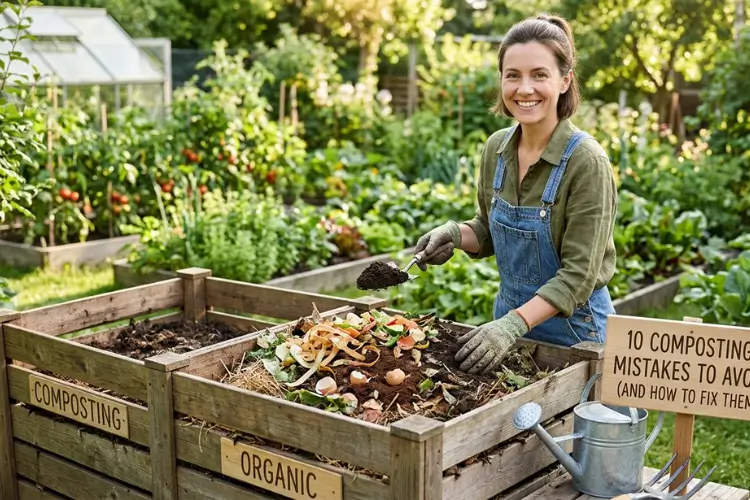
Scraps you can’t eat (coffee grounds, eggshells, avocado pits, onion skins) should go to compost, not the trash. Here’s how to compost food scraps at home. In a landfill, food breaks down without oxygen and releases methane.
Composting options for any home:
- Curbside collection: many U.S. cities now offer it. Check your city’s website.
- Backyard bin: great if you have outdoor space
- Bokashi bucket: a small, sealed system that works in apartments
- Drop-off points: farmers markets and community gardens often accept scraps
Easy reusable swaps:
- Glass jars and containers instead of plastic wrap
- Beeswax wraps for cheese, bread, and half-cut produce
- A plate over a bowl instead of foil
- Silicone bags for freezing
Use up what you already own first. For more ideas, see these Zero Waste kitchen tips.
The most sustainable container is the one already in your cupboard.
Sustainable Cooking by the Numbers
- 29% of the U.S. food supply (70 million tons) went unsold or uneaten in 2024. (ReFED, 2026)
- $762 is what the average American spends each year on food that gets wasted. (ReFED, 2026)
- $2,913 is the yearly cost of wasted food for an average U.S. household of four. (EPA, 2025)
- 60% of global food waste happens in households. (UNEP, 2024)
- 79 kg (about 174 lbs) of food is wasted per person, per year, worldwide. (UNEP, 2024)
- 8 to 10% of global greenhouse gas emissions come from food loss and waste. (UNEP, 2024)
- 85% vs 32%: the share of energy that reaches your food on induction vs gas. (ENERGY STAR)
As UNEP’s Executive Director Inger Andersen put it, “Food waste is a global tragedy.”
The good news?
It’s also the problem you have the most control over.
Common Sustainable Cooking Myths
Myth 1: “Buying local is the most sustainable choice.” Local is great, but what you eat matters much more than food miles.
Myth 2: “Organic always means lower carbon.” Organic farming has real benefits for soil and reduced synthetic chemicals, but it doesn’t automatically mean a smaller carbon footprint.
Myth 3: “Sustainable cooking is expensive.” The biggest habits (planning, storing, using leftovers) save money. Most people spend less, not more.
Myth 4: “I need new eco products to start.” You need a list, a freezer bag, and a lid. That’s the whole starter kit.
Your First-Week Sustainable Kitchen Plan
Here’s how to start without overwhelm:
- Day 1: Clean out your fridge and set up an “eat first” bin.
- Day 2: Plan 4 dinners using what you already have.
- Day 3: Shop with a list that includes quantities.
- Day 4: Start a freezer scrap bag.
- Day 5: Cook one beef-free dinner you’d happily eat again.
- Day 6: Remix a leftover into a new meal.
- Day 7: Look up composting options in your area.
One week.
Seven small actions.
Ready for more? Our zero waste beginner guide takes it beyond the kitchen.
Start With One Tip Tonight
You don’t need to do all 10 tips this week.
You don’t even need to do three.
Pick one. Maybe the “eat first” bin. Maybe putting a lid on the pasta pot.
Do it until it’s automatic.
Then pick the next one.
Because sustainable cooking isn’t about being perfect.
It’s about wasting a little less, every single day.