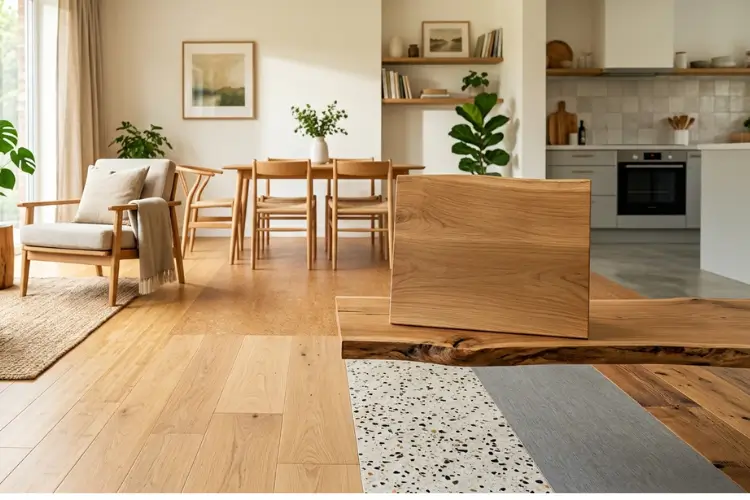
The most eco-friendly flooring options right now are bamboo, cork, reclaimed hardwood, linoleum, and FSC-certified hardwood. They’re renewable, low in VOCs, and built to last decades instead of years.
But “eco-friendly” gets slapped on a lot of flooring that doesn’t deserve it.
So let’s slow down and actually compare the options: cost, durability, air quality, all of it. That way you can pick a floor you’re not second-guessing in five years.
Quick answer, if you’re in a hurry:
- Best overall: Bamboo
- Most affordable: Cork or linoleum
- Most durable: FSC-certified hardwood
- Best for air quality / allergies: Cork or natural stone
- Best for pets and high traffic: Bamboo or recycled rubber
Here’s the full breakdown.
What Actually Makes Flooring “Eco-Friendly”?
Here’s the truth nobody tells you: there’s no single legal definition of “eco-friendly flooring.”
Anyone can print it on a box.
So instead of trusting the label, judge flooring on four things:
- Renewable or recycled source: Did the material come from something that regrows fast, or from waste that would’ve gone to a landfill?
- Low VOC emissions: Volatile organic compounds off-gas from adhesives, finishes, and some synthetic materials, and they affect the air you actually breathe indoors.
- Durability and lifespan: A floor that lasts 40 years and never needs replacing is greener than a “sustainable” floor you’re ripping out in five.
- End-of-life recyclability or biodegradability: What happens to it when it’s finally done?
Keep these four in mind. You’ll see them come up again and again below.
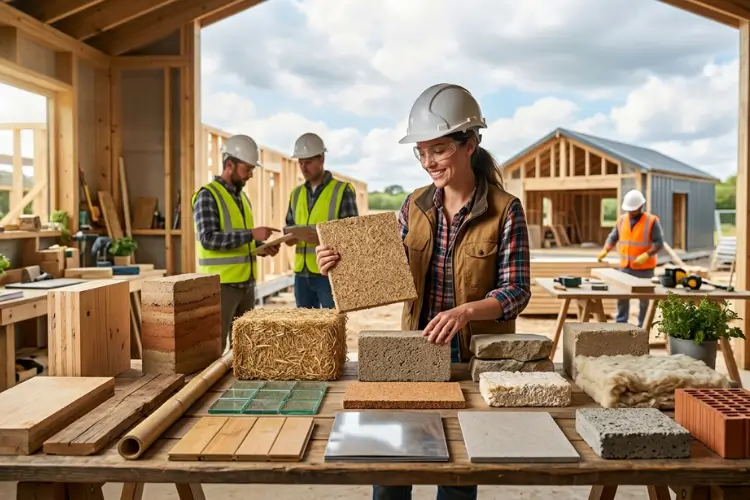
Flooring is just one piece of the puzzle, by the way. If you’re renovating more than just the floor, it’s worth looking at sustainable building materials more broadly, since the same four criteria apply to everything from insulation to countertops.
The 10 Eco-Friendly Flooring Options
Here’s the detailed breakdown of each one, starting with the most versatile pick.
1. Bamboo Flooring
Bamboo flooring is made from the fast-growing bamboo plant, pressed and fused into hard, wood-like planks.
Why It’s Eco-Friendly
It’s considered eco-friendly because it isn’t wood at all. It’s a grass, and it regrows fast enough to make deforestation a non-issue.
By the numbers: bamboo reaches harvest-ready maturity in about 5 years, compared to 60 to 100 years for oak. That’s not a small gap[1]. That’s the entire case for bamboo in one sentence.
Because bamboo regenerates from its own root system after harvest, there’s no replanting, no clear-cutting, no decades-long wait. High-quality bamboo also scores harder than oak or maple on the Janka hardness scale, meaning it resists dents and scratches better than a lot of “premium” hardwood.
Cost, Durability, and Where to Use It
Expect $5–$11 per square foot installed. It holds up well in living rooms, bedrooms, and kitchens: anywhere with moderate foot traffic. One caution: check the adhesive and finish, since not all bamboo products are automatically low-VOC. Ask for FloorScore certification specifically.
2. Cork Flooring
Cork flooring is made from the bark of the cork oak tree, not the tree itself.
Why It’s Eco-Friendly
It’s eco-friendly because harvesting cork doesn’t kill or even damage the tree. The bark regenerates and can be re-harvested every 9 to 12 years, and a single cork oak, which lives up to 200 years, can be harvested over 16 times.[2] Same tree, harvested a dozen times over, never cut down. That’s a long life by most standards, though it’s nothing compared to some of the world’s oldest living trees, some of which have been standing for thousands of years.
Beyond the harvesting method, cork is naturally fire-resistant, hypoallergenic, and biodegradable at end of life. It’s also naturally springy underfoot, which makes it genuinely comfortable to stand on for long periods.
Cost, Durability, and Where to Use It
Cork runs $6–$14 per square foot installed and lasts 25–40 years with basic care. It’s a strong pick for bedrooms, home offices, and playrooms: anywhere comfort and quiet matter. It’s softer than hardwood, so it’s not the first choice for a high-heel, high-traffic entryway.
3. Reclaimed Hardwood
Reclaimed hardwood is exactly what it sounds like: wood salvaged from old barns, factories, warehouses, and demolished buildings, then milled into new flooring.
Why It’s Eco-Friendly
No new trees are cut down. Full stop. You’re taking wood that’s already been standing for a century, often old-growth, denser and more stable than anything grown today, and giving it a second life instead of sending it to a landfill.
Cost, Durability, and Where to Use It
Expect $8–$18 per square foot installed, and a 50+ year lifespan if it’s properly refinished over time. It shines in living rooms and dining rooms where you want visible character. The nail holes, weathering, and color variation are the whole point. If you want uniform, showroom-perfect planks, this isn’t it.
4. FSC-Certified Hardwood
Regular hardwood isn’t automatically sustainable. FSC-certified hardwood is wood verified by the Forest Stewardship Council to come from responsibly managed forests.
Why It’s Eco-Friendly
The certification is the point here. It means harvesting practices support forest regeneration instead of stripping it. It’s third-party verification, not a marketing claim, that the forest it came from is being managed for the long term.
Cost, Durability, and Where to Use It
Run $9–$20 per square foot installed, with a 50–100 year lifespan since solid hardwood can be sanded and refinished multiple times. It’s a strong whole-home choice if your budget allows it. Just confirm the FSC label is on the actual product, not just the company’s marketing page. Once it’s installed, a little care goes a long way. Here’s how to clean wood floors and furniture the right way, without harsh chemicals that undo the whole point of choosing an eco-friendly floor in the first place.
5. Linoleum (Not Vinyl)
Here’s the truth nobody tells you: linoleum and vinyl are not the same material, even though people use the names interchangeably. Linoleum is made from linseed oil, cork dust, wood flour, and jute backing, all natural, biodegradable materials. Vinyl is petroleum-based PVC. They just look similar.
Why It’s Eco-Friendly
Linoleum is completely biodegradable, naturally antimicrobial, and has been manufactured essentially the same way for over 150 years. It’s one of the lowest-VOC flooring materials on this entire list.
Cost, Durability, and Where to Use It
At $4–$8 per square foot installed, it’s one of the most affordable genuinely sustainable options here, lasting 25–40 years. It’s durable and water-resistant enough for kitchens and bathrooms, and forgiving enough for kids’ rooms. Look for “natural linoleum” or “Marmoleum” on the label to avoid vinyl imitators marketed as “linoleum.”
Is Vinyl Flooring Eco-Friendly?
Short answer: not really, and most guides won’t tell you that directly.
Vinyl is petroleum-based PVC, often manufactured with chlorine-based fire retardants and phthalates. It’s not renewable, and standard vinyl isn’t biodegradable.
But: some newer vinyl products incorporate recycled PVC content and lower-VOC formulations. See SPC flooring below, which is the more defensible version of this category. If sustainability is your top priority, vinyl shouldn’t be your first pick. If budget or moisture resistance is non-negotiable, look specifically for recycled-content, low-VOC vinyl products, not standard sheet vinyl.
6. Natural Stone Tile
Natural stone (slate, granite, limestone, travertine) is about as low-impact as flooring gets once it’s installed, because it’s quite literally just rock.
Why It’s Eco-Friendly
No manufacturing chemicals go into the material itself, no VOCs off-gas from the stone, and it lasts essentially forever with basic sealing. Extraction has an environmental cost, but a stone floor you never replace evens that out over decades.
Cost, Durability, and Where to Use It
Expect $10–$25 per square foot installed, with a 75-100+ year lifespan. It’s a natural fit for entryways, bathrooms, and kitchens where durability and water resistance matter most. Just check the grout and sealant, since those can carry VOCs even when the stone itself doesn’t.
7. Terrazzo
Terrazzo is a composite of marble, quartz, granite, or glass chips set in a binder and polished smooth.
Why It’s Eco-Friendly
Modern terrazzo is frequently made with recycled aggregate (crushed glass, reclaimed stone offcuts) instead of virgin material. It diverts waste material that would otherwise be discarded, and it’s essentially indestructible. Commercial terrazzo floors regularly outlast the buildings around them.
Cost, Durability, and Where to Use It
It’s a premium option at $15–$30 per square foot installed, but with a 75-100+ year lifespan, it’s built for spaces that need to perform for decades: kitchens, high-traffic commercial spaces, or any room you never want to touch again. Check whether the binder is epoxy or cement-based, since cement-based terrazzo generally has lower VOC output.
8. Recycled Rubber Flooring
Rubber flooring might not be the first thing that comes to mind when you think “eco-friendly,” but it’s a genuinely solid option, and one most guides skip entirely.
Why It’s Eco-Friendly
It’s typically made from post-consumer waste, most often recycled tires. That’s material diverted from landfills, given a second life underfoot.
Cost, Durability, and Where to Use It
At $4–$9 per square foot installed with a 20–30 year lifespan, it’s shock-absorbent, water-resistant, and nearly indestructible. That’s why it’s a natural fit for basements, home gyms, and kids’ playrooms. It’s not the look you want in a formal living room, but for function-first spaces, it’s hard to beat.
9. Wool Carpet (Natural Fiber)
Most carpet is a petroleum product. Wool carpet is the exception: a renewable, biodegradable natural fiber that’s been used for flooring for thousands of years.
Why It’s Eco-Friendly
Wool is naturally renewable (sheep regrow it every year), naturally flame-resistant without added chemical treatments, and biodegrades at end of life instead of sitting in a landfill for centuries like synthetic carpet.
Cost, Durability, and Where to Use It
Expect $6–$15 per square foot installed and a 15–25 year lifespan with good care. It’s ideal for bedrooms and cozy living spaces where softness matters more than moisture resistance. If you go this route, look for GoodWeave certification, which verifies the carpet wasn’t produced with child labor, a real issue in parts of the handwoven rug and carpet industry.
10. Stone Plastic Composite (SPC) / Recycled-Content Vinyl
SPC is a newer flooring category: a rigid core made from limestone composite topped with a printed wear layer, built to mimic wood or stone without using either.
Why It’s Eco-Friendly (With Caveats)
It’s not a renewable material, but the better products in this category use recycled content in the core and meet FloorScore low-VOC standards. It’s the most defensible version of “vinyl-adjacent” flooring if durability and moisture resistance are your top priorities.
Cost, Durability, and Where to Use It
At $3–$7 per square foot installed, it’s one of the cheapest options here, with a 15–25 year lifespan. It’s genuinely excellent for basements, rental properties, and high-moisture rooms where natural materials would struggle. Just don’t mistake it for a top-tier sustainable choice. It’s a practical middle ground, not a green flagship.
Quick Comparison: 10 Eco-Friendly Flooring Options at a Glance
Here’s the side-by-side nobody else has bothered to build:
| Material | Cost per sq ft (installed) | Lifespan | VOC Level | Best Rooms |
| Bamboo | $5–$11 | 20–50 years | Low (check finish) | Living rooms, bedrooms, kitchens |
| Cork | $6–$14 | 25–40 years | Very low | Bedrooms, home offices, playrooms |
| Reclaimed hardwood | $8–$18 | 50+ years | Low | Living rooms, dining rooms |
| FSC-certified hardwood | $9–$20 | 50–100 years | Low | Whole-home, high-value rooms |
| Linoleum | $4–$8 | 25–40 years | Very low | Kitchens, bathrooms, kids’ rooms |
| Natural stone tile | $10–$25 | 75–100+ years | None (grout/sealant vary) | Entryways, bathrooms, kitchens |
| Terrazzo | $15–$30 | 75–100+ years | None (binder varies) | High-traffic commercial, kitchens |
| Recycled rubber | $4–$9 | 20–30 years | Low | Basements, gyms, kids’ playrooms |
| Wool carpet | $6–$15 | 15–25 years | Very low | Bedrooms, cozy living spaces |
| SPC / recycled vinyl | $3–$7 | 15–25 years | Low–moderate | Basements, rentals, high-moisture areas |
Prices vary by region and installer, so treat these as national ballparks, not quotes.
How to Verify a Floor Is Actually Sustainable (Certifications That Matter)
Not all “eco-friendly” flooring claims are backed by a certification. Always check for one of these before you buy.
- Look for FSC certification on any wood product. It verifies the wood came from a responsibly managed forest, not just a company’s word.
- Check for FloorScore certification. Issued through SCS Global Services, it verifies low VOC emissions and indoor air quality compliance.
- Look for Greenguard Gold. Managed by UL, this certification sets stricter chemical emissions limits, especially relevant for homes with kids or anyone sensitive to indoor air quality.
- Ask if the product qualifies for LEED credits. If a flooring product contributes to LEED certification points, that’s a sign it’s been evaluated against a recognized sustainability standard, not just marketed as one.
- Read past the front label. “Eco-friendly,” “green,” and “natural” are unregulated marketing terms. A certification logo is not.
The certifications, explained
FSC (Forest Stewardship Council): The FSC label means the wood in your floor was harvested from a forest managed to specific ecological and social standards, including regeneration, biodiversity, and fair labor practices. It’s the single most important label to look for on any hardwood, bamboo, or cork product.
FloorScore: This certification, administered by SCS Global Services, tests flooring products for VOC emissions against California’s strict Section 01350 indoor air quality standard, and certified products are recognized by LEED, CHPS, and BREEAM.[3] If a product is FloorScore certified, it’s been independently tested, not just self-declared.
Greenguard Gold: Managed by UL (Underwriters Laboratories), Greenguard Gold goes a step further than standard low-VOC claims, applying stricter emissions limits specifically because schools and healthcare facilities use it as a benchmark. If you’re flooring a nursery or a room for someone with respiratory sensitivities, this is the certification to prioritize.
LEED (Leadership in Energy and Environmental Design): Managed by the U.S. Green Building Council, LEED isn’t a product certification exactly. It’s a building certification. But flooring products can contribute credits toward a home or building’s LEED score, which means manufacturers who want that business have already done real sustainability homework on the product.
Which Eco-Friendly Flooring Is Right for You?
So where do you start?
Honestly, it comes down to what you’re optimizing for.
- Tight budget? Linoleum or SPC flooring get you real sustainability credentials without a premium price tag.
- Long-term investment? FSC-certified hardwood or natural stone will outlast almost everything else on this list.
- Air quality is the priority? Cork and linoleum are your two lowest-VOC, most breathable choices.
- Kids, pets, chaos? Bamboo and recycled rubber are built to take a beating.
There’s no single “most eco-friendly” floor that’s right for every home. There’s just the one that’s right for yours, and now you’ve got the real numbers to decide.
And if this is the start of a bigger push toward a lower-impact home, flooring is a great place to start, but it’s not the only place. Our zero waste beginner guide walks through the next steps, room by room.