Some trees on this list were already thousands of years old when the Great Pyramid of Giza was built. A few were alive before humans invented writing. And at least one of them isn’t really “a tree” in the way you’re picturing it.
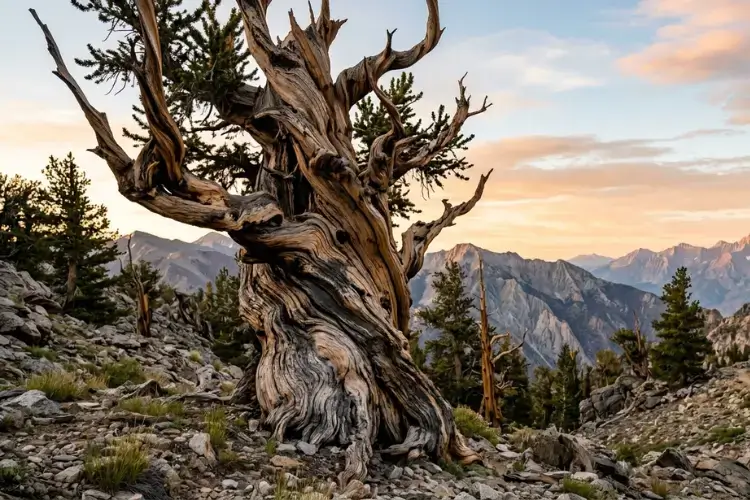
The oldest verified living tree on Earth is an unnamed Great Basin bristlecone pine (Pinus longaeva). It grows in California’s White Mountains. Its estimated age: just over 5,000 years.
Its more famous neighbor, Methuselah, held the record for decades. It’s still one of the oldest individually dated trees ever confirmed.
Now count clonal colonies (organisms made of identical stems sharing one root system) and the picture changes. A quaking aspen colony in Utah called Pando may be tens of thousands of years old.
Below is a ranked list of the 15 oldest known individual (non-clonal) living trees on Earth. After that: the two clonal organisms that complicate the whole question. Plus, where you can go see them, and where you can’t.
Trees aren’t the only place nature keeps breaking its own records. From the biggest flowers on Earth to the largest insects in the world, size and age extremes turn up everywhere once you start looking.
Quick Facts: The World’s Oldest Trees at a Glance
- Oldest individual tree: Unnamed bristlecone pine, ~5,070 years, White Mountains, California
- Oldest named individual tree: Methuselah, ~4,850 years, White Mountains, California
- Oldest clonal organism: Pando (quaking aspen colony), possibly up to 80,000 years, Utah
- Oldest tree species by lifespan: Great Basin bristlecone pine (Pinus longaeva)
- Oldest tree in the eastern United States: BLK 227 bald cypress, 2,624+ years, North Carolina
- Trees on Earth today: an estimated 3.04 trillion, the most recent global tree census (Crowther et al., Nature, 2015; still the reference figure as of 2026, since no newer full census has been conducted)
Clonal vs. Non-Clonal Trees: Why “Oldest” Depends on Definition
Before ranking anything, one distinction matters most. Most “oldest tree” lists skip it.
A non-clonal tree is a single organism. It has one continuous trunk. It has grown, uninterrupted, since it first sprouted. Its age can usually be measured directly, ring by ring. Methuselah is non-clonal: one tree, alive as one tree, for roughly 4,850 years.
A clonal tree colony is different. It’s a group of genetically identical stems. They share one root system. That root system can stay alive for thousands, even tens of thousands, of years, even as individual trunks die and regrow. Pando and Old Tjikko are both clonal. Their visible trunks might be decades or centuries old. But the roots beneath them are far older.
Neither definition is “more correct.” They just answer different questions. That’s why sources disagree so wildly on “the oldest tree.” This article ranks non-clonal individuals first, then covers the two record-holding clonal organisms separately.
The 15 Oldest Living Trees on Earth, Ranked by Age
From a secret grove in California to a windswept mountainside in Iran, these are the 15 oldest individual trees ever verified.
1. Unnamed Great Basin Bristlecone Pine: ~5,070 years
Species: Pinus longaeva | Location: White Mountains, California, USA
This is the oldest verified living tree on the planet. Almost nobody knows exactly where it stands. The tree comes from a core sample Edmund Schulman collected before his death. It wasn’t fully crossdated until 2009, by dendrochronologist Tom Harlan.
The tree quietly surpassed Methuselah’s record. But the U.S. Forest Service has never revealed its location. It’s the same reason it protects Methuselah. Souvenir hunters are a real threat.
2. Methuselah: ~4,850 years
Species: Pinus longaeva | Location: Inyo National Forest, White Mountains, California, USA
Methuselah held the “world’s oldest known living tree” title from 1957 until it was quietly overtaken by tree #1 above. It’s named after the biblical patriarch said to have lived 969 years. That title turned out to undersell it by several millennia.
The Forest Service won’t mark or photograph its exact spot along the 4.5-mile Methuselah Trail. Visitors walk through the grove without ever knowing which tree it is.
3. Gran Abuelo (Alerce Milenario): up to ~5,484 years (disputed)
Species: Fitzroya cupressoides | Location: Alerce Costero National Park, Chile
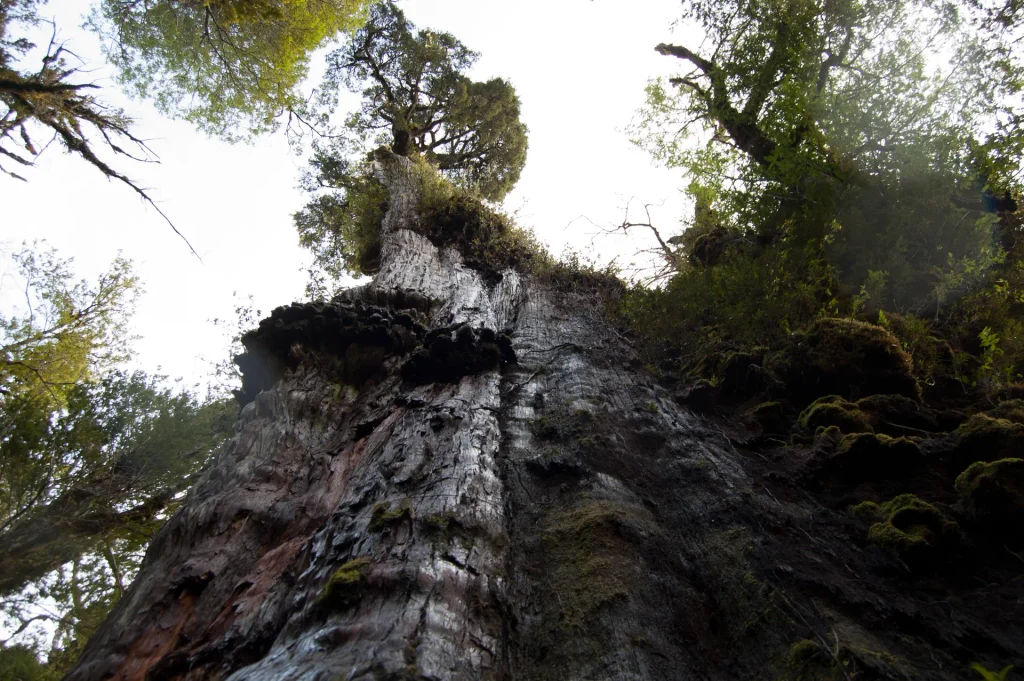
In 2022, researchers made headlines with this Patagonian cypress. Nicknamed “Gran Abuelo,” or “great-grandfather,” it might be older than Methuselah.
Its trunk is massive: over 13 feet across. Scientists could only extract a partial core. They counted 2,400 rings, then modeled the rest statistically.
That computer-modeled estimate isn’t fully accepted by scientists yet. But the verified partial core alone makes Gran Abuelo one of the oldest trees on Earth. Unlike Methuselah, its location isn’t secret. Tourists can walk right up to it.
4. Sarv-e Abarqu (Zoroastrian Sarv): ~4,000–4,500 years
Species: Cupressus sempervirens | Location: Abarkuh, Yazd Province, Iran
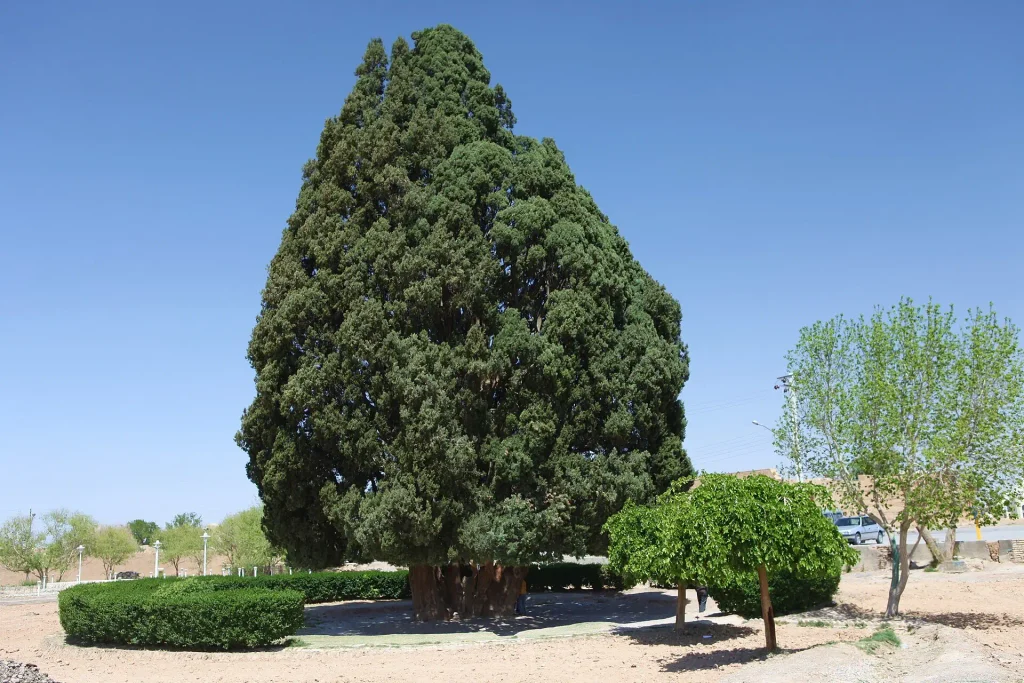
This ancient cypress is believed to be the oldest living thing in Asia. Iran considers it a national monument. It also holds deep meaning in Zoroastrian tradition.
The tree took root around the dawn of recorded civilization in the region. Unlike many trees on this list, it stands in plain public view, not a remote forest.
5. Llangernyw Yew: estimated 4,000–5,000 years
Species: Taxus baccata | Location: Llangernyw, North Wales, UK
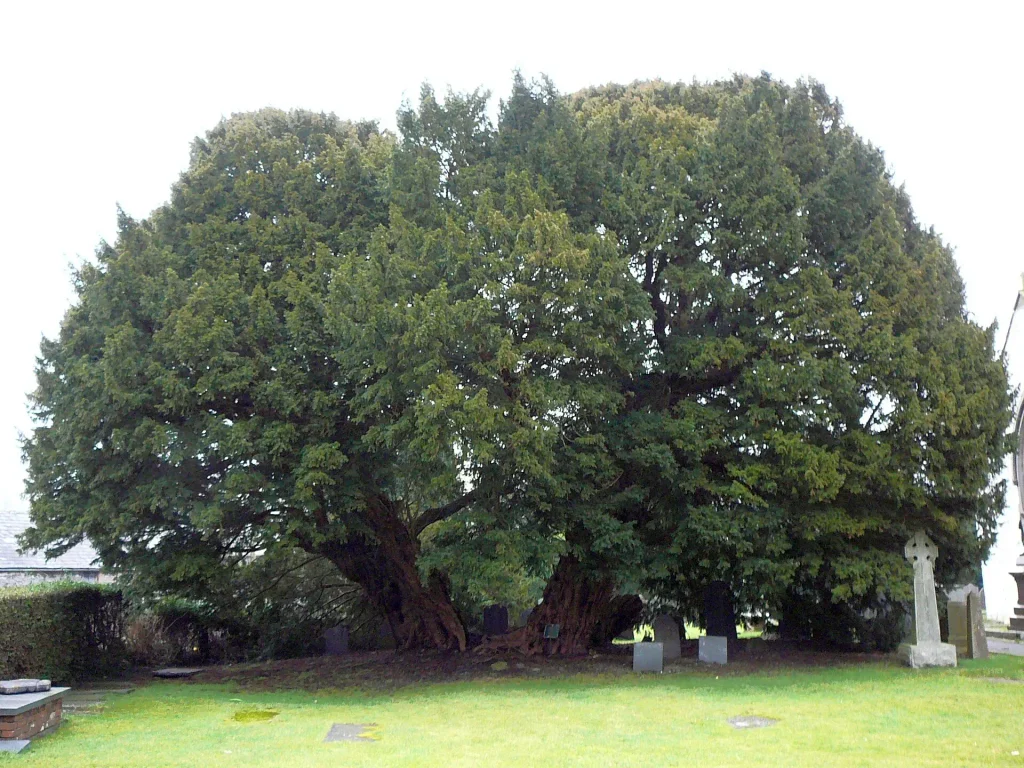
This yew grows in the churchyard of St. Digain’s parish church. It’s often cited as one of Britain’s three oldest trees, possibly one of Europe’s oldest too.
Yews are hard to date precisely. Old specimens often hollow out from the inside, destroying the very rings scientists need to count. That’s why estimates for Llangernyw span such a wide range. Even the low end still places it among the world’s most ancient trees.
6. Fortingall Yew: estimated 2,000–5,000 years
Species: Taxus baccata | Location: Fortingall, Perthshire, Scotland
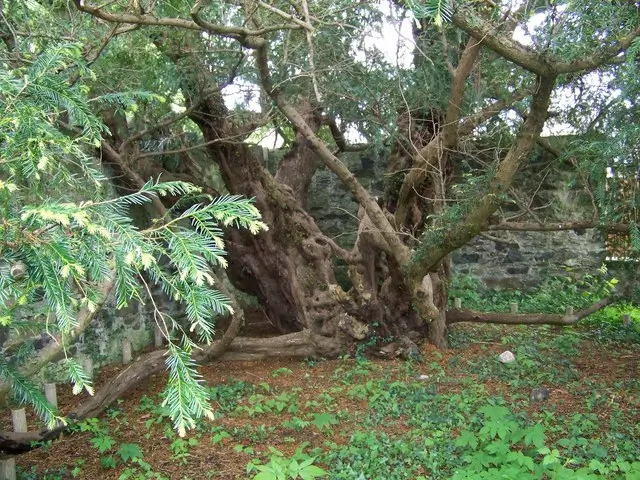
The Fortingall Yew is one of Europe’s most storied ancient trees. Local tradition puts its age as high as 9,000 years. Scientific estimates don’t support that figure.
Conservative, ring-based estimates land in the low thousands. But yews hollow out with age. No one can core all the way to its true center. That’s why its age remains genuinely unresolved, not simply “unverified.”
7. Jōmon Sugi: estimated 2,000–7,000 years
Species: Cryptomeria japonica | Location: Yakushima Island, Japan
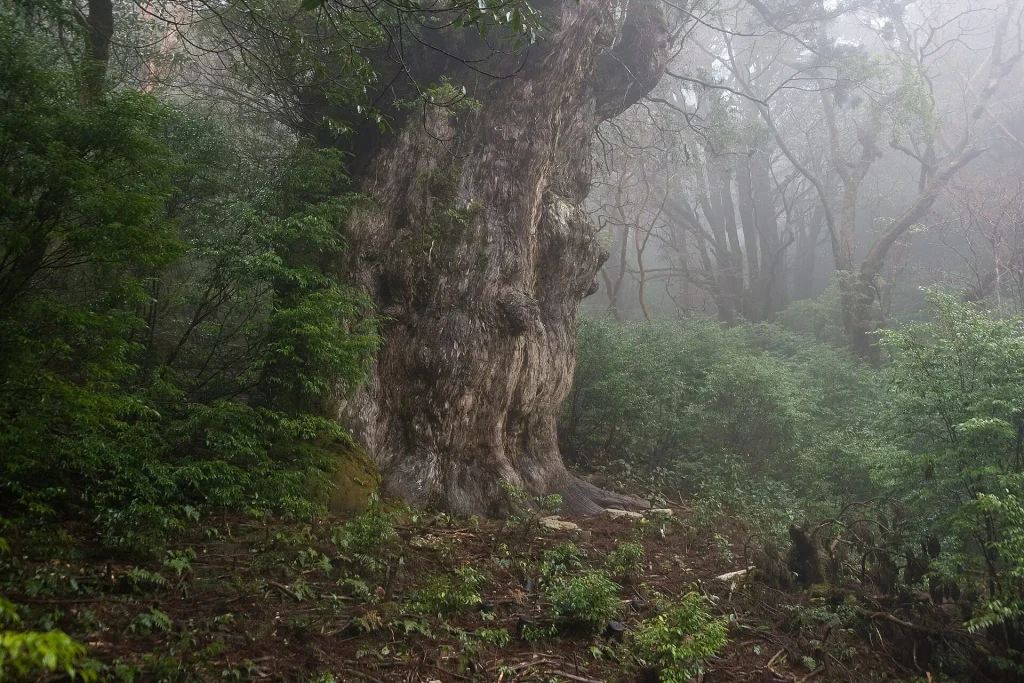
Named after Japan’s Jōmon period, this massive cedar anchors Yakushima’s UNESCO World Heritage-listed ancient forest.
Its age estimates carry an unusually wide range. Some researchers argue for a more conservative 2,000-plus years. Local tradition and looser estimates push toward 7,000. The reason: like the European yews on this list, its interior has partially decayed. A clean ring count isn’t possible.
8. The President: ~3,200 years
Species: Sequoiadendron giganteum | Location: Sequoia National Park, California, USA
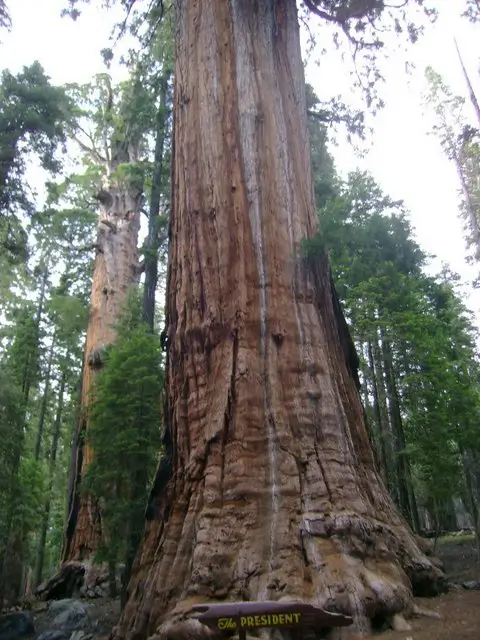
Giant sequoias grow too large for coring tools to reach their full age while alive. So estimates come from comparing growth rates to felled specimens of known age.
The President is one of the largest sequoias by volume on Earth. It’s estimated at more than 3,200 years old. A maintained trail in Sequoia National Park leads right to it.
9. General Sherman: ~2,200 years
Species: Sequoiadendron giganteum | Location: Sequoia National Park, California, USA
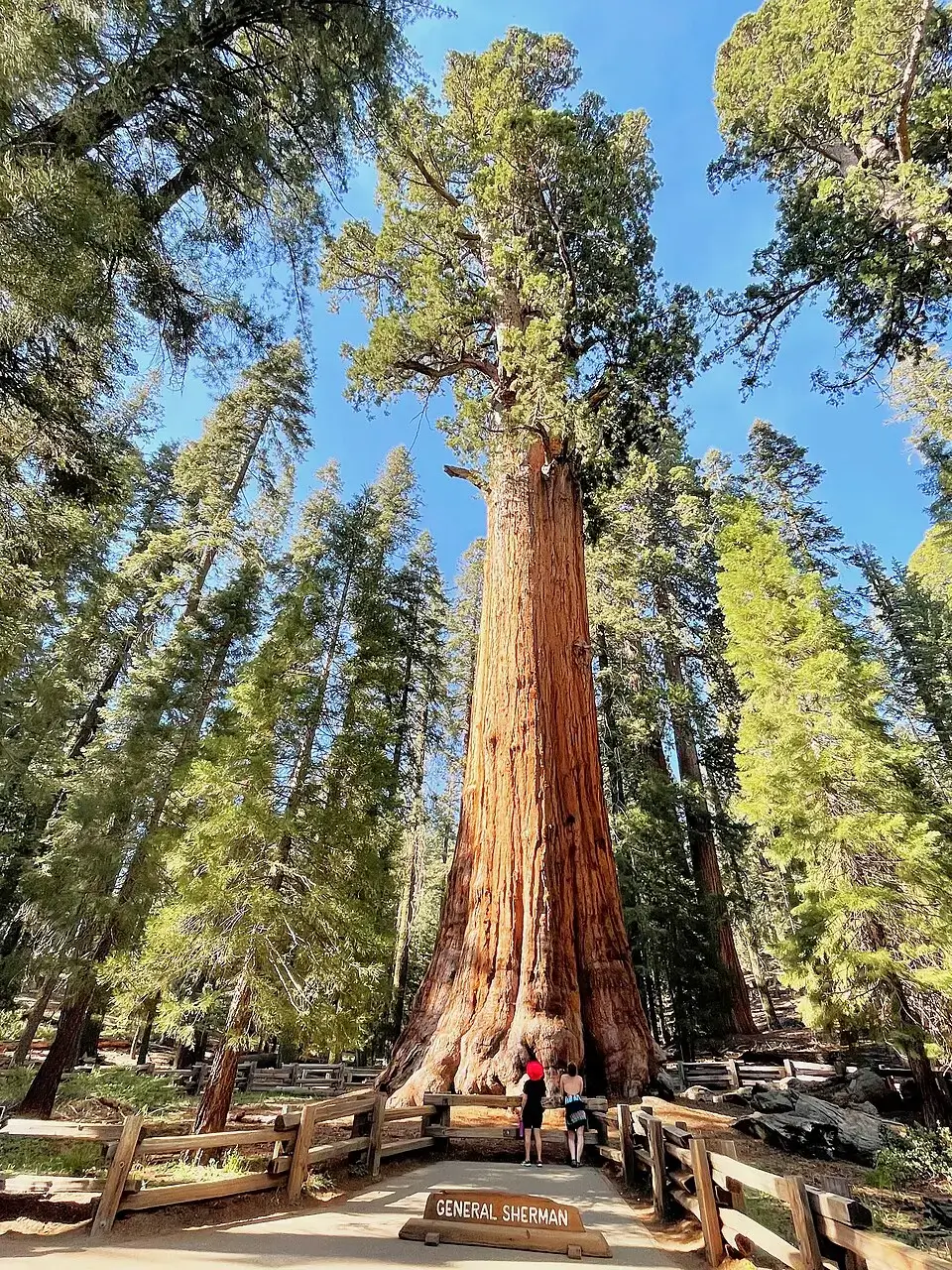
General Sherman isn’t the oldest tree on this list. But it’s the most-visited. It’s the largest tree on Earth by trunk volume. A paved, accessible trail leads to it, making it the most tourist-friendly ancient tree in North America.
At roughly 2,200 years old, it was already centuries old when the Roman Empire was at its height.
10. BLK 227 Bald Cypress: 2,624+ years
Species: Taxodium distichum | Location: Black River, North Carolina, USA
Researchers identified this unnamed bald cypress in 2019. It’s the oldest known living tree in eastern North America. Its precise location, like Methuselah’s, stays confidential.
Scientists sampled only a fraction of the ancient cypresses along the Black River. That means an even older tree could still be standing in the same swamp, undiscovered.
11. CB-90-11: 2,435+ years
Species: Pinus aristata (Rocky Mountain bristlecone pine) | Location: Black Mountain / Almagre Mountain, Colorado, USA
This tree is a close cousin of the Great Basin bristlecone pine. It doesn’t quite match its relative’s extreme lifespan. But a 1992 study found twelve living specimens over 1,600 years old on these two Colorado peaks. CB-90-11 was the oldest confirmed, at 2,435-plus years.
12. Unnamed Qilian Juniper: 2,230+ years
Species: Juniperus przewalskii | Location: Delingha, Qinghai Province, China
Researchers identified this juniper in 2019. Its age: 2,230 years, as measured in 2009. It’s the oldest known tree in China, one of 98 documented Chinese trees over 1,000 years old.
It grows in a remote mountain region, in terrain that echoes the extreme, high-altitude conditions found among some of the tallest mountains in the world. That’s common among China’s oldest surviving trees. Remoteness is often what saved them from centuries of logging.
13. Patriarca Verde: ~3,800 years (unverified)
Species: Olea europaea | Location: Puglia region, Italy
This is likely the oldest olive tree on the planet. The “Green Patriarch” stands 14 meters tall. Its trunk measures roughly 20 meters in circumference.
Olive tree ages are notoriously hard to verify scientifically. Many old specimens are hollow or heavily coppiced. So this widely cited figure is a strong estimate, not a confirmed ring count.
14. Adonis: 1,075+ years
Species: Pinus heldreichii (Bosnian pine) | Location: Pindus Mountains, northern Greece
Adonis has something most trees on this list lack: rigorous confirmation. Dendrochronologists dated it at over 1,075 years old. That makes it Europe’s oldest scientifically verified living tree.
Several unverified European specimens, like the Fortingall Yew, are claimed to be far older. None have Adonis’s level of proof.
15. Great Camphor of Takeo: traditionally 3,000+ years (unverified)
Species: Cinnamomum camphora | Location: Takeo, Saga Prefecture, Japan
This is one of Japan’s most revered “sacred trees.” Local tradition says it’s more than 3,000 years old.
That figure comes from tradition and rough estimation, not a peer-reviewed ring count. It’s included here for a reason: some of the world’s most famous “ancient” trees have never actually been scientifically dated. This is one of them.
The Clonal Giants: Pando and Old Tjikko
These two organisms aren’t ranked with the 15 above. They’re a fundamentally different kind of “old.” But depending on your definition of a tree, they may be the two oldest living things on Earth.
Pando grows in Utah’s Fishlake National Forest. It’s a single clonal colony: roughly 40,000 genetically identical quaking aspen (Populus tremuloides) trunks. All of them share one continuous root system. That root system is estimated at up to 80,000 years old.
Individual trunks live only about 130 years. Then they die, and new growth replaces them from the same root mass. That means no visible part of Pando is more than a couple of centuries old, even though the organism as a whole may be the oldest living thing on the planet.
Pando is currently in decline. Overgrazing by deer and elk is stopping young stems from regenerating. Its slow disappearance is a reminder of just how many reasons why forests are important extend far beyond any single tree.
Old Tjikko is a Norway spruce (Picea abies) on Fulufjället Mountain in Sweden. It’s the world’s oldest known individual clonal tree. Its root system has been carbon-dated to roughly 9,550 years old.
Like Pando, its visible trunk is young, usually no more than a few hundred years old. The tree regenerates through a process called layering. Low branches touch the ground and take root. New trunks sprout as old ones die.
Comparison Table: All 15 Trees at a Glance
| Rank | Tree | Species | Est. Age | Location | Type | Public Access |
| 1 | Unnamed bristlecone pine | Pinus longaeva | ~5,070 yrs | White Mountains, CA, USA | Individual | Location secret |
| 2 | Methuselah | Pinus longaeva | ~4,850 yrs | White Mountains, CA, USA | Individual | Location secret |
| 3 | Gran Abuelo | Fitzroya cupressoides | ~5,484 yrs (modeled) | Alerce Costero NP, Chile | Individual | Yes |
| 4 | Sarv-e Abarqu | Cupressus sempervirens | ~4,000–4,500 yrs | Yazd Province, Iran | Individual | Yes |
| 5 | Llangernyw Yew | Taxus baccata | ~4,000–5,000 yrs | North Wales, UK | Individual | Yes |
| 6 | Fortingall Yew | Taxus baccata | ~2,000–5,000 yrs | Perthshire, Scotland | Individual | Yes |
| 7 | Jōmon Sugi | Cryptomeria japonica | ~2,000–7,000 yrs | Yakushima, Japan | Individual | Yes (permit trail) |
| 8 | The President | Sequoiadendron giganteum | ~3,200 yrs | Sequoia NP, CA, USA | Individual | Yes |
| 9 | General Sherman | Sequoiadendron giganteum | ~2,200 yrs | Sequoia NP, CA, USA | Individual | Yes |
| 10 | BLK 227 | Taxodium distichum | 2,624+ yrs | Black River, NC, USA | Individual | Location undisclosed |
| 11 | CB-90-11 | Pinus aristata | 2,435+ yrs | Colorado, USA | Individual | Yes (remote hike) |
| 12 | Unnamed Qilian juniper | Juniperus przewalskii | 2,230+ yrs | Qinghai, China | Individual | Remote/restricted |
| 13 | Patriarca Verde | Olea europaea | ~3,800 yrs (est.) | Puglia, Italy | Individual | Yes |
| 14 | Adonis | Pinus heldreichii | 1,075+ yrs | Pindus Mountains, Greece | Individual | Yes (remote hike) |
| 15 | Great Camphor of Takeo | Cinnamomum camphora | ~3,000 yrs (est.) | Saga, Japan | Individual | Yes |
| N/A | Pando | Populus tremuloides | up to ~80,000 yrs | Fishlake NF, Utah, USA | Clonal colony | Yes |
| N/A | Old Tjikko | Picea abies | ~9,550 yrs (root system) | Fulufjället, Sweden | Clonal | Yes (guided tours) |
Can You Visit These Ancient Trees? A Practical Guide
Access varies a lot from tree to tree. Some sit along paved park trails, others are hidden on purpose.
Trees open to the public
Most trees on this list can be visited. General Sherman and The President sit along maintained trails in Sequoia National Park. They’re among the easiest ancient trees on Earth to see in person.
Gran Abuelo in Chile is open, too. So are Sarv-e Abarqu in Iran and both British yews.
Some take more effort. Jōmon Sugi requires a permitted, multi-hour hike across Yakushima’s mountainous terrain. Old Tjikko in Sweden is reachable on guided tours, offered several days a week in summer.
Trees that are protected (and why)
Three trees on this list are deliberately hidden: the record-holding unnamed bristlecone pine, Methuselah, and the BLK 227 bald cypress.
The reason is always the same. Visitor traffic, root compaction, and souvenir-taking are real threats to trees this old and fragile. Land managers keep exact locations out of guidebooks, maps, and social media. It’s the safest way to protect them.
Hike the Methuselah Trail in Inyo National Forest, and you’re almost certainly walking past the tree. You just won’t be told which one it is.
How Scientists Determine a Tree’s Age
Most ages here come from dendrochronology. That’s the science of dating trees by counting growth rings in the trunk. Here’s how it works:
- Core extraction: Researchers use a hollow tool called an increment borer. It pulls a thin, pencil-sized core from bark to center. The tree survives.
- Ring counting: Each ring usually equals one year of growth. Counting rings gives a baseline age.
- Cross-dating: Scientists compare ring patterns against other samples from the same region. This confirms the count and catches missing or false rings.
- Age estimation and verification: Very old or very large trees are tricky. The center may be rotted. The trunk may be too thick to core all the way through. In these cases, researchers combine partial cores with statistical modeling. That’s why some ages on this list, Gran Abuelo especially, are still debated.
Dendrochronologist Edmund Schulman pioneered this work on bristlecone pines in the 1950s. Researchers at the University of Arizona’s Laboratory of Tree-Ring Research continue it today. So does the independent group Rocky Mountain Tree-Ring Research.
Oldest Trees in the United States
Five entries on this list stand on American soil. That makes the U.S. home to more verified ancient trees than any other country. It’s a rare exception among the common trees in the United States that most people actually recognize:
- The record-holding unnamed bristlecone pine and Methuselah: both in California’s White Mountains, the two oldest verified individual trees on Earth
- The President and General Sherman: California’s giant sequoias, in Sequoia National Park
- BLK 227: the oldest known tree in eastern North America, hidden along North Carolina’s Black River
- CB-90-11: Colorado’s oldest confirmed Rocky Mountain bristlecone pine
- Pando: Utah’s 80,000-year-old aspen colony, arguably the oldest living organism on the planet, clonal or otherwise
Methodology & Sources
Ages here come primarily from Guinness World Records’ oldest-tree listings. They’re supported by peer-reviewed and university-affiliated dendrochronology research, including work from the University of Arizona’s Laboratory of Tree-Ring Research and Rocky Mountain Tree-Ring Research. The U.S. Forest Service and named, published studies fill in the rest.
Some ages are modeled, not directly ring-counted. Gran Abuelo is the clearest example. Others rest on tradition rather than science. The Great Camphor of Takeo and Patriarca Verde fall here. Each entry above notes which kind of evidence backs its number.
These trees are still being studied. Ages get revised as new research comes out. This article is reviewed and updated to reflect the latest verified data.