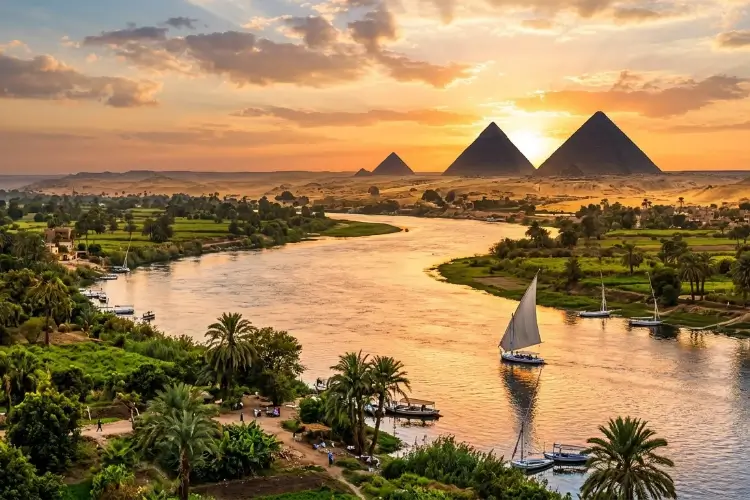
You probably learned one thing about the Nile in school: it’s long, and it’s in Egypt.
That’s about 10% of the real story.
The Nile is roughly 4,130 miles long by the U.S. Geological Survey’s count, and other measurements push it higher. It flows through 11 countries, not just one. And it has been quietly shaping human civilization for so long that geologists now think the river itself might be 30 million years old.
So let’s actually get into it. Here are 10 facts about the Nile that go way beyond the textbook version.
The Nile River, by the numbers:
- Length: ~4,132 miles per the USGS (other sources cite up to ~4,258 miles)
- Countries crossed: 11
- Basin size: roughly 1.2 to 1.3 million square miles, about 10% of the African continent
- People living in the basin: ~272 million
- Leading age estimate: ~30 million years old
Keep those five numbers in your back pocket. We’re going to unpack every one of them.
Fact 1: The “Longest River in the World” Title Is Still Disputed
Here’s the truth nobody tells you: there is no universally agreed-upon length for the Nile.
The USGS lists the Nile at 4,132 miles and the Amazon at 4,000. That’s why the Nile has traditionally worn the “longest river” crown. But rivers are surprisingly hard to measure. Where does a river system actually “start”? Which tributary counts as the true source? Change the answer to either question and the final number moves by hundreds of miles.
In 2007, a Brazilian expedition re-measured the Amazon and put it at more than 4,200 miles, which would make it the longer river. Most geographers still stick with the Nile.
So where does that leave you? With a fun fact that comes with an asterisk: the Nile is widely considered the longest river in the world, but “widely considered” is doing some heavy lifting in that sentence.
Fact 2: It Flows Through 11 Countries, Not Just Egypt
Say “the Nile” and most people picture pyramids. Fair enough. But Egypt only touches a fraction of this river’s total journey.
The Nile flows through 11 countries: Tanzania, Uganda, the Democratic Republic of the Congo, Rwanda, Burundi, Ethiopia, Kenya, Eritrea, South Sudan, Sudan, and Egypt. Its drainage basin covers roughly 1.2 to 1.3 million square miles, depending on the source. That’s about 10% of the entire African continent draining into one river system.
By the way: this is exactly why the Nile isn’t just an Egyptian resource. It’s a shared, and increasingly contested, resource across a huge chunk of the continent. We’ll come back to that in Fact 9.
Fact 3: The Nile Is Actually Two Rivers in One
Here’s the part that surprises almost everyone: “the Nile” isn’t one single river with one single source. It’s two rivers that merge into one.
The White Nile is the longer of the two, and it’s generally treated as the river’s main stream. It begins in the Great Lakes region of East Africa, with Lake Victoria as its best-known starting point. The Blue Nile is shorter, but it’s the real workhorse. It starts at Lake Tana in Ethiopia and carries most of the Nile’s water and most of its fertile silt.
Where the White Nile and Blue Nile Meet
The two rivers converge at one specific point: the city of Khartoum, Sudan. From there, they travel together as a single Nile, flowing north through Egypt and finally emptying into the Mediterranean Sea.
Two rivers, one name, one destination. The Nile has been a team effort the entire time.
Fact 4: The Nile Might Be 30 Million Years Old
This is the fact that quietly rewrites everything.
For years, a leading view held that the Nile in its present path was about 6 million years old. But a 2019 study published in Nature Geoscience presented geological evidence that the Nile drainage has been stable for around 30 million years. The researchers tied it to a large convection cell in Earth’s mantle beneath the region, which has helped hold up the Ethiopian highlands and pull the land down in the north.
Thirty million years. That’s long before humans existed, let alone pharaohs. The river that watched the rise and fall of ancient Egypt was already ancient by the time Egypt showed up.
The simple fix for your mental timeline? Stop thinking of the Nile as old. Start thinking of it as geological.
Fact 5: Ancient Egypt Literally Would Not Exist Without It
Egypt sits inside one of the driest regions on the planet. Without the Nile, there’s no fresh water, no farmland, and almost certainly no ancient Egyptian civilization at all.
For thousands of years, the Nile flooded on a predictable annual schedule, and that flood deposited rich, dark silt across the surrounding land. That silt is what made farming possible in the middle of a desert. Ancient Egyptians built their agricultural calendar, and a big part of their cultural life, around this one recurring event.
The Flood Festival Egyptians Still Celebrate Today
Egyptians still mark this history every August with Wafaa el-Nil, a festival celebrating the river’s ancient flood. Families gather along the banks to picnic and camp by the water, echoing a relationship with the Nile that stretches back roughly 5,000 years.
Because: a civilization doesn’t build a festival that lasts thousands of years around a river that only sort of mattered.
Fact 6: Its Crocodiles Are as Dangerous as You’d Think
The Nile isn’t just historically significant. It’s also genuinely dangerous, and the Nile crocodile is a big reason why.
Nile crocodiles are apex predators that can reach about 20 feet in length, though 16 feet is a more typical size. National Geographic notes they have a somewhat deserved reputation as man-eaters, and estimates suggest that up to 200 people may die from Nile crocodile attacks each year.
One honest caveat: firm numbers are sketchy. Many attacks go unreported, and these crocodiles live across sub-Saharan Africa, not just along the Nile itself. So treat that figure as a rough estimate, not a precise count.
Either way, if you’re ever picturing a peaceful float down the river, add a healthy dose of respect for what’s underneath the surface.
Fact 7: Ancient Engineers Built a 600-Mile Flood System We Only Just Mapped
Here’s the truth nobody tells you: the Nile’s flood management wasn’t just a natural gift. People engineered it.
In 2023, an international research team published a study in the journal Geoarchaeology documenting a vast network of stone walls called river groynes along about 600 miles (1,000 kilometers) of the Nile, from the first cataract in Egypt to the fourth cataract in Sudan. They located nearly 1,300 of them using satellite imagery, drone surveys, and ground work. Radiometric dating showed that some were built more than 3,000 years ago.
These walls helped control flow and trap fertile silt. Some were even built within living memory, and local farmers still use the same approach today. In other words: some of the “natural” fertility of the Nile Valley has been human-managed for millennia.
Fact 8: About 272 Million People Live in the Nile Basin
This isn’t ancient history. This is happening today.
According to the Nile Basin Initiative’s 2021 State of the Basin report, the population living inside the Nile Basin has grown from about 238 million to roughly 272 million people. All of them share one river system.
So where do you start if you want to understand modern geopolitics in northeast Africa? Right here. Water security along the Nile isn’t a side issue. For hundreds of millions of people, it’s the main issue, and it’s a big part of why water conservation matters everywhere.
Fact 9: The Aswan High Dam Changed Egypt, and a Newer Dam Is Changing the Debate
Completed in 1970, the Aswan High Dam was built to control the Nile’s flooding and generate hydroelectric power, one of the best-known renewable energy sources. According to NASA, its power station provides 2.1 gigawatts, which was fully half of Egypt’s electricity needs back in 1970. It also gave many villages access to electricity for the first time.
But the Aswan Dam isn’t the whole story anymore. Upstream on the Blue Nile, Ethiopia inaugurated the Grand Ethiopian Renaissance Dam in September 2025. It is Africa’s largest hydroelectric project, and Egypt protested to the United Nations, calling it an existential threat to its water security. Egypt and Sudan have long demanded a legally binding agreement on how the dam is filled and operated.
The Nile isn’t just a historical marvel. It’s a live political flashpoint.
Fact 10: Nobody Has Ever Definitively Found Its True Source
You’d think a river this famous would have a clearly marked starting point. It doesn’t.
Many sources point to Lake Victoria as the origin of the White Nile. But the lake itself is fed by rivers, so it isn’t necessarily the most distant “true” source. Others point to the Kagera River and its tributary, the Ruvubu, which begins in Burundi. Even the USGS admits that picking a source is partly a judgment call, since they generally go with the longest, straightest tributary.
The simple fix for anyone who wants a clean, tidy answer? There isn’t one. And honestly, that’s part of what makes this river so fascinating.
Nile River vs. Amazon River: How They Actually Compare
Since the comparison keeps coming up, let’s put it side by side instead of leaving it vague.
| Metric | Nile River | Amazon River |
| Length (USGS) | ~4,132 miles | ~4,000 miles |
| Average discharge | ~2,800 cubic meters per second | ~210,000 cubic meters per second |
| “Longest river” status | Traditionally holds the title | Some measurements place it longer, the debate is ongoing |
Look at the discharge row. The Amazon moves roughly 75 times more water than the Nile.
Longest by distance, or biggest by volume? The Nile and the Amazon aren’t really competing in the same category. They just happen to share the same headline.
The Nile Is Far More Than a Long River in Egypt
The Nile isn’t just Egypt’s river, and it isn’t just an old river either. It’s two rivers merged into one, possibly tens of millions of years old, home to roughly 272 million people in its basin, and sitting at the center of an unresolved dispute between Egypt and Ethiopia.
That’s a lot more than “it’s long, and it’s in Egypt.”
Next time someone mentions the Nile, you’ll have a lot more than a length in miles to bring to the conversation.