Turn on the tap. Water comes out. Every time.
It’s easy to assume that will never change. I used to assume it too, until I started digging into the actual numbers behind America’s water supply. They’re not subtle.
Here’s the truth nobody tells you: the water crisis isn’t a someday problem. It’s already showing up in your utility bill, your local drought map, and the pipes under your street. And it’s getting more urgent, not less.
So let’s talk about why water conservation matters right now, what’s actually driving the urgency, and what you can do about it starting today.
What Is Water Conservation?
Water conservation is the practice of using freshwater efficiently and cutting waste, so that a limited, unevenly distributed resource can meet both today’s needs and tomorrow’s.
That’s the textbook version. In plain terms, it means using only the water you actually need, fixing the water you’re losing without noticing, and making choices (indoors and outdoors) that stretch a supply that isn’t growing to match demand that is.
The Short Answer: Why Water Conservation Matters Right Now
Here’s the fast version, if you only read one section:
- Less than 3 percent of the water on Earth is fresh, and most of that is frozen or buried.
- The average American household uses more than 300 gallons of water a day, and household leaks alone waste nearly 900 billion gallons a year nationwide.
- Droughts across the American West are getting longer and more frequent, straining supplies that were already stretched thin.
- Every gallon you save also saves energy, because treating and moving water takes power at every step.
- Agriculture uses the majority of the world’s freshwater, so household habits matter, but they’re not the whole story.
Now let’s get into why each of these actually matters.
How Much Water Do We Actually Have?
We talk about water like it’s endless. It isn’t.
The 3 Percent Problem
Here’s the number that should stop you: less than 3 percent of all the water on Earth is fresh. Most of that fraction is locked away in glaciers, ice caps, and deep groundwater we can’t easily reach. What’s actually accessible for drinking, farming, and daily life is a sliver of a sliver.
By the way: the total amount of water on the planet isn’t shrinking. What’s shrinking is our access to the clean, usable portion of it, as pollution, overuse, and climate shifts put more strain on a fixed supply.
Where Water Stress Is Worst Right Now
Some regions feel this more than others. The American Southwest has been living with this reality for years, as the Colorado River Basin, which supplies water to tens of millions of people across seven states, has faced sustained shortages severe enough to trigger the federal government’s first-ever shortage declaration in 2021, followed by further cuts in the years since. California’s Central Valley has cycled through repeated multi-year droughts throughout its history, including the driest three-year stretch on record from 2012 to 2014, according to the California Department of Water Resources. Even states that don’t think of themselves as “drought states,” like parts of the Southeast and Midwest, have seen local water restrictions during dry summers.
This isn’t a California problem or a Southwest problem. It’s a national one, just distributed unevenly, for now.
6 Reasons Water Conservation Is More Urgent Than Ever
Water has always mattered. So why does conservation feel more urgent today than it did a generation ago? Here’s what’s actually changed.
1. Freshwater Is a Finite, Shrinking Resource
We already covered the headline number: under 3 percent of Earth’s water is fresh, and most of that isn’t accessible. That baseline hasn’t changed in centuries. What’s changed is how hard we’re leaning on it.
2. Population Growth Is Concentrated Where Water Is Already Scarce
Here’s a nuance most articles skip: total US water withdrawals have actually stayed flat, even declined, since peaking around 1980, despite the population growing by tens of millions since then. Efficiency gains deserve the credit for that.
But national averages hide the real pressure point. Population growth has concentrated hardest in the Sun Belt and the arid West, the exact regions already stretched thinnest on water supply. When people move faster than local infrastructure and reservoirs can keep up, flat national numbers don’t mean much to the city watching its reservoir drop.
3. Climate Change Is Making Droughts Longer and More Frequent
The simple fix everyone reaches for? Just wait for the rain. But that’s exactly the problem. Mountain snowpack across the western United States, the same snowpack that fills reservoirs every spring, has declined at more than 90 percent of measured sites since 1955, with an average decline of about 23 percent. Less snowpack means less of a natural reserve to carry the West through its dry summer months.
4. Water Treatment and Delivery Consumes Massive Energy
Because: water doesn’t just appear at your faucet. It gets pumped, treated, filtered, and delivered, often across long distances and multiple pressure zones. Every one of those steps burns energy. When you save water, you’re also saving the electricity or fuel it took to get that water to you in the first place. That’s the water-energy nexus, and it’s part of why the shift toward renewable energy sources matters for water conservation too, not just for cutting emissions.
5. Aging Infrastructure Is Wasting Billions of Gallons
Here’s a number that’s hard to sit with: household leaks waste nearly 900 billion gallons of water every year across the United States. That’s roughly equal to the annual water use of 11 million homes, gone, before it ever gets used for anything.
And that’s just households. Nationally, aging and failing infrastructure loses an estimated 33.3 trillion gallons of treated water every year, worth more than $187 billion in lost revenue, and the EPA puts the country’s drinking water infrastructure needs at $625 billion over the next 20 years. Infrastructure doesn’t fix itself. Every gallon lost to a cracked pipe is a gallon that had to be treated and pumped for nothing.
6. Conservation Protects Ecosystems, Not Just Humans
We’re not the only ones who need water. Rivers, wetlands, and the wildlife that depend on them need consistent flow to survive, and so do the watersheds that anchor entire forests, which is part of why forests matter so much to the broader water cycle. When human demand pulls too hard on a river system, ecosystems downstream pay the price first, long before most people notice a problem at the tap.
What Happens If We Don’t Conserve Water?
So what’s actually at stake if none of this changes?
The short version: higher water bills, more frequent restrictions, greater strain on farms and food prices, and ecosystems that don’t recover as easily as we’d like to believe.
| Consequence | What it looks like in practice |
| Rising utility costs | Water treatment and delivery get more expensive as supplies tighten, and utilities pass those costs to customers |
| More frequent restrictions | Outdoor watering bans, car-wash limits, and tiered pricing become more common in drought-prone regions |
| Agricultural strain | Farmers face tighter irrigation allocations, which can affect crop yields and food prices |
| Ecosystem damage | Lower river flows and shrinking wetlands stress fish populations and wildlife habitat |
| Infrastructure failure risk | Underfunded, aging systems become more likely to fail under sustained high demand |
None of this is hypothetical. Versions of every row in that table have already happened somewhere in the US in the last decade.
The Core Methods of Water Conservation
Here’s the truth nobody tells you: conservation isn’t one thing. It’s four different levers, and most people only pull one of them.
Reduce
This is the highest-impact lever available to most households. It means using less water through efficient fixtures and small daily habit changes, like shorter showers and full laundry loads instead of half-empty ones.
Reuse and Recycle
Reuse means giving water a second job before it goes down the drain. Graywater, the lightly used water from sinks, showers, and washing machines, can water landscaping instead of being sent straight to a treatment plant. Recycling goes a step further: treating wastewater so it can be safely returned to use for irrigation, industry, or replenishing groundwater.
Repair
Fix what’s already broken. Remember that 900 billion gallon leak number? A huge share of that is preventable. A single dripping faucet or a running toilet can waste thousands of gallons a year, silently, until someone notices the water bill.
Rethink
The simple fix here isn’t a product. It’s a mindset shift. Choosing drought-tolerant landscaping over thirsty lawns, picking water-efficient appliances when it’s time to replace one anyway, and treating water use as a design choice rather than an afterthought, the same thinking behind what actually makes a home green in the first place. This is the lever that makes the other three stick over time.
How to Conserve Water at Home: A Step-by-Step Starting Point
You don’t need to overhaul your entire house this weekend. Start with two or three of these. Small changes compound faster than people expect.
Indoor water-saving steps:
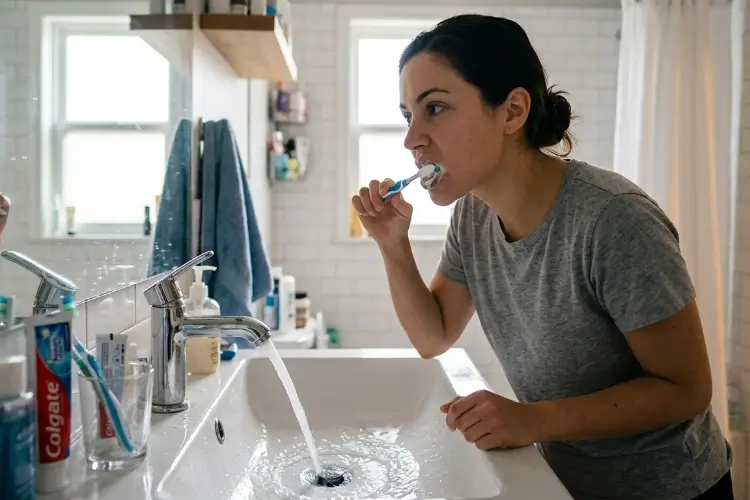
- Turn off the tap while brushing your teeth. Saves about 8 gallons per day.
- Turn off the tap while shaving. Saves about 10 gallons per shave.
- Fix leaky faucets promptly. Saves up to 3,000 gallons per year, per leak.
- Install a WaterSense-labeled toilet. Saves about 13,000 gallons and $130 a year.
- Install WaterSense-labeled bathroom faucets. Saves roughly 700 gallons per family, per year.
- Run the dishwasher only when it’s full. Saves nearly 320 gallons a year.
- Shorten your shower by two minutes. Saves close to 1,800 gallons a year, per person.
- Check your water meter for silent leaks by watching for movement when nothing’s running.
Small fixture swaps add up fastest when you pair them with a few other zero-waste bathroom swaps, since the same room that wastes the most water often wastes the most plastic too.
Outdoor water-saving steps:
- Water plants in the early morning or evening, not midday, to cut evaporation loss, a habit that matters even more if you’re growing vegetables in a small urban garden with a tighter water budget.
- Replace thirsty turf with drought-tolerant landscaping, especially since outdoor use can hit 60 percent of household water in arid regions.
- Apply mulch around plants and beds to help soil hold moisture longer, and pairing it with the right organic fertilizer builds soil that retains even more of it.
- Install a rain sensor on your sprinkler system so it doesn’t run after a storm.
- Audit your irrigation system yearly. An unmaintained system can waste up to 25,000 gallons a year.
- Use a broom instead of a hose to clean driveways and walkways.
- Capture rainwater in a rain barrel for garden use.
- Cover pools when they’re not in use to cut evaporation significantly.
Water Conservation Beyond the Home: Community and Policy
Here’s the part most conservation articles skip: your household isn’t where most of the water goes.
Agriculture accounts for roughly 70 percent of global freshwater withdrawals. Industrial use adds another significant share. Household use, the showers, laundry, and lawns most conservation tips focus on, is a real but smaller piece of the total picture, which is part of why sustainable food systems and water conservation are really the same conversation.
That doesn’t mean your habits don’t matter. They absolutely do, especially at scale, and especially in your local community where household demand directly affects local reservoirs and treatment capacity. But real, lasting change also depends on water utilities modernizing aging infrastructure, agricultural operations adopting more efficient irrigation, and policy that prices and allocates water more sustainably.
Individual action and systemic change aren’t competing priorities. They’re the same effort, working at two different scales.
Water Conservation vs. Water Scarcity: What’s the Difference?
These two terms get used almost interchangeably, and that’s a problem, because they’re not the same thing.
| Term | What it means | Example |
| Water conservation | The practice of using water efficiently and reducing waste | Fixing a leaking faucet, installing a WaterSense toilet |
| Water scarcity | A shortage of available freshwater relative to demand in a given area | A region under mandatory outdoor watering restrictions during drought |
In short, conservation is something you do. Scarcity is a condition you respond to. Good conservation habits can delay or reduce scarcity, but they can’t manufacture water that isn’t there.
The Water Crisis Isn’t Coming. It’s Already Here.
Water conservation isn’t a someday problem, and it isn’t just about shorter showers.
It’s a finite resource under growing pressure from population growth, climate shifts, aging infrastructure, and demand that shows no sign of slowing down. The good news? You don’t need to solve all of that yourself. You just need to start.
Fix the leak you’ve been putting off. Swap one fixture. Rethink one habit. Then keep going.
Because the water crisis isn’t coming. It’s already here, and every gallon you save is one less gallon the next drought has to fight for.