Quick picks, if you’re in a hurry:
- Best Overall: Jobe’s Organics All-Purpose Granular Fertilizer
- Best Budget: Burpee Natural Organic All-Purpose Plant Food
- Best for Vegetables & Tomatoes: Dr. Earth Organic 5
- Best for Flowers: Espoma Garden-Tone
- Best for Lawns: Milorganite
So what actually is the best organic fertilizer for a home garden?
Organic fertilizer is any soil amendment made from natural plant, animal, or mineral sources (think compost, bone meal, fish emulsion, or seaweed extract) rather than synthetic chemicals. It feeds your soil slowly, over weeks instead of days, and it builds the kind of long-term fertility a bag of synthetic 24-8-16 simply can’t.
I’ve spent years testing feeding schedules across raised beds, containers, and a stubborn patch of lawn that refused to green up. Here’s what actually works.
Below, you’ll find 15 organic fertilizers worth your money, a side-by-side comparison table, and a real buying guide, not just a list of products with a paragraph slapped underneath each one.
What Makes a Fertilizer “Organic”?
Organic fertilizer is a soil amendment made from natural plant, animal, or mineral materials that feeds plants by slowly releasing nutrients as soil microbes break the material down.
That’s the technical definition. Here’s the practical one: it’s food for your soil, not just your plant.
Synthetic fertilizers dump nutrients straight into the root zone. Organic fertilizers feed the microbial ecosystem first, and that ecosystem feeds your plants. It’s slower. It’s also more durable.
By the way: look for the OMRI Listed seal (Organic Materials Review Institute) when you’re comparing bags. It means an independent nonprofit, not the manufacturer, verified the product actually meets USDA organic standards. It’s the one label on a fertilizer bag you don’t have to take on faith.
How We Chose These Organic Fertilizers
Here’s the truth nobody tells you: most “best fertilizer” lists are written from a spec sheet, not a garden.
We evaluated each product on four things: NPK transparency, OMRI certification status, ingredient sourcing, and price-per-application over a full growing season. Where possible, picks reflect real application in raised beds, containers, and lawn patches over multiple seasons, not just what the label promises.
We’re not paid to rank any single brand higher. If a product underperformed, it’s not on this list.
The 15 Best Organic Fertilizers for Home Gardens
Here’s the full rundown, in order, with what each one actually does best.
1. Jobe’s Organics All-Purpose Granular Fertilizer: Best Overall
This is the one to grab if you only want to buy one bag.
It’s fast-acting for an organic product, easy to spread, and works across vegetables, flowers, and shrubs without needing a different bag for every bed. The 4-4-4 NPK is balanced enough for general feeding, and it only needs reapplying every 4 to 6 weeks during the growing season.
Best for: gardeners who want one product to cover the whole yard.
2. Burpee Natural Organic All-Purpose Plant Food: Best Budget Pick
Don’t let the price fool you: this one still performs.
It’s a solid 4-4-4 blend that covers the same general-purpose ground as pricier options, just without the brand markup. If you’re feeding a large garden and cost-per-application matters, start here.
Best for: big gardens, tight budgets.
3. Dr. Earth Organic 5: Best for Vegetables & Tomatoes
Tomatoes are hungry plants. This fertilizer knows it.
Dr. Earth Organic 5 is built specifically for the nutritional demands of tomatoes, vegetables, and herbs, with beneficial microbes and mycorrhizae mixed right into the formula. The higher phosphorus (5-7-3) supports fruit and root development, which is exactly what a tomato plant needs mid-season.
Funny enough, the tomato itself is a great example of vegetables that are actually fruits, even though every recipe treats it like a vegetable. The same mix-up applies to a few other common garden crops, including bell peppers, which come with their own set of bell pepper myths worth clearing up.
Best for: vegetable beds, especially tomatoes and peppers.
4. Espoma Garden-Tone: Best for Flowers
Garden-Tone is made from natural ingredients (bone meal, poultry manure, alfalfa meal) blended for balanced nitrogen, phosphorus, and potassium. It also contains beneficial microbes that improve soil fertility over time.
The result: healthier blooms and stronger overall plant vigor, not just a quick color boost.
Best for: flower beds, ornamentals, mixed borders.
5. Milorganite: Best for Lawns
Milorganite sits in an interesting middle ground. It’s made from heat-dried microbes (a byproduct of municipal water treatment), which means it delivers a steadier nutrient release than most synthetic lawn feeds while still greening up grass reliably.
It won’t burn your lawn even if you overapply slightly, a real risk with synthetic 24-8-16 blends.
Best for: lawns, especially if you’ve burned grass with synthetic fertilizer before.
6. Jobe’s Organics Fertilizer Spikes: Best for Trees & Shrubs
Spikes are the “set it and forget it” option.
These premeasured spikes deliver a slow-release blend directly to the root zone, made from natural ingredients like feather meal and bone meal. No spreading, no mixing, no runoff risk.
It’s a small thing, feeding a tree once or twice a year, but it adds up. Some of the world’s oldest living trees have been standing for thousands of years, and consistent, gentle feeding early on is part of what gives a tree the best shot at that kind of lifespan.
Best for: trees, shrubs, anyone who doesn’t want to measure anything.
7. Neptune’s Harvest Fish & Seaweed Blend: Best Liquid Fertilizer
Liquid fertilizers work fast because plants absorb them almost immediately through both roots and leaves.
This fish-and-seaweed blend combines quick nitrogen availability with the trace minerals and growth compounds seaweed is known for. Dilute it, spray it, and you’ll typically see a response within days, fast for an organic product.
Best for: a quick boost between granular feedings.
8. Espoma Plant-Tone: Best Granular All-Purpose
Plant-Tone is Espoma’s broader all-purpose granular, a step up from Garden-Tone if you want one formula that spans vegetables, flowers, and shrubs without swapping products by bed.
Best for: gardeners who want granular reliability without micromanaging by plant type.
9. Dr. Earth Organic and Natural Acid-Lovers Fertilizer: Best for Acid-Loving Plants
Blueberries, azaleas, and rhododendrons don’t want the same soil chemistry as your tomatoes.
This formula is built to support acid-loving plants specifically, helping maintain the lower soil pH those species need to actually take up nutrients.
Best for: blueberries, azaleas, camellias, rhododendrons.
10. Espoma Bio-Tone Starter Plus: Best Starter Fertilizer
New transplants and seedlings need a gentler, more targeted push than an established bed.
Bio-Tone Starter Plus is formulated for transplanting, with added mycorrhizae to help new root systems establish faster. If you’re planting a new bed this season, start here before switching to a general-purpose feed later.
Best for: new transplants, new garden beds.
11. Miracle-Gro Performance Organics All Purpose Plant Nutrition: Best for Containers & Indoor Plants
This one splits the difference: the convenience of a familiar granular fertilizer with organic-derived ingredients.
It’s not OMRI Listed, so if certified-organic status is non-negotiable for you, skip it. But for container gardens and indoor plants where you want reliable, even feeding, it performs well.
Best for: containers, indoor plants, gardeners who prioritize convenience.
12. Alaska Fish Emulsion: Best Fish Emulsion
Fish emulsion is one of the oldest organic fertilizers around, and it still works because it works.
It’s rich in nitrogen, phosphorus, and potassium, and it delivers nutrients quickly since it’s already in liquid form. The smell fades within a day or two outdoors, worth knowing before you use it near a patio.
Best for: leafy greens, quick nitrogen boosts, foliar feeding.
13. Espoma Bone Meal: Best Bone Meal
Bone meal is almost pure phosphorus, with a 4-12-0 NPK that’s built for one job: root and bloom development.
Mix it into the soil at planting time for bulbs, roses, and root vegetables. It’s slow to break down, so it’s not a quick fix. It’s a foundation you lay before you plant.
Best for: bulbs, root vegetables, roses, planting-time soil prep.
14. Brut Organic Worm Castings: Best Worm Castings
Worm castings are less a “fertilizer” in the traditional sense and more a soil conditioner that happens to feed your plants too.
They’re OMRI Listed, gentle enough to use on virtually anything without risk of burning, and they improve soil structure with every application. The nutrient numbers look low on paper (1-0-0), but the real value is in what they do for soil biology long-term.
Best for: seedlings, houseplants, anywhere you want zero burn risk.
15. GS Plant Foods Kelp Fertilizer: Best Seaweed/Kelp Fertilizer
This one is built around a single hero ingredient: Ascophyllum nodosum seaweed extract.
Kelp fertilizer isn’t primarily an NPK powerhouse. It’s a stress-tolerance and trace-mineral booster. Plants fed regularly with kelp extract tend to handle drought, heat, and transplant shock better.
Best for: stressed plants, drought-prone areas, a supplement alongside your main feeding schedule.
Quick-Pick Comparison Table: All 15 at a Glance
| Product | Best For | NPK | Form | OMRI Listed | Price Range |
| Jobe’s Organics All-Purpose Granular | Best Overall | 4-4-4 | Granular | Yes | $$ |
| Burpee Natural Organic All-Purpose | Best Budget | 4-4-4 | Granular | Yes | $ |
| Dr. Earth Organic 5 | Vegetables & Tomatoes | 5-7-3 | Granular | Yes | $$ |
| Espoma Garden-Tone | Flowers | 3-4-4 | Granular | Yes | $$ |
| Milorganite | Lawns | 6-4-0 | Granular | No* | $$ |
| Jobe’s Organics Fertilizer Spikes | Trees & Shrubs | 4-4-4 | Spikes | Yes | $$ |
| Neptune’s Harvest Fish & Seaweed Blend | Best Liquid | 2-3-1 | Liquid | Yes | $$ |
| Espoma Plant-Tone | Best Granular | 5-3-3 | Granular | Yes | $$ |
| Dr. Earth Acid Lovers | Acid-Loving Plants | 3-4-3 | Granular | Yes | $$ |
| Espoma Bio-Tone Starter Plus | Slow-Release Starter | 4-3-3 | Granular | Yes | $$ |
| Miracle-Gro Performance Organics | Container & Indoor | 8-2-4 | Granular | No* | $$ |
| Alaska Fish Emulsion | Best Fish Emulsion | 5-1-1 | Liquid | Yes | $$ |
| Espoma Bone Meal | Best Bone Meal | 4-12-0 | Granular | Yes | $ |
| Brut Organic Worm Castings | Best Worm Castings | 1-0-0 | Granular | Yes | $$$ |
| GS Plant Foods Kelp Fertilizer | Best Seaweed/Kelp | 1-0-2 | Liquid | Yes | $$ |
*Milorganite and Miracle-Gro Performance Organics use natural/organic-derived ingredients but aren’t OMRI Listed, worth knowing if certified-organic status matters for your garden.
Organic vs. Synthetic Fertilizer: What the Data Actually Shows
Is organic fertilizer actually better than synthetic? Let’s look at the numbers instead of the marketing.
| Fact | Organic | Synthetic |
| Typical NPK range | 2-2-2 to 5-5-5 | 10-10-10 to 24-8-16 |
| Nutrient release speed | Slow (weeks to months) | Fast (days) |
| Soil microbial impact | Feeds and builds microbial life | Neutral to reduced over time |
| Burn risk if over-applied | Low | High |
Here’s the truth nobody tells you: a lower NPK number on an organic bag isn’t a weakness. It means the nutrients release over months instead of days, matched roughly to the pace your plants can actually use them.
Synthetic fertilizers are concentrated chemical salts. That’s exactly why they work fast, and exactly why they can burn your plants and leach into waterways if you apply too much.
Organic fertilizers work differently. Soil microbes break the material down gradually and release nutrients as plants need them, which is part of why organic feeding tends to build soil structure over multiple seasons instead of just borrowing against it.
Research comparing fertilization strategies has found that organic amendments can meaningfully shift soil microbial communities and, in some cropping studies, even boost yields compared to fully synthetic programs, though results vary by crop, soil type, and application rate. It’s not a universal win. It’s a different tool for a different timeline.
The simple fix? If you want fast, visible green-up, a light synthetic boost can help in the short term. But if you’re building a garden you’ll be feeding for the next ten years, organic is the investment that compounds.
How to Choose the Right Organic Fertilizer for Your Garden
It comes down to four things: your soil, your plants, your application method, and one label to look for.
Test Your Soil First
You can’t fix what you haven’t measured.
A basic home soil pH test (or a sample sent to your local cooperative extension office) tells you whether you’re dealing with acidic, neutral, or alkaline soil, and that determines which nutrients your plants can actually absorb, no matter how good the fertilizer is.
Most gardens benefit from a soil test every 2 to 3 years.
Match NPK to Your Plant Type
- Leafy greens and lawns: higher nitrogen (the first number)
- Root vegetables, bulbs, and flowering plants: higher phosphorus (the second number)
- Fruiting plants and stress tolerance: higher potassium (the third number)
Granular vs. Liquid vs. Spike: Which Application Method?
Granular is the workhorse: easy to spread, slow-release, good for general beds.
Liquid works fastest, ideal when a plant needs a quick correction or you’re feeding containers where you want even distribution.
Spikes are the lowest-effort option: press them in and forget them, best for trees and shrubs you don’t want to fertilize repeatedly.
What “OMRI Listed” Actually Means
OMRI, the Organic Materials Review Institute, is an independent nonprofit that reviews products against USDA National Organic Program standards.
If a bag says “OMRI Listed,” it’s been vetted by a third party. If it just says “organic” with no seal, that’s a claim you’re taking on the manufacturer’s word alone.
How to Apply Organic Fertilizer (Step-by-Step)
- Test your soil: Know your pH and existing nutrient levels before you buy anything.
- Choose the right NPK for your plants: Match the formula to what you’re growing, using the guide above.
- Water the area first: Applying to dry soil wastes product and can stress roots.
- Apply at the base of the plant, not on the leaves: Follow the label’s rate. Organic doesn’t mean unlimited.
- Water again after application: This helps activate microbial breakdown.
- Reapply on schedule: Most granular organics need reapplication every 4 to 6 weeks during the growing season; liquids more often, spikes far less.
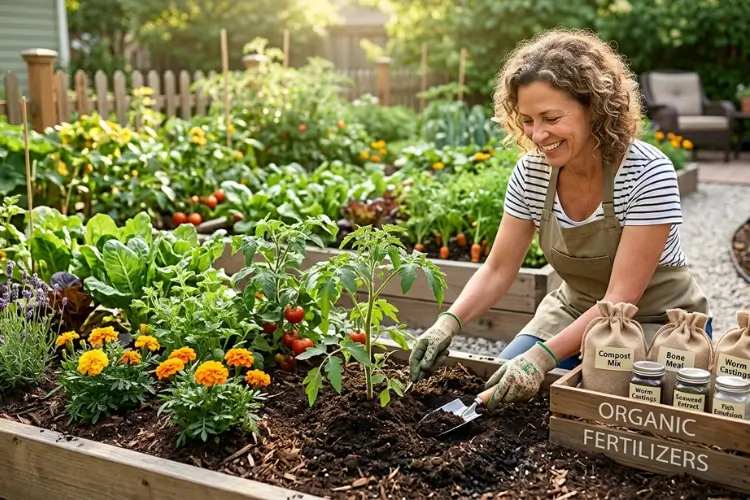
3 Homemade Organic Fertilizers You Can Make Today
Can you make organic fertilizer at home? Absolutely, and it’s one of the most satisfying parts of organic gardening.
Compost: Layer kitchen scraps (fruit peels, vegetable trimmings, coffee grounds) with yard waste (grass clippings, dried leaves). Over months, it breaks down into a rich, nutrient-dense amendment that feeds your soil for free. It’s also one of the easiest ways to put these zero waste kitchen tips into practice, since you’re turning what would’ve been trash into something your garden actually needs.
Compost tea. Steep finished compost in water for a day or two, strain it, and you’ve got a liquid fertilizer perfect for potted plants or a quick foliar feed.
Banana peel and eggshell blend: Chop banana peels (potassium-rich) and crushed eggshells (calcium-rich) and bury them a few inches deep near the base of your plants. It’s slow, it’s simple, and it uses waste you’re already producing.
One safety note: if you ever try wood ash as a homemade potassium source, use only ash from chemical-free, untreated wood, and go light. It raises soil pH quickly and can hurt acid-loving plants like blueberries.
Our Top Picks Recap
If you only remember three things from this guide, make it these:
- Best Overall: Jobe’s Organics All-Purpose Granular Fertilizer
- Best for Vegetables: Dr. Earth Organic 5
- Best for Flowers: Espoma Garden-Tone
Organic fertilizer isn’t a trend. It’s a slower, steadier way to build a garden that gets better every season instead of just surviving the current one.
Start with your soil test. Match the fertilizer to what you’re growing. And give it the season it needs to actually work, because that’s the whole point.
If this way of gardening resonates with you, it’s usually the first domino. A lot of people who switch to organic feeding end up rethinking other habits too, and if you’re curious where that road leads, our zero waste beginner guide is a natural next step.