Here’s the thing nobody tells you about lava: you don’t need to touch it to feel it change you.
Watching molten rock move across the earth is one of those experiences that rewires something in you. It’s ancient. It’s violent. And it’s completely, genuinely safe to witness, if you do it the right way.
So let’s talk about the right way.
Quick answer: Yes, you can safely and legally watch lava flow. From Hawaii’s crater overlooks to Iceland’s fresh lava fields to boiling lava lakes in Africa, there are real, ranger-approved, guide-led ways to see it happen. The one rule that matters more than any other: never cross an official barrier to get closer. The distance is the safety.
The 9 places, at a glance:
- Hawaii Volcanoes National Park, USA
- Reykjanes Peninsula, Iceland
- Stromboli, Italy
- Mount Yasur, Vanuatu
- Pacaya Volcano, Guatemala
- Acatenango (views of Fuego), Guatemala
- Mount Etna, Italy
- Nyiragongo, Democratic Republic of Congo
- Erta Ale, Ethiopia
Is It Actually Safe to Watch Lava?
Yes. But not in the way most people assume.
The lava itself isn’t usually what hurts people. Active flows can exceed 2,000°F, but you’re never meant to be close enough for the heat itself to be the danger.
Here’s what actually causes injuries:
- Falling on sharp, glassy lava rock while walking in or out
- Standing too close to a “skylight” that collapses underfoot
- Breathing volcanic gas that shifts direction with the wind
- Crossing a barrier because “it looked fine from here”
Back in 2003, a tourist in Hawaii fell onto an active flow and suffered burns across 8% of his body, mostly his hands, forearm, and thigh. He didn’t get too close on purpose. He lost his footing on ground that isn’t like anything most of us have walked on before.
That’s the real lesson. The danger isn’t the lava glowing in the distance. It’s what happens on the walk there.
The Safety Rules Every Lava Viewing Spot Follows
Every legitimate lava-viewing destination on this list runs on the same three rules. Learn them once, and you’re prepared everywhere.
How close is too close
If a ranger, guide, or official barrier says stop, that’s the edge. Not a suggestion. The edge.
Boat tours to ocean-entry lava in Hawaii, for example, are required to stay roughly 300 meters (984 feet) from the entry point. That’s not overcaution. That’s the distance where heat and steam explosions stop being a threat.
Gear you actually need
Wear this, every time:
- Sturdy, closed-toe boots (sneakers melt, sandals cut)
- Long pants, no shorts
- 2-3 liters of water per person (the distilled, spring, or purified water debate doesn’t matter here, just bring enough of it)
- A flashlight with spare batteries if you’re out near dusk
- Gloves, if you’ll be hiking across a fresh flow field
By the way: gardening gloves work fine. You’re not handling lava. You’re protecting your hands from sharp rock on the way there.
When park officials close a viewing area
Conditions change fast. A flow that was safe to view yesterday can be off-limits today because the wind shifted, the flow direction changed, or the ground became unstable.
The fix? Check before you go, not when you arrive.
Quick stats box:
- Lava surface temperature: typically 1,800°F to over 2,000°F
- Minimum safe boat-tour distance from ocean entry (Hawaii): about 300 meters / 984 feet
- Recommended water per person on a lava hike: 2-3 liters
How to Check If a Volcano Is Erupting Right Now
Before you book anything, spend ten minutes here.
- Check the Smithsonian Global Volcanism Program’s weekly report. It tracks activity at nearly every volcano on earth, updated regularly.
- Cross-reference with the local monitoring agency. For Hawaii, that’s the USGS Hawaiian Volcano Observatory. For Iceland, it’s the Icelandic Meteorological Office at safetravel.is.
- Look at the park or reserve’s own alert page. Hawaii Volcanoes National Park and Virunga National Park both post current access conditions directly.
- Confirm your tour operator’s cancellation policy. If lava is the whole point of the trip, you want a full refund if it stops flowing before you land.
Here’s the truth nobody tells you: some of these volcanoes have lava almost all the time, and some only erupt in bursts. Knowing which kind you’re booking changes everything about how far in advance you should plan.
The 9 Places You Can (Safely) Watch Lava Flow
Here they are, ranked by how they actually deliver a real lava-viewing experience, not just a pretty photo.
1. Hawaii Volcanoes National Park, USA
This is where most people’s lava story starts, and for good reason.
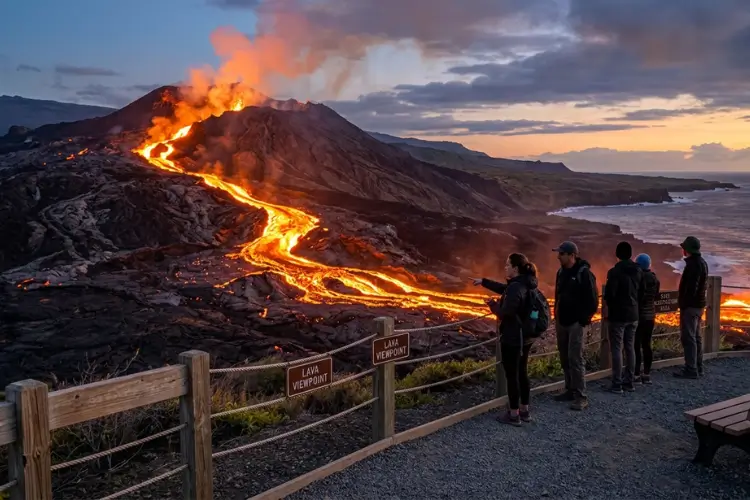
Kilauea has been one of the most consistently active volcanoes on earth for decades. When activity is happening at Halemaʻumaʻu crater, you can watch the glow from official overlooks along Crater Rim Drive, no hike required.
When surface flows are accessible and the park deems it safe, rangers open hiking access to the flow field itself. When lava reaches the ocean, licensed boat tours depart from Hilo Harbor and take you to within about 300 meters of the entry point, close enough to feel the scale of it, far enough to be safe.
Standing at the Chain of Craters overlook at night, with the road closed a couple hundred meters short of the flow, is still one of the most jaw-dropping things you can see for free.
Cost: Park entry is inexpensive. Boat and helicopter tours run $200-$400+ per person.
Difficulty: Easy (overlooks) to moderate (guided hikes).
Lava guarantee: Eruption-dependent. Check HVO before booking.
2. Reykjanes Peninsula, Iceland
Iceland turned an eruption into a national attraction, and it worked.
The Sundhnúksgígar crater row near Grindavik has erupted nine times since December 2023, with the eruption cycle continuing into 2025 before pausing in early 2026. When it’s active, you can hike marked trails to viewpoints over the lava field, or take a helicopter tour that flies directly over fresh flows and steaming fissures.
Even without flowing lava on a given day, you’ll still see black lava fields from the 2021-2025 eruptions up close, plus steaming vents and mineral-streaked ground. Iceland has also turned this same volcanic heat into one of its best renewable energy sources, powering most of the country through geothermal plants.
The simple fix if you’re planning around an active eruption? Don’t book more than a few weeks out, and always check safetravel.is before you go.
Cost: Self-guided hikes are free (parking fees apply). Helicopter tours run $300-$600+.
Difficulty: Easy to moderate hikes, no experience needed for helicopter tours.
Lava guarantee: Eruption-dependent, currently paused as of early 2026.
3. Stromboli, Italy
Stromboli has been erupting, gently and reliably, for centuries. Locals call it the Lighthouse of the Mediterranean because it’s basically never fully quiet.
You can view its rhythmic strombolian eruptions from a boat offshore at night, watching sparks arc against the dark water, or join a guided hike partway up the slope. Independent summit access is restricted for safety, but licensed guides run regular routes to approved viewpoints.
Cost: Boat tours from around $50-$80. Guided hikes vary by operator.
Difficulty: Moderate, guide required for hikes.
Lava guarantee: Very high. This is one of the most reliably active volcanoes on the list.
4. Mount Yasur, Vanuatu
Want lava with almost zero hiking effort? This is your volcano.
Mount Yasur, on Tanna Island, sits close enough to the access road that 4WD vehicles can get within 150 meters of the crater rim. From there, it’s about a 15-minute walk to the edge, where you can look directly down into an actively erupting crater throwing sparks and rock into the sky.
Here’s the catch: there are no safety rails at the rim. This is a spot where the terrain is forgiving but the exposure isn’t, so a guide and common sense both matter here.
Cost: Entry and guide fees typically $50-$100.
Difficulty: Easy access, but exposed terrain at the rim.
Lava guarantee: High. Yasur has been continuously active for generations.
5. Pacaya Volcano, Guatemala
Pacaya is proof that a great lava experience doesn’t require a plane ticket to the far side of the world if you’re already in Central America.
It’s a complex volcano just outside Guatemala City, easily reached on a day trip, with guided trails leading through old lava fields toward areas of ongoing activity. Depending on conditions, you may see glowing rock, steam vents, or an active flow front from a safe, marked distance.
Cost: Around $15-$40 for guided access.
Difficulty: Moderate, a few hours round trip.
Lava guarantee: Moderate, activity varies by season.
6. Acatenango, Guatemala (views of Fuego)
This one’s a little different: you’re not watching Acatenango erupt, you’re camping on it to watch its neighbor, Volcán de Fuego, do the erupting.
Fuego is one of the most consistently explosive volcanoes on earth, and from an overnight camp on Acatenango’s slopes, you get a front-row seat to its eruptions after dark, glowing rock arcing against the sky, from a genuinely safe distance. The trail climbs through pine forest before breaking into open volcanic slopes, a good reminder of just how many reasons forests are important to the ecosystems clinging to even the most active volcanoes.
The simple fix? Book with an operator who provides cold-weather gear. It gets brutally cold at altitude overnight, and that’s usually what catches first-timers off guard, not the volcano.
Cost: Guided overnight treks run $60-$150.
Difficulty: Hard, a strenuous multi-hour climb with an overnight camp.
Lava guarantee: High for Fuego’s eruptions, viewed from a distance.
7. Mount Etna, Italy
Etna is Europe’s most active volcano, and it’s set up for visitors in a way few others are.
Cable cars and 4WD vehicles carry you most of the way up, cutting the physical demand way down compared to most volcanoes on this list. From the upper slopes, guided groups can approach craters and, during active periods, view flowing lava and strombolian bursts.
Cost: Cable car and guide packages run roughly $70-$120.
Difficulty: Easy to moderate, most of the ascent is mechanized.
Lava guarantee: Moderate to high, Etna erupts frequently.
8. Nyiragongo, Democratic Republic of Congo
Nyiragongo holds one of the largest lava lakes on the planet, a genuinely permanent, churning pool of molten rock inside its summit crater.
Guided treks through Virunga National Park take you to the crater rim, where overnight camping lets you watch the lava lake glow and churn through the night, one of the rawest volcanic sights on earth.
Because: this one requires real planning. Access depends on the regional security situation, and trips should only be booked through Virunga National Park’s official tour program with an experienced operator.
Cost: Official Virunga treks run several hundred dollars, permits included.
Difficulty: Hard, multi-hour climb plus overnight camping at altitude.
Lava guarantee: Extremely high. This lava lake is essentially always active.
9. Erta Ale, Ethiopia
Erta Ale is the volcano that separates casual lava-watchers from serious ones.
Located in the Danakil Depression, one of the hottest, most remote places on earth, it holds a boiling lava lake that’s been active since the 1960s. Getting there means a roughly six-hour drive followed by a three-hour night ascent, almost always as part of a guided expedition.
This isn’t a spot for independent travel. Go with an experienced tour operator, follow their security and route guidance exactly, and treat the remoteness with the respect it deserves.
Cost: Multi-day expedition packages typically run $400-$900+.
Difficulty: Very hard, remote, hot, and physically demanding.
Lava guarantee: Extremely high. This lava lake has been active for over 60 years.
Compare All 9 Lava-Viewing Destinations
| Destination | Country | Guaranteed Lava | How to View | Approx. Cost | Difficulty |
| Hawaii Volcanoes NP | USA | Eruption-dependent | Overlook, hike, boat, helicopter | $0-$400+ | Easy-Moderate |
| Reykjanes Peninsula | Iceland | Eruption-dependent | Hike, helicopter | $0-$600+ | Easy-Moderate |
| Stromboli | Italy | Very high | Boat, guided hike | $50-$150 | Moderate |
| Mount Yasur | Vanuatu | High | Short walk to rim | $50-$100 | Easy (exposed rim) |
| Pacaya | Guatemala | Moderate | Guided hike | $15-$40 | Moderate |
| Acatenango (Fuego view) | Guatemala | High | Overnight guided trek | $60-$150 | Hard |
| Mount Etna | Italy | Moderate-High | Cable car + guided ascent | $70-$120 | Easy-Moderate |
| Nyiragongo | DR Congo | Extremely high | Multi-hour guided trek + camp | $300-$700+ | Hard |
| Erta Ale | Ethiopia | Extremely high | Multi-day expedition | $400-$900+ | Very Hard |
What “Blue Fire” Sites Like Kawah Ijen Actually Are
Quick myth-bust, because this trips up a lot of travelers.
Indonesia’s Kawah Ijen is famous for its glowing “blue lava,” and it’s genuinely stunning to see in photos. But here’s the truth: that blue glow isn’t lava at all. It’s sulfuric gas igniting as it escapes the volcano, burning with a blue flame in the dark.
Ijen is real, it’s active, and it’s worth visiting for the phenomenon and its striking turquoise acid lake. Just go in knowing you’re watching burning gas, not flowing molten rock, so your expectations match reality.
Real Accidents, and What They Teach You
Let’s stay honest for a second, because that’s what actually keeps you safe.
USGS records document real injuries and fatalities tied to lava viewing over the decades, almost always from the same handful of causes: falling on unstable ground, standing too close to a collapsing skylight, or crossing a barrier that was there for a reason. That 2003 case of a visitor sustaining burns across 8% of his body happened because he fell, not because he touched lava on purpose.
The pattern is consistent enough to draw one clear lesson: the walk in and out is more dangerous than the lava itself. Respect the terrain as much as you respect the heat.
Which One Should You Actually Pick
If this is your first lava trip, start with Hawaii or Iceland. Both have well-established infrastructure, ranger oversight, and multiple viewing methods to match your comfort level and budget.
If you want something more intense but still beginner-friendly, Mount Yasur or Stromboli deliver a genuinely dramatic show without a serious physical challenge.
And if you’re chasing the real bucket-list, hardcore experience? Nyiragongo and Erta Ale hold two of the most extraordinary lava lakes on earth, but they demand real planning, real fitness, and a trustworthy guide.
If earth’s extremes are what draw you in, this probably won’t be the last list like this you read. The same fascination that pulls people toward lava tends to pull them toward the windiest places in the world and the tallest mountains in the world too.
Wherever you go, the rule stays the same. The barrier is there for you, not to ruin your photo. Respect it, and lava viewing becomes one of the safest wild experiences you’ll ever have.