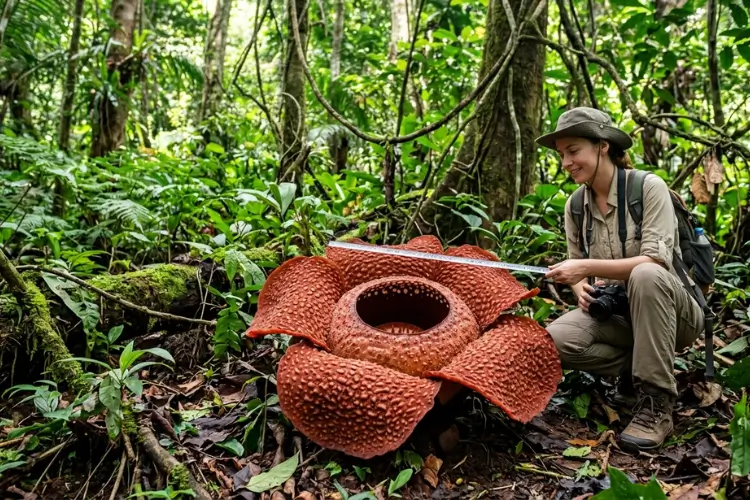
Quick answer: The biggest single flower in the world is Rafflesia arnoldii. It can grow up to 3.6 feet across and weigh as much as 24 pounds. But “biggest” gets complicated fast, because some record holders on this list aren’t technically one flower at all.
So what actually counts as the biggest flower on Earth?
It depends what you’re measuring. And almost nobody explains that clearly before throwing a list at you.
I’ve dug through the botanical records, the conservation data, and the actual measurements behind these plants, not just the recycled stats you’ll find on most “biggest flower” roundups. Here are 10 of the biggest flowers on Earth, what makes each one a genuine record holder, and which ones you could actually grow yourself.
What Actually Counts as the “Biggest” Flower?
Here’s the truth nobody tells you upfront: there are three different kinds of “biggest,” and mixing them up is why so many lists contradict each other.
A single flower is exactly what it sounds like. One bloom, one structure, no tricks. Rafflesia arnoldii wins this category outright.
An inflorescence is a cluster of many small flowers that grows and blooms together so tightly it looks and functions like one giant flower. The titan arum is the most famous example. It’s often called the “world’s largest flower,” but that’s not quite right. It’s the world’s largest unbranched inflorescence.
A flowering plant just means the tallest or largest overall plant that produces flowers, regardless of how big any single bloom is. A giant sunflower plant can tower over you at 12 feet, even though each individual flower head is nowhere near Rafflesia’s size.
Keep that distinction in mind as you read. It’s the difference between “biggest flower” being a fun fact and being an accurate one.
Nature does this to us constantly, by the way. We covered a similar mix-up in our piece on vegetables that are actually fruits, where the botanical definition and the everyday definition don’t match either.
The 10 Biggest Flowers on Earth, One by One
Here’s a closer look at each record holder, starting with the biggest single flower of them all.
1. Rafflesia arnoldii — Earth’s Biggest (and Smelliest) Single Flower
- Type: Single flower
- Max recorded size: 111 cm (3.6 ft) across, up to 11 kg (24 lb)
- Native range: Sumatra and Borneo, Indonesia and Malaysia
Rafflesia arnoldii doesn’t have leaves, roots, or a stem. It lives entirely inside the tissue of a host vine, invisible for most of its life, until it’s ready to bloom. Then it erupts, seemingly out of nowhere, into five fleshy, mottled petals that can weigh as much as a large dog.
How big does it actually get?
You’ll see its diameter cited anywhere from 100 to 111 cm depending on the source and the specimen measured. Guinness World Records’ verified specimen, discovered in West Sumatra, came in at 111 cm across. That’s the figure I’m using here, because it’s the one with an actual verified measurement behind it.
Why does it smell like rotting meat?
Because that’s exactly what it’s designed to smell like. Rafflesia has no nectar and no sweet scent to offer pollinators. Instead, it mimics the odor of decaying flesh to attract carrion flies, which land on the flower expecting a meal and end up covered in pollen instead.
Researchers at Harvard, working with Rafflesia specialist Charles Davis, have spent years studying how a plant related to tiny spurge-family flowers evolved into something this enormous. It’s one of the more genuinely strange stories in plant biology.
By the way: Rafflesia is also endangered. Habitat loss in Sumatra and Borneo is putting real pressure on where it can still grow.
2. Titan Arum (Amorphophallus titanum) — The Biggest Flower Cluster
- Type: Inflorescence
- Max recorded size: Up to 3 m (10 ft) tall
- Native range: Sumatra, Indonesia
The titan arum isn’t technically one flower. It’s thousands of tiny flowers packed into a single towering structure, acting as one.
That structure, called a spadix, is wrapped in a frilled, maroon-red petal-like sheath called a spathe. When it opens, usually for just 24 to 48 hours after years of growth, it’s genuinely one of the most dramatic sights in the plant world.
And yes, it smells like rotting flesh too. Same strategy as Rafflesia, different plant family entirely. When a titan arum blooms at a public garden, it draws crowds who line up for hours, because it might not bloom again for years.
3. Talipot Palm (Corypha umbraculifera) — The Biggest Branched Flower Cluster
- Type: Branched inflorescence
- Max recorded size: Up to 8 m (26 ft) tall
- Native range: South Asia and Southeast Asia
Here’s a flower that doesn’t look like a flower at all. It looks like a tree exploding.
The talipot palm grows for 30 to 80 years as an ordinary, if enormous, palm tree. Then, once in its entire life, it produces a single massive branching flower cluster that can reach 26 feet tall, the largest branched inflorescence of any plant on Earth.
The simple fix for remembering it? Think of it as a plant that spends its whole life saving up for one spectacular finale. Because after it flowers and fruits, the talipot palm dies.
4. Puya raimondii — The Tallest Flower Spike on Earth
- Type: Flower spike
- Max recorded size: Up to 15 m (49 ft) tall
- Native range: High Andes of Peru and Bolivia
Puya raimondii is sometimes called the “queen of the Andes,” and once you see one, you understand why.
This bromeliad grows for decades as a spiky rosette close to the ground. Then it sends up a flower spike that can reach nearly 50 feet, studded with thousands of individual blooms. It’s the tallest flowering structure of any plant species alive today.
It thrives at altitudes over 12,000 feet, which is not exactly a hospitable environment for most flowering plants. That alone makes it worth knowing about.
5. Giant Amazon Water Lily (Victoria amazonica) — The Biggest Flower on Water
- Type: Single flower
- Max recorded size: Up to 40 cm (16 in) across
- Native range: Amazon basin
This one’s famous for its leaves, which can grow over 8 feet wide and are strong enough to support a small child. But the flower itself deserves attention too.
Victoria amazonica blooms open white in the evening, smelling faintly of pineapple, then close the next morning and reopen deep pink the following night. It’s one of the few flowers on this list that actually changes color mid-bloom, and it does it as part of a clever pollination trick involving trapped beetles.
6. Pelican Flower (Aristolochia grandiflora) — The Flower With the Longest Single Petal
- Type: Single flower (calyx)
- Max recorded size: Sepal tail up to 4 m (13 ft) long
- Native range: Southern Mexico, Central America, and the West Indies
This is the record holder most people have never heard of.
The pelican flower’s bulbous body is only about 20 inches wide, but it trails a single sepal, technically not a petal, that can stretch up to 13 feet. That tail is the longest single floral structure of any flower on Earth.
Like the corpse flowers on this list, it also smells like rotting meat, and for the same reason. If you’re noticing a pattern here, you’re right. A lot of nature’s biggest flowers got that way by evolving to smell terrible.
7. Giant Sunflower — The Biggest Flower You Can Grow at Home
- Type: Flowering plant
- Max recorded size: Blooms up to 14 in across, plants up to 35.75 ft tall (current world record)
- Native range: Cultivated worldwide, native to North America
Now we’re getting into flowers you don’t need a rainforest expedition to see.
Giant sunflower cultivars, particularly Russian varieties, commonly top 12 to 20 feet in home gardens, but the current world record stands at 10.90 m (35 ft 9 in), grown by Alex Babich in Fort Wayne, Indiana, and verified by Guinness World Records in September 2025. If you’re measuring by “the biggest flowering plant a regular person can grow in their backyard,” this is your answer.
They need 6 to 8 hours of direct sun daily and rich, well-draining soil. Plant in spring, harvest by late summer. It’s genuinely one of the more satisfying things you can grow, watching a single seed become a plant taller than your house.
8. Dinner Plate Dahlia — The Biggest Bloom for a Backyard Garden
- Type: Single flower
- Max recorded size: 10 to 14 in across
- Native range: Cultivated garden variety
If a giant sunflower feels like too much commitment, dinner plate dahlias are the more manageable giant.
Named for exactly what you’d expect, these dahlias produce blooms that commonly measure 10 to 14 inches across, roughly the size of an actual dinner plate. The variety ‘Emory Paul’ is particularly celebrated for its fuchsia color and record-setting size.
Plant tubers in spring after the last frost, in full sun with well-draining soil. Stake them early. Those stems can reach 4 to 5 feet and won’t always hold up the weight of a flower that big on their own.
9. Southern Magnolia — The Biggest Flower on North America’s Oldest Flowering Tree
- Type: Single flower
- Max recorded size: Up to 12 in across
- Native range: Southeastern United States
Magnolias are believed to be one of the earliest flowering plants on Earth, with fossil evidence dating back around 100 million years. That’s nothing compared to some of the world’s oldest living trees, but it’s still enough to make magnolias one of the true elders of the flowering plant world.
Because magnolias evolved before bees existed, their flowers developed to be pollinated by beetles instead, which is part of why they don’t have true petals and sepals. They have petal-like tepals, tougher and more durable, built to survive being crawled over.
Southern magnolia (Magnolia grandiflora) produces creamy white blooms that can reach 12 inches across, with a fragrance so distinct it’s practically a regional signature across the American South.
10. King Protea — South Africa’s Giant National Flower
- Type: Flower head
- Max recorded size: Up to 12 in across
- Native range: South Africa
The king protea earns its name. It’s the largest species in the entire protea family and South Africa’s national flower.
What looks like one giant bloom is actually a dense head of small true flowers surrounded by large, colorful bracts, similar in structure to a sunflower’s design, just on a bigger and showier scale. Blooms can reach up to 12 inches across, in shades ranging from soft pink to deep crimson.
It’s built for a harsh environment too. King proteas are adapted to South Africa’s fynbos region, which sees regular wildfires, and the plant has evolved a thick underground rootstock that survives fire and resprouts afterward.
The Biggest Flowers on Earth
Here’s how they stack up side by side:
| Flower | Type | Max Recorded Size | Native Region |
| Rafflesia arnoldii | Single flower | 111 cm (3.6 ft) across, up to 11 kg (24 lb) | Sumatra & Borneo, Indonesia |
| Titan arum | Inflorescence | Up to 3 m (10 ft) tall | Sumatra, Indonesia |
| Talipot palm | Branched inflorescence | Up to 8 m (26 ft) tall | South Asia, Southeast Asia |
| Puya raimondii | Flower spike | Up to 15 m (49 ft) tall | Andes (Peru & Bolivia) |
| Giant Amazon water lily | Single flower | Up to 40 cm (16 in) across | Amazon basin |
| Pelican flower | Single flower (sepal) | Sepal tail up to 4 m (13 ft) long | Central America, Mexico |
| Giant sunflower | Flowering plant | Blooms up to 14 in, plant up to 35.75 ft tall (record) | Cultivated worldwide, native to N. America |
| Dinner plate dahlia | Single flower | 10 to 14 in across | Cultivated garden variety |
| Southern magnolia | Single flower | Up to 12 in across | Southeastern United States |
| King protea | Flower head | Up to 12 in across | South Africa |
Biggest Flower vs. Biggest Flowering Plant vs. Biggest Inflorescence: Quick Comparison
Because it’s worth repeating, since it’s the single most confused point in every “biggest flower” list online:
- Biggest single flower: Rafflesia arnoldii
- Biggest inflorescence (unbranched): Titan arum
- Biggest inflorescence (branched): Talipot palm
- Tallest flower spike: Puya raimondii
- Longest single floral structure: Pelican flower
- Biggest flower a home gardener can grow: Giant sunflower or dinner plate dahlia
Different question, different answer. Now you know which one you’re actually asking.
Which of These Could You Actually Grow?
Most of this list will never show up in a backyard. Rafflesia needs a rainforest host vine. Puya raimondii needs the high Andes. The titan arum needs years of patient greenhouse cultivation just to bloom once.
But two of these giants are genuinely within reach.
Giant sunflowers and dinner plate dahlias are both things you can plant this spring with nothing more than a sunny patch of soil and some patience. You won’t set a world record. But you will end up with something in your own garden that makes people stop and stare, which, honestly, is the whole appeal of a giant flower in the first place.
If record-breaking nature is your thing, it doesn’t stop at flowers. Go take a look at the largest insects in the world, or browse some random animal facts that may surprise you for more of the same “wait, really?” feeling this list probably gave you.