
Sustainable travel is a way of traveling that reduces harm to the environment, respects local cultures, and keeps money in local communities, so destinations stay healthy for the people who live there and for future visitors.
It rests on three pillars: environmental, social, and economic.
In practice, that means lower-carbon transport, locally owned places to stay, traveling off-peak, and spending your money with local businesses.
Why does it matter? Because tourism produced 8.8% of global greenhouse gas emissions in 2019, and that share keeps growing.
TL;DR
- Sustainable travel = traveling in a way that protects nature, respects local people, and supports local economies.
- The 3 pillars: environmental, social/cultural, and economic.
- The biggest lever is transport. It makes up about 72% of the CO2 from overnight tourism.
- Most travelers care: 85% say sustainable travel is important to them (Booking.com, 2026).
- No trip is 100% sustainable. But small, smart choices add up fast.
I Used to Think Sustainable Travel Meant Reusing Hotel Towels
For years, I thought I was a pretty green traveler.
I skipped the daily towel change. I carried a reusable water bottle. I felt good about it.
Then I learned where a trip’s emissions actually come from.
One long-haul flight outweighs a lifetime of reused towels. By a lot.
Here’s the truth nobody tells you:
Most “eco travel tips” focus on the small stuff. The big stuff is where the real impact lives.
So in this guide, I’ll walk you through what sustainable travel actually means, why it matters, and which changes are worth your energy. Ranked by impact, not by how good they look on Instagram.
What Is Sustainable Travel?
Sustainable travel means exploring the world in a way that leaves places as good as you found them, or better.
It covers three things at once: the planet, the people, and the local economy.
The Official Definition
UN Tourism (formerly the UNWTO) defines sustainable tourism as tourism that fully accounts for its current and future economic, social, and environmental impacts, while meeting the needs of visitors, the travel industry, the environment, and host communities.
That’s a mouthful.
My plain-English version: travel in a way the place would be glad you came.
What Sustainable Travel Looks Like in Real Life
Sustainable travel isn’t a special kind of trip. It applies to every trip.
A few examples:
- A weekend getaway: You take the train instead of driving solo, stay at a family-run inn, and eat at the farmers’ market.
- A national park trip: You book a timed-entry slot, stick to marked trails, and pack out everything you pack in.
- An international vacation: You fly nonstop, stay two weeks instead of four days, hire a local guide, and visit in shoulder season.
Same trips. Smaller footprint. Often a better experience, too.
Sustainable Travel vs. Sustainable Tourism vs. Ecotourism vs. Responsible Travel
These terms get mixed up constantly. Here’s the simple difference:
Sustainable tourism describes how the industry operates. Responsible travel describes how you, the traveler, behave.
| Term | Who it describes | Applies to | Main focus | Example |
| Sustainable travel | You, the traveler | Any trip | Planet + people + local economy | Taking the train and staying somewhere locally owned |
| Sustainable tourism | The travel industry and destinations | Any destination | Managing long-term impacts | A city limiting cruise ship arrivals |
| Ecotourism | Travelers and operators | Nature-based trips only | Conservation and education | A guided stay at a rainforest lodge |
| Responsible travel | You, the traveler | Any trip | Your personal choices and behavior | Asking before photographing people |
| Regenerative travel | Travelers and destinations | Any trip | Leaving places better than before | Joining a reef restoration day |
By the way: Ecotourism is one type of sustainable travel. But sustainable travel isn’t limited to jungles and coral reefs. A city break in Chicago can be sustainable, too.
The 3 Pillars of Sustainable Travel
Sustainable travel rests on three pillars: environmental, social and cultural, and economic.
Think of them like a three-legged stool.
Knock one out, and the whole thing wobbles.
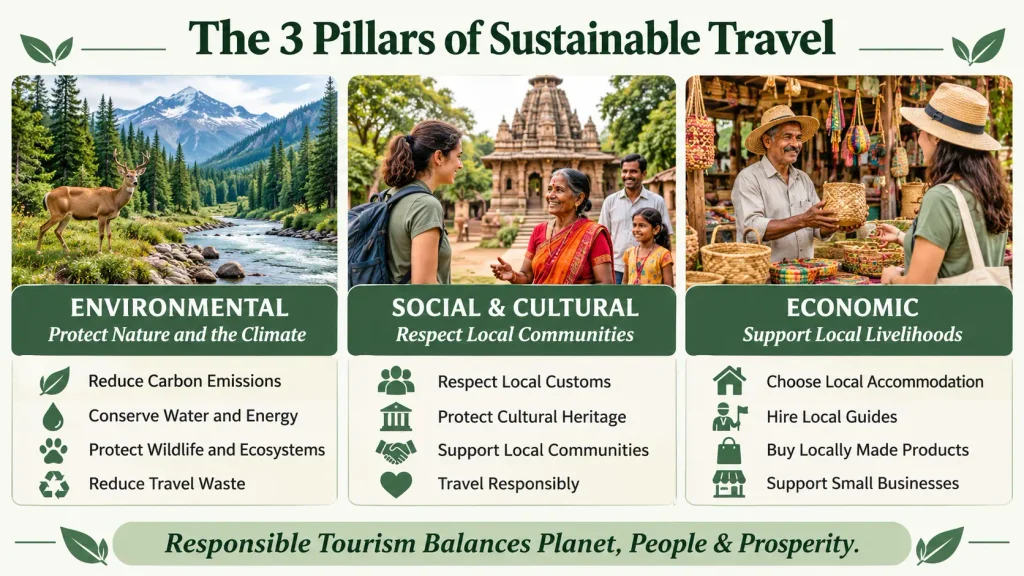
1. Environmental: Protecting Nature and the Climate
This is the pillar most people think of first.
It’s about cutting your carbon emissions, reducing waste, conserving water and energy, and protecting wildlife and ecosystems.
Wondering why water conservation matters on a trip? Many popular destinations face water stress, especially in peak season.
What it looks like:
- Choosing trains or buses over short flights
- Staying on trails and following Leave No Trace principles
- Skipping wildlife experiences that involve riding, holding, or feeding animals
2. Social and Cultural: Respecting the People Who Live There
Every destination is someone’s home.
This pillar is about respecting local customs, protecting cultural heritage, and making sure tourism improves life for residents instead of pushing them out.
What it looks like:
- Learning a few words of the local language
- Dressing and behaving respectfully at religious and cultural sites
- Avoiding overcrowded hotspots at peak times
3. Economic: Keeping Your Money Local
Where your money goes matters as much as where you go.
When you book with international chains, a big share of what you spend can flow out of the destination. When you spend locally, it stays.
What it looks like:
- Staying at locally owned guesthouses or B&Bs
- Hiring local guides
- Buying souvenirs made by local artisans (not imported trinkets)
Why Sustainable Travel Matters (By the Numbers)
Sustainable travel matters because tourism is huge, it’s growing fast, and its footprint is bigger than most people think.
📊 Sustainable Travel Stats at a Glance
| Stat | Source |
| Tourism caused 8.8% of global greenhouse gas emissions in 2019 | Nature Communications, 2024 |
| Tourism emissions grew about 3.5% per year, roughly twice as fast as the global economy | Nature Communications, 2024 |
| 20 countries produce about three-quarters of tourism emissions | Nature Communications, 2024 |
| 1.52 billion international tourist arrivals in 2025, a post-pandemic record | UN Tourism, 2026 |
| 85% of travelers say sustainable travel is important to them | Booking.com, 2026 |
| 100 million room nights booked at third-party certified properties on Booking.com in 2025 | Booking.com, 2026 |
Tourism’s Climate Footprint Is Bigger Than You Think
A major 2024 study in Nature Communications found that tourism’s share of global emissions rose from 7.3% in 2009 to 8.8% in 2019.
That’s a 40% increase in a decade.
And the researchers found the sector has made little real progress on decarbonizing. More trips are simply adding more emissions.
Overtourism Is Changing How Locals Feel About Visitors
Too many visitors in the same place at the same time creates real problems.
Traffic. Litter. Crowding. Rising rents.
In Booking.com’s 2025 research, travelers themselves named these as downsides of tourism where they live. The good news? More travelers are adjusting: 39% said they look for advice on visiting at other times of year, and 36% choose alternative destinations to avoid crowds.
Travelers Want to Do Better (But Often Don’t Know How)
Here’s the interesting part.
Booking.com’s 2026 report, based on 32,500 travelers across 35 markets, found a “generational paradox.” Younger travelers express stronger intentions to travel sustainably. But older travelers actually take more concrete actions.
The gap isn’t about caring.
It’s about knowing what to do.
That’s exactly what the rest of this guide is for.
Where Your Trip’s Footprint Actually Comes From
Transportation is typically the biggest source of a trip’s carbon footprint.
Research by Peeters and Dubois found transport accounts for about 72% of the CO2 emissions from overnight tourism. For international trips, most of that comes from flying.
| Part of your trip | Typical impact | Why | Your biggest lever |
| Getting there | 🔴 Very high | Flights, especially long-haul, burn huge amounts of fuel | Fly less, fly nonstop, take trains |
| Where you stay | 🟠 Medium | Energy, water, laundry, AC | Choose certified or locally owned lodging |
| What you eat | 🟠 Medium | Imported food and meat-heavy meals | Eat local and plant-forward |
| Getting around | 🟡 Low to medium | Rental cars vs. transit | Walk, bike, use public transit |
| Activities | 🟡 Varies | Jet skis vs. hiking | Choose low-impact, locally run experiences |
| Waste and souvenirs | 🟢 Low (but visible) | Single-use plastics, imported goods | Refill, reuse, buy local crafts |
The simple fix?
Start at the top of this table. Not the bottom.
How to Travel Sustainably: 10 Steps Ranked by Impact
These steps are ranked from biggest impact to smallest.
Do the first three, and you’ve already done more than most “eco travelers.”
1. Fly less, and fly smarter
Flying is usually the single largest part of your travel footprint.
When you do fly, choose nonstop routes (takeoffs burn a lot of fuel), fly economy (more people share the emissions), and compare flights using the CO2 estimates shown in Google Flights. Taking one longer trip instead of three short ones also makes a big difference.
2. Take the train or bus when you can
For short and medium distances, ground transport wins.
The European Environment Agency found that rail is the greenest motorized way to travel in Europe, with far lower greenhouse gas emissions per passenger-kilometer than flying. In the US, routes like Amtrak’s Northeast Corridor make city-to-city trips easy without a plane or a car.
3. Stay longer and travel slower
Fewer trips, longer stays.
Slow travel spreads the emissions of getting there across more days of actual experience. You also spend more locally, see more, and come home less exhausted.
4. Choose certified or locally owned places to stay
Look for real certifications, not vague “eco” labels.
Certifications recognized by the Global Sustainable Tourism Council (GSTC) are a good starting point. Family-run guesthouses and B&Bs also keep more of your money in the community.
5. Travel off-peak and off the beaten path
Shoulder season helps everyone.
You get lower prices and fewer crowds. Locals get relief from peak-season pressure. Consider a “second city” instead of the most famous one.
6. Eat local and eat more plants
Food is a quiet but real part of your footprint.
Local, seasonal, and plant-forward meals typically have a lower impact than imported, meat-heavy ones. They’re also usually the best meals of the trip.
And the benefits of eating locally grown food go beyond flavor. Your money supports local farmers, too.
7. Spend with local businesses and guides
Your money is a vote.
Hire local guides, eat at independent restaurants, and book tours with operators based in the destination.
8. Get around like a local
Once you arrive, ditch the rental car if you can.
Walk, bike, or use public transit. Many cities now have bike share and easy transit passes for visitors. If you do need a car, an electric or hybrid rental is a better pick than a standard gas model. Not sure which? Here’s how electric vs hybrid cars compare.
9. Protect nature everywhere you go
Follow Leave No Trace principles.
Stay on marked trails, pack out your trash, keep your distance from wildlife, and never feed animals. Skip any wildlife attraction that lets you ride, hold, or pose with wild animals.
10. Cut single-use waste
Small, but it adds up.
Pack a reusable bottle, a tote bag, and a utensil kit. Skip single-use toiletries and pack a few zero waste bathroom swaps instead. It’s the easiest habit on this list.
Want the full packing checklist? My zero waste travel tips walk you through it.
Sustainable Travel Examples From Around the World
Sustainable travel isn’t theory. Destinations everywhere are already putting it into practice.
In the USA
- Amtrak: Scenic long-distance routes like the Coast Starlight turn the journey itself into part of the trip.
- National park reservation systems: Some of the busiest parks, such as Arches and Rocky Mountain, have used timed-entry or reservation systems in peak season to reduce crowding. Always check NPS.gov before you go.
- Hawaii: The state has introduced a “green fee” through its lodging tax to fund climate resilience and natural resource protection, and has encouraged visitors to give back through volunteer programs.
Around the World
- Copenhagen, Denmark: The CopenPay initiative rewards visitors with perks like free activities or meals for green actions such as cycling or picking up litter.
- Bhutan: Visitors pay a Sustainable Development Fee per night, which funds conservation, health, and education.
- Palau: Visitors sign the Palau Pledge, a promise stamped into their passport to protect the island’s environment.
- Venice, Italy: A day-tripper access fee on peak days aims to manage overcrowding in the historic center.
Honest Trade-offs: Cost, Carbon Offsets, and Greenwashing
Let’s talk about the stuff most guides skip.
Is Sustainable Travel More Expensive?
Sometimes. But often it’s cheaper.
Off-season travel, public transit, local guesthouses, and street food are usually less expensive than the alternatives. Where it can cost more: trains on some long routes, certified eco-lodges, and fewer (but longer) trips.
And cost is a real barrier. In Booking.com’s 2026 research, 47% of travelers said discounts and financial incentives would most encourage them to make more sustainable choices.
Do Carbon Offsets Actually Work?
Some do. Many don’t do as much as they claim.
Investigations in recent years have found that some offset credits, especially certain forest-protection projects, overstated their climate benefit.
My rule: Reduce first. Offset last.
If you do offset, choose projects with strong, independent verification, and treat it as a bonus, not a permission slip to fly more.
How to Spot Greenwashing
If a hotel says “eco” but can’t tell you how, be skeptical.
Red flags:
- Vague claims like “eco-friendly” or “green” with no details
- The only “sustainability” effort is the towel card
- A certification you can’t find or verify online
What to look for instead:
- A certification recognized by GSTC (check the GSTC website)
- Specific, measurable actions: solar power, local hiring, water recycling, no single-use plastics
- Staff who can actually answer your questions
Same Trip, Two Ways: What Actually Changes
What does sustainable travel look like side by side?
Here’s the same European vacation planned two different ways.
| Typical trip | Sustainable version | |
| Length | 4 days, 3 cities | 10 days, 2 cities |
| Getting there | Connecting flights | Nonstop flight |
| Between cities | Short-haul flight | Train |
| Getting around | Taxis and rideshares | Walking, transit, bike share |
| Where you stay | International chain hotels | Family-run guesthouses |
| When you go | Peak summer | Shoulder season (May or September) |
| Carbon impact | Higher | Noticeably lower |
| How it feels | Rushed and tiring | Slower and more connected |
Three lessons from this comparison:
- The train ride often becomes a highlight, not just a way to get from A to B.
- Local hosts give better tips than any app, and your money stays in the community.
- Shoulder season saves money, so the longer trip can cost less than you’d expect.
Key Takeaways
- Sustainable travel means protecting nature, respecting people, and supporting local economies.
- Tourism produced 8.8% of global emissions in 2019, and the number is growing.
- Transport is your biggest lever. Start there, not with the towels.
- Slower, longer, local trips are often better and cheaper.
- Be skeptical of “eco” labels. Look for real certifications and specifics.
So where do you start?
Pick one change for your next trip.
Just one.
Maybe it’s a train instead of a short flight. Maybe it’s a family-run guesthouse. Maybe it’s traveling in September instead of July.
Then build from there. That’s how all lasting sustainable habits start. 🌍