The biggest sustainable fashion myths? That it’s too expensive, that your donated and recycled clothes get a second life, and that buying “eco” brands is the best fix.
Here’s the truth nobody tells you:
The most sustainable piece of clothing is the one already in your closet.
Less than 1% of clothing material gets recycled into new clothes. And even the famous “fashion causes 10% of global emissions” stat is shaky. The UN’s own English-language estimate is 2 to 8%.
Below, I’ve graded 10 common myths with a clear verdict, the data behind each one, and what to do instead.
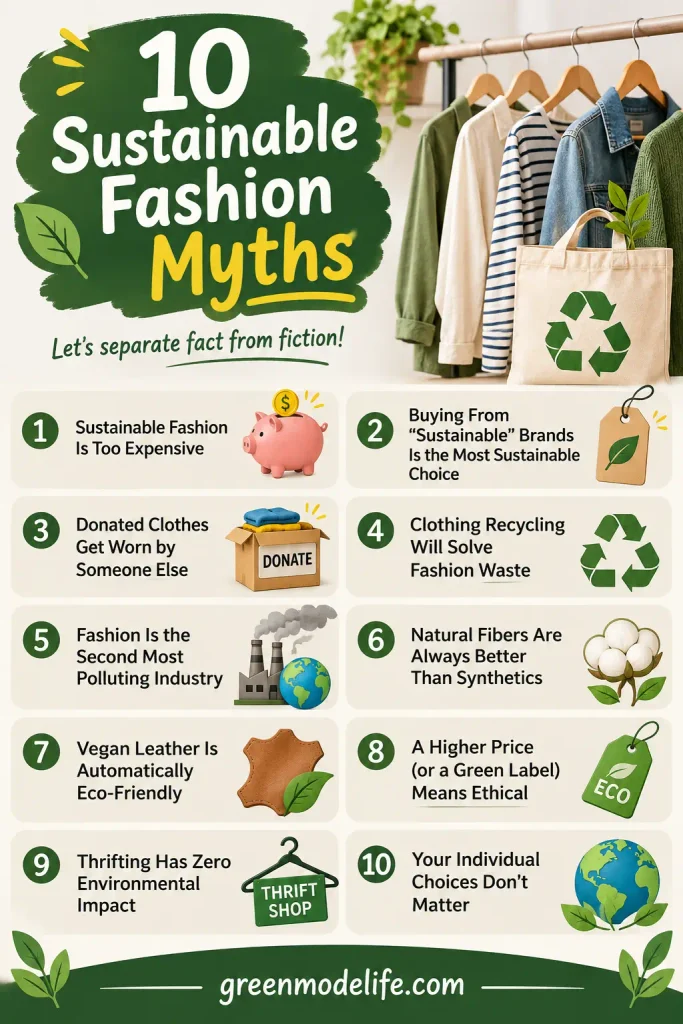
The Quick Verdict: 10 Sustainable Fashion Myths at a Glance
| # | Myth | Verdict | The truth in one line |
| 1 | Sustainable fashion is too expensive | Mostly False | Wearing, repairing and buying secondhand cost less than fast fashion per wear |
| 2 | Buying from “sustainable” brands is the best choice | False | Buying less beats buying “better” |
| 3 | Donated clothes get worn by someone else | Mostly False | A large share is exported, downcycled or thrown away |
| 4 | Clothing recycling will solve fashion waste | False (for now) | Less than 1% of clothing material becomes new clothing |
| 5 | Fashion is the second most polluting industry | False | No credible ranking exists, and the “10%” stat is disputed |
| 6 | Natural fibers are always better | Half-True | Every fiber has trade-offs; how long you wear it matters most |
| 7 | Vegan leather is automatically eco-friendly | Half-True | Many vegan leathers are plastic |
| 8 | A higher price or green label means ethical | False | Price and vague labels prove nothing |
| 9 | Thrifting has zero environmental impact | Half-True | Secondhand overbuying is still overbuying |
| 10 | Your individual choices don’t matter | False | Shoppers are already reshaping the market |
Sustainable Fashion by the Numbers
- 2 to 8% of global greenhouse gas emissions come from the fashion industry (UNEP)
- Less than 1% of old clothing is used to make new clothing (Ellen MacArthur Foundation)
- 73% of the materials used to make clothing are landfilled or burned at end of life (Ellen MacArthur Foundation)
- 36% fewer wears per garment than 15 years earlier (Ellen MacArthur Foundation)
- $55.5 billion spent on secondhand fashion in the US in 2025, about 12% of total apparel spend (ThredUp 2026 Resale Report)
What Is Sustainable Fashion, Really?
Sustainable fashion is clothing designed, made, used and disposed of in ways that reduce environmental harm and treat workers fairly across the whole lifecycle, not just the fabric.
That last part matters.
Because: Most myths come from looking at one slice of the lifecycle (the price tag, the fabric, the donation bin) and ignoring the rest.
So let’s look at the whole picture.
10 Sustainable Fashion Myths, Debunked
Here’s each myth, its verdict, the data behind it, and what to do instead.
Myth 1: Sustainable Fashion Is Too Expensive
Verdict: Mostly False
Sustainable fashion is only expensive if you think it means buying new clothes from eco brands.
That’s one option. It’s also the smallest one.
When I first started, I assumed I’d have to replace my whole closet with $80 organic tees.
What actually worked? Wearing what I already owned. That cost me nothing.
The cheapest sustainable options are:
- Wearing what you own (free)
- Repairing (a sewing kit costs less than one fast fashion top)
- Swapping with friends or at community swaps (free)
- Buying secondhand (often cheaper than new fast fashion)
The cost-per-wear math
Here’s where “expensive” falls apart.
| Durable jeans | Fast fashion jeans | |
| Price | $90 | $25 |
| Times worn before worn out | 150 | 15 |
| Cost per wear | $0.60 | $1.67 |
Illustrative example. Your numbers will vary, but the pattern holds.
The “cheap” option costs almost three times more every time you wear it.
And by the way:
Quality pieces keep resale value. According to ThredUp’s 2026 Resale Report, half of younger shoppers have cut back on low-quality clothing because it’s worth almost nothing secondhand.
What to do instead:
- Track cost per wear, not price tags
- Shop your closet before any store
- When you buy new, buy things you’ll wear 30+ times
Myth 2: Buying From “Sustainable” Brands Is the Most Sustainable Choice
Verdict: False
A new organic cotton shirt is still a new shirt.
It still needs raw materials, water, energy, dyeing, shipping and packaging.
Here’s the real problem:
Global clothing production roughly doubled between 2000 and 2015, while the number of times each garment gets worn fell by about 36%, according to the Ellen MacArthur Foundation.
That’s not a fabric problem.
It’s a volume problem.
The simple fix?
Use the “Buyerarchy of Needs,” created by illustrator Sarah Lazarovic:
- Use what you have
- Borrow
- Swap
- Thrift
- Make
- Buy (last)
What to do instead:
- Treat buying new, even from eco brands, as the last step, not the first, and use a simple zero waste shopping guide when you do
- Wait 30 days before buying anything non-essential
- Buy from sustainable brands for true gaps, not for a “sustainable wardrobe makeover”
Myth 3: Donated Clothes Get Worn by Someone Else
Verdict: Mostly False
I used to feel great dropping a bag at the donation bin.
Then I learned what happens next.
Charity shops can’t sell everything they receive. Much of what’s left gets sold to textile brokers, baled, and shipped overseas.
One major destination is Kantamanto Market in Accra, Ghana, one of the world’s largest secondhand clothing markets. Traders there repair, dye and resell an enormous amount.
But: The Or Foundation estimates roughly 40% of that clothing leaves the market as waste. Much of it ends up in informal dumps and on beaches.
That figure is disputed. A report from the Ghana Used Clothing Dealers Association put waste at under 5% of imported clothing, and an earlier Or Foundation study also found only about 4% of an incoming bale was unusable. Part of the gap comes down to definitions: one number counts what’s unusable in the bale, the other counts what vendors can’t sell.
Either way, the direction is clear.
Donating clothes doesn’t erase them. It relocates them.
What to do instead:
- Resell good-condition pieces yourself (Poshmark, Depop, ThredUp, local consignment)
- Give directly to people who need them: shelters, refugee groups, friends
- Only donate clean, wearable items; torn or stained clothes are more likely to be discarded
- The best donation strategy is buying less in the first place
Myth 4: Clothing Recycling Will Solve Fashion Waste
Verdict: False (for now)
Clothing recycling sounds like a clean fix.
The reality is sobering.
- Less than 1% of old clothing is used to make new clothing (Ellen MacArthur Foundation)
- In the US, clothing and footwear waste grew from about 1.4 million tons in 1960 to over 13 million tons in 2018, and around 70% of it was landfilled (US EPA)
Why so low?
Most clothes are blends (cotton plus polyester plus elastane). Separating those fibers is hard, expensive and still mostly experimental.
What gets “recycled” is usually downcycled into rags, insulation or stuffing.
And “recycled polyester”? It’s mostly made from plastic bottles, not old clothes.
Recycling can’t fix a problem that starts with overproduction.
What to do instead:
- Treat recycling as the last option, after wearing, repairing and reselling
- Choose single-fiber garments (100% cotton, 100% wool) when you do buy; they’re easier to recycle
- Use textile recycling drop-offs only for items truly past saving
Myth 5: Fashion Is the Second Most Polluting Industry
Verdict: False (but the impact is real)
You’ve probably seen this one.
“Fashion is the second most polluting industry in the world, after oil.”
It’s everywhere.
And there’s no credible study that ranks industries this way.
Where the “10% of emissions” number actually came from
This one surprised me.
An analysis by textile industry expert Lutz Walter traced the popular 10% figure back to a 2018 UNEP story. The English version said fashion produces 2 to 8% of global carbon emissions. But the French, Spanish and Russian versions of the same article said 10%.
A translation difference became a global “fact.”
Here’s what credible estimates actually say:
| Source | Estimate of fashion’s share of global emissions |
| UNEP | 2 to 8% |
| McKinsey and Global Fashion Agenda, Fashion on Climate | About 4% |
So why does this matter?
Because inflated stats give critics an easy excuse to dismiss the whole issue.
And the real impact is already big enough. UNEP notes the industry accounts for 24% of insecticide use and 11% of pesticide use worldwide.
You don’t need to exaggerate a problem that large.
What to do instead:
- Use “2 to 8%” (UNEP) when you share fashion’s climate impact
- Check the original source before reposting any fashion stat
- Focus on fashion’s water, waste and microplastic impact, which are well documented
Myth 6: Natural Fibers Are Always Better Than Synthetics
Verdict: Half-True
Natural fibers biodegrade more easily. Synthetics shed microplastics.
That part is true.
But “natural” doesn’t mean low-impact. Conventional cotton, for example, is water and pesticide intensive.
Here’s how common fibers compare:
| Fiber | Pros | Cons |
| Conventional cotton | Biodegradable, breathable | Heavy water and pesticide use |
| Organic cotton | No synthetic pesticides | Still water intensive; lower yields |
| Polyester | Durable, cheap | Made from fossil fuels; sheds microfibers |
| Recycled polyester | Reuses plastic bottles | Still sheds microfibers; rarely recycled again |
| Wool | Very durable, needs less washing | Land use and animal welfare concerns |
| Lyocell (e.g. Tencel) | Wood-based; closed-loop solvent process | Quality varies by producer |
| Linen and hemp | Low water and pesticide needs | Wrinkles; can cost more |
Here’s the truth:
The most sustainable fabric is the one you’ll wear the longest.
A polyester rain jacket worn for 10 years can beat a cotton top worn 5 times.
What to do instead:
- Ask “How long will I wear this?” before “What’s it made of?”
- Wash synthetics less often, in cold water, and consider a microfiber-catching wash bag (more zero waste laundry tips here)
- Avoid blends when you can; they’re harder to recycle
Myth 7: Vegan Leather Is Automatically Eco-Friendly
Verdict: Half-True
“Vegan” tells you what a product isn’t made of.
It doesn’t tell you what it is made of.
Many vegan leathers are polyurethane (PU) or PVC. That’s plastic.
Plant-based options (made from things like cactus, apple waste or mushrooms) are improving. But many still use plastic coatings or binders to make them durable.
Animal leather has its own issues: cattle farming emissions and chemical-heavy tanning.
So which wins?
It depends on one thing: how long it lasts.
A cheap PU jacket that peels in a year isn’t a green choice. Neither is a leather bag you never use.
What to do instead:
- Buy secondhand leather or vegan leather; no new production needed
- Keep real leather going for years with a homemade leather conditioner
- Check the full material breakdown, not just the “vegan” tag
- Choose the option you’ll use for years
Myth 8: A Higher Price (or a Green Label) Means Ethical
Verdict: False
Price tells you what a garment costs, not how it was made.
Luxury and mid-price brands often use the same global supply chains as cheaper labels. A bigger price tag can reflect branding, materials or margins. It doesn’t prove fair wages, lower impact or genuinely ethical fashion practices.
And vague labels like “eco,” “conscious” or “green”?
They often mean nothing at all. In the US, the FTC’s Green Guides warn marketers against broad, unqualified environmental claims like these.
Here’s what the real certifications actually cover:
| Label | What it actually checks |
| GOTS | Organic fiber content plus environmental and social criteria in processing |
| Fair Trade Certified | Worker conditions and fair pay at certified factories |
| OEKO-TEX Standard 100 | Tested for harmful substances (a safety label, not a sustainability label) |
| bluesign | Chemical and resource management in production |
| B Corp | Company-wide social and environmental performance |
What to do instead:
- Trust specific, verifiable claims over vague ones
- Check what a certification covers; it’s usually narrower than the marketing suggests
- Look up brands on rating tools like Good On You
Myth 9: Thrifting Has Zero Environmental Impact
Verdict: Half-True
Secondhand is almost always better than buying new.
But it isn’t impact-free.
A 2025 study in Scientific Reports found that many secondhand fashion shoppers show the same patterns as fast fashion shoppers: frequent buying, trend chasing and quick turnover.
Thrift hauls. Shipping from resale apps. Buying things “because they’re only $4.”
It adds up.
Secondhand is better than new, but buying less is better than both.
What to do instead:
- Shop secondhand with a list, not for entertainment
- Apply the same 30-wear test you’d use for new clothes
- Bundle resale purchases to cut shipping
Myth 10: Your Individual Choices Don’t Matter
Verdict: False
It’s easy to feel tiny next to a global industry.
But look at what shoppers have already done.
In 2025, Americans spent $55.5 billion on secondhand clothing, footwear and accessories, about 12% of all apparel spend, according to ThredUp’s 2026 Resale Report. Around 60% of Americans bought something secondhand.
Brands noticed.
Big retailers are now offering in-store repairs to win over younger shoppers.
Policy is moving too. California’s Responsible Textile Recovery Act (SB 707), signed in 2024, is the first US law that makes clothing producers fund and run a statewide program to collect, repair, reuse and recycle textiles.
None of that happened in a vacuum.
It happened because enough people changed what they bought, wore and asked for.
What to do instead:
- Keep your everyday sustainable habits simple and consistent; that’s what shifts demand
- Ask brands directly about their factories and materials
- Share accurate information (like this article’s sources) instead of scary stats
How to Spot a Sustainable Fashion Myth: A 5-Question Check
So how do you avoid getting fooled next time?
Run any claim, ad or viral stat through these five questions:
- Is the claim specific? “Made with 100% GOTS-certified organic cotton” means something. “Eco-friendly” doesn’t.
- Who verified it? Look for a named third-party certification, and check what it covers.
- Is the full supply chain visible? Transparent brands name their factories and publish supplier lists.
- How much of the business does it cover? A “conscious collection” can be a tiny slice of a huge fast fashion catalog.
- Is the business model built on volume? If a brand drops new styles every week, no fabric choice fixes that.
For stats, add one more step: click through to the original source. You’ll be surprised how often it doesn’t say what the headline says. (The same check works on common zero waste myths too.)
What Actually Worked When I Changed My Wardrobe
I’m not perfect at this.
Nobody is.
But a few simple habits made a bigger difference than any “eco” purchase ever did.
- A 30-day no-buy. It showed me how much I bought out of boredom.
- A closet count. Every item, on the bed. Eye-opening.
- A wear tracker. I noted what I actually wore for a month. A surprising chunk of my closet never left the hanger.
- A basic repair kit. Needle, thread, buttons, patches. Most fixes took under 10 minutes.
- Reselling instead of dumping. Good pieces went online, and the money funded my few real gaps.
What didn’t work?
My first move was buying a stack of “eco” basics I didn’t need. Classic Myth 2.
Key Takeaways
- The most sustainable clothes are the ones you already own
- Buying less beats buying “sustainable”
- Donated and recycled clothes rarely become new clothes
- Fashion’s real share of global emissions is about 2 to 8%, not 10%
- Specific, verified claims matter; vague labels and high prices don’t
Forget the Myths: Start With the Clothes You Already Own
Sustainable fashion isn’t about being perfect.
It isn’t about spending more, either.
It’s about wearing what you have, buying less, and questioning the claims (and the stats) you hear along the way.
So where do you start?
Pick one thing this week. Count your closet. Fix one item. Or skip one purchase.
Want more small first steps beyond your closet? My zero waste beginner guide walks you through them.
That’s it. That’s the whole first step.