Buildings and construction quietly account for more than a third of global energy demand and 37% of energy and process-related CO2 emissions. Say that out loud to most people and you’ll get a blank stare.
But architects know it. Cities know it. And in 2026, the industry is finally treating it like the emergency it’s always been.
Here’s what that looks like on the ground: 10 real, measurable shifts in how cities are being designed, built, and retrofitted right now. Not vague “sustainability” talk. Actual trends, backed by real numbers, changing real skylines.
Let’s get into it.
What’s Actually Driving This Shift Right Now
So why is this happening now, specifically?
Three forces are colliding.
First, the rules are tightening. LEED v5 launched in 2025 as the most carbon-focused rating system the U.S. Green Building Council has ever released. And even the regulators are struggling to keep pace with their own ambitions. In mid-2026, the USGBC quietly pushed the deadline for registering new commercial projects under the older LEED v4 and v4.1 standards from June 2026 out to June 2027. That’s not a sign the pressure is easing. It’s a sign that decarbonizing faster than supply chains and financing can handle is genuinely hard.
Second, the money makes sense now. In the 2021 World Green Building Trends survey from Dodge Construction Network, owners reported roughly 9% higher asset value for green projects and operating costs about 10.5% lower in year one, climbing to nearly 17% over five years. That’s not a moral argument anymore. That’s a spreadsheet argument.
Third, tenants and buyers are asking questions. People want to know how a building performs, not just how it looks. And the global green building market, valued at roughly $642 billion in 2025 by The Business Research Company, is projected to climb toward $958 billion by 2030. That’s a market responding to real demand, not a trend chasing headlines.
Here’s the truth nobody tells you: green architecture stopped being a design philosophy a few years back. It became a compliance calendar, a financing strategy, and a competitive edge, all at once.
So let’s walk through the 10 trends actually driving it.
The 10 Green Architecture Trends to Watch in 2026
These are the 10 trends doing the most to change how cities get built, from net-zero buildings to climate-resilient infrastructure.
1. Net-Zero and Carbon-Positive Buildings
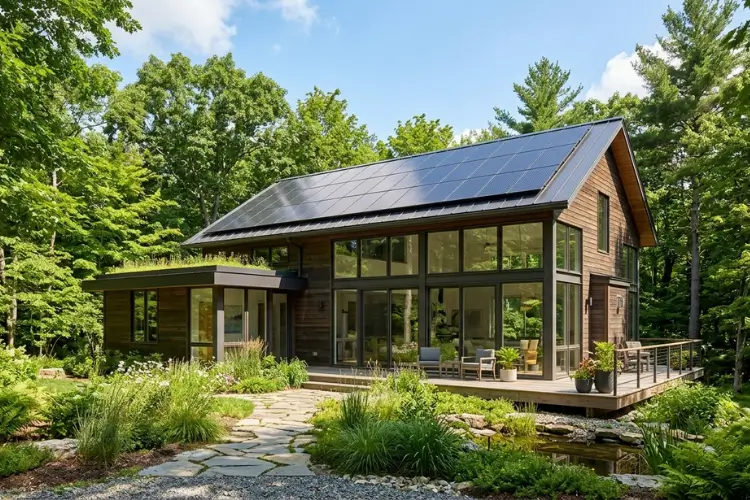
Net-zero means a building produces as much energy as it consumes over a year. Carbon-positive goes further: the building actively removes more carbon than it generates across its lifecycle.
This used to be a flagship-project ambition. Now it’s becoming a baseline expectation for new commercial construction in major markets.
The Edge in Amsterdam is the building most often cited here for good reason. It combines solar panels (see how solar energy works) with aquifer thermal energy storage and a smart energy management system to generate more power than it uses annually.
What does this mean for a city? When enough individual buildings hit net-zero, the grid itself starts to feel it. Fewer peak-demand spikes. Lower strain during heat waves. Want the bigger picture? See what is a smart grid. A skyline that’s quietly doing climate work instead of just consuming.
2. Mass Timber Construction Goes Mainstream
Here’s the fix nobody expected: wood.
Mass timber, one of the most talked-about sustainable building materials, is made of engineered panels of layered wood strong enough to replace steel and concrete in mid-rise and even high-rise buildings. It’s having a real moment. And the carbon math is genuinely striking.
Why it matters:
- Wood sequesters carbon as it grows, and that carbon stays locked in for the life of the building (see how it compares in bamboo vs timber).
- It’s lighter than concrete, which means faster construction and less structural material overall.
- Well-engineered mass timber buildings can sequester more carbon during construction than they emit.
Cities that once required steel or concrete for anything above a few stories are now approving mass timber mid-rises. That single code change is reshaping what a “green skyline” can even look like.
3. Biophilic Design at City Scale
Biophilic design means weaving nature directly into the built environment. Natural light, living walls, water features, organic shapes.
It’s not new. What’s new is the scale.
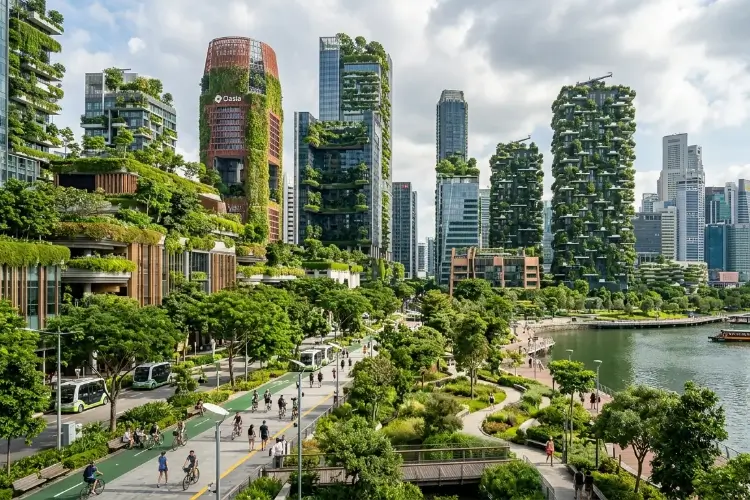
Architects in 2026 are designing entire building facades as living systems, using green walls that regulate indoor temperature and manage stormwater runoff at the same time. That’s a functional system, not decoration.
The data points the same way. A study of 7,600 office workers across 16 countries found that people working in spaces with natural elements like greenery and sunlight reported 15% higher well-being, felt 15% more creative, and were 6% more productive. And the WELL Building Standard issues specific certification credits for biophilic features. That’s turned a nice-to-have into a certifiable, marketable asset.
By the way: Milan’s Bosco Verticale, the “vertical forest” towers home to hundreds of trees and thousands of shrubs and plants, remains the clearest proof of concept most cities point to when arguing for greenery codes of their own.
4. Adaptive Reuse Over New Construction
The simple fix? Stop tearing buildings down.
Adaptive reuse means transforming existing structures, old factories, warehouses, offices, into modern, energy-efficient spaces instead of demolishing and starting fresh.
Here’s why this is quietly becoming one of the most important trends on this list: a building that already exists has already paid its “carbon debt.” The concrete is poured. The steel is forged. Demolishing it and building new means paying that debt all over again before a single tenant moves in.
That’s why adaptive reuse is often the lowest-carbon option on the table, simply because the hardest part is already done.
Cities are responding with faster permitting for adaptive reuse projects, recognizing that retrofitting the buildings they already have will do more for their emissions numbers than any number of shiny new towers.
5. AI-Assisted Building Design and Energy Management
AI has quietly worked its way into nearly every stage of the architecture process.
According to the 2025 Vectorworks AEC Trend Report, which surveyed over 500 industry professionals, 86.2% expect AI to be moderately to highly prevalent in the field within the next decade. About half already say it’s moderately to extremely prevalent today.
Where it’s actually showing up:
- Generative design tools that model dozens of layout options against energy performance targets before a single wall is drawn.
- Smart Building Energy Management Systems (BEMS), one of the most practical green tech innovations, use IoT sensors to optimize HVAC, lighting, and water use in real time.
- AI-driven renders that let architects explore adaptive reuse concepts on existing buildings in a fraction of the time it used to take.
The energy numbers alone justify the investment. According to ACEEE, building energy management and control systems can reduce energy use by 10% to 25%. That’s not incremental. That’s real money on every utility bill.
6. Passive and Bioclimatic Design
Before you reach for solar panels or smart sensors, there’s a older, quieter strategy: design the building so it barely needs them in the first place.
Passive design, a staple of many eco home design ideas, uses orientation, natural airflow, shading, and daylight to reduce a building’s energy demand before any technology gets involved. Bioclimatic design takes it further, modeling a building’s response to the actual climate and topography of its specific site.
Architects are now running detailed sun-path modeling relative to a site’s exact topography during the earliest conceptual phase, not as an afterthought.
Why does this matter for cities specifically? Because passive strategies scale for free. A well-oriented building doesn’t need a bigger budget to keep working. It just needs to have been designed right the first time.
7. Vertical Greenery and Urban Forests
We’ve touched on green walls already. This trend goes bigger: entire vertical ecosystems built into dense urban cores.
Liuzhou Forest City in southern China, designed by Stefano Boeri Architetti, is the most ambitious example of this idea so far. The plan calls for homes for 30,000 people alongside nearly a million plants and 40,000 trees, absorbing an estimated 10,000 tons of carbon dioxide annually while producing roughly 900 tons of oxygen. Those are the architect’s own projections, not measured results.
Singapore’s Marina One takes a similar idea and folds it into commercial density, integrating lush vegetation into a multilevel “green heart” that boosts biodiversity and occupant wellbeing right in the middle of a financial district.
Here’s the shift to watch: this used to be a signature move for one flagship tower per city. Now it’s becoming a planning requirement, with municipalities like Istanbul mandating green standards, including quotas for renewable energy sources and water recycling, across all new commercial construction.
8. Regenerative Architecture
Sustainable design used to mean doing less harm. Slightly better windows. A bit more insulation.
Regenerative architecture asks a different question entirely: can a building actively improve its surroundings, not just minimize damage to them?
Think of it as designing a structure to function like a living organism inside its ecosystem, rather than sitting on top of one. That might mean a building that treats its own wastewater, generates surplus clean energy for its neighbors, or actively restores soil and biodiversity on its site.
This is still the newest trend on this list. But it’s where the most ambitious architects are pointing their attention, because “net-zero” is quickly becoming the floor, not the ceiling.
9. Modular and Prefabricated Low-Waste Building
Construction waste is one of the least talked-about parts of a building’s carbon footprint. Modular construction is starting to change that.
Prefabricated components, built in controlled factory settings and assembled on-site, cut material waste dramatically compared to traditional on-site construction. They also speed up build timelines, which matters when cities are racing to meet net-zero targets on aggressive deadlines.
Modular construction pairs naturally with other trends on this list:
- It makes net-zero targets easier to hit, since less waste means less embodied carbon from the start.
- It works especially well with mass timber, since panelized wood systems are built for factory precision.
- It reduces the on-site disruption that makes adaptive reuse and infill projects harder to permit in dense neighborhoods.
10. Climate-Resilient Urban Infrastructure
Green architecture isn’t just about emissions anymore. It’s about surviving what’s already coming.
Stormwater and Flood Design
Green roofs are increasingly doing double duty, managing stormwater runoff while also lowering indoor temperatures. As storms intensify, cities are requiring this kind of dual-function design in flood-prone zones rather than treating drainage as a separate engineering problem.
Heat-Resilient Materials and Urban Cooling
Reflective and permeable materials, paired with strategic vegetation, are being used to fight the urban heat island effect directly, the phenomenon where dense cities run several degrees hotter than surrounding areas simply because of concrete and asphalt.
This is the trend that ties the whole list together. A city with net-zero buildings, mass timber towers, and vertical forests still needs to survive the next flood or heat wave. Resilience isn’t optional anymore. It’s the baseline every other trend gets built on top of.
How These Trends Compare
Not every trend costs the same, moves at the same speed, or delivers impact the same way. Here’s the honest breakdown.
| Trend | Relative Upfront Cost | Carbon/Energy Impact | Adoption Timeline |
| Net-zero buildings | Higher | Very high | Growing fast in commercial |
| Mass timber | Varies by project | High (sequesters carbon) | Rapid, code-dependent |
| Biophilic design | Moderate | Moderate, high wellbeing ROI | Widespread, still scaling |
| Adaptive reuse | Varies by project | Very high (avoids embodied carbon) | Accelerating in dense cities |
| AI/BEMS integration | Low to moderate | High (10-25% energy cuts) | Fast, tech-driven |
| Passive/bioclimatic design | Low | Moderate, compounds over time | Standard in new design |
| Vertical greenery | Higher | Moderate, high air-quality value | Flagship to mainstream |
| Regenerative architecture | Highest | Very high, long-term | Early stage |
| Modular/prefab | Varies by project | Moderate (waste reduction) | Fast-growing |
| Climate-resilient design | Moderate | High (risk mitigation) | Becoming mandatory |
The cost column is an editorial assessment, not measured data, and real costs vary widely by project. For green building as a whole, a 2013 World Green Building Council review found that most green buildings cost between 0% and 4% more than conventional ones.
What This Means for Your City
So where does this leave you, whether you’re an architect, a developer, or just someone watching your skyline change?
Here’s the pattern across all 10 trends: the winners aren’t chasing the flashiest single feature. They’re stacking trends together.
A mass timber building with passive solar orientation, a living facade, and BEMS-driven energy management isn’t 10% better than a conventional building. It’s operating in a completely different category.
If you’re evaluating a project, ask three questions:
- Does this reduce embodied carbon, not just operational energy?
- Does it hold up under the climate stress your city will actually face in the next decade?
- Does it make financial sense on a five-year horizon, not just a marketing brochure?
If the answer to all three is yes, you’re looking at architecture built for where cities are actually headed, not where they used to be.
Why These Green Architecture Trends Work Best Together
None of these 10 trends are working in isolation anymore. That’s the real story here.
Net-zero targets lean on mass timber and passive design to hit their numbers. Biophilic facades double as stormwater systems. AI-driven BEMS makes adaptive reuse projects easier to justify financially. Every trend on this list is quietly propping up two or three others.
That’s why the cities pulling ahead aren’t the ones chasing a single flashy building. They’re the ones building the policy, the permitting speed, and the financing to let all 10 trends reinforce each other at once.
If you’re working on a project right now, you don’t need to chase every trend on this list. Pick the two or three that fit your site, your budget, and your climate, and design them to work together from day one.