A smart grid is an electricity network that talks back.
Instead of power flowing one way, from a plant to your house, in the dark, a smart grid moves electricity and data together, in real time, in both directions. That’s the whole idea in one sentence.
But here’s why it actually matters to you: the grid you’re plugged into right now was mostly built for a world without solar panels, electric cars, or heat waves that push demand to record highs. A smart grid is how that system catches up.
So let’s break down what that really means, how it works, and where things actually stand in 2026.
What Is a Smart Grid?
A smart grid is the modern version of the electrical grid, upgraded with sensors, two-way communication, and automated controls that let it sense problems and respond to them, often before you even notice.
Think of it like the difference between a landline and a smartphone. A landline just carries a signal. A smartphone carries the signal, plus data about the call, plus the ability to reroute itself if something goes wrong.
That’s the shift happening to the power grid.
The core difference isn’t the electricity. It’s the information traveling alongside it.
The U.S. Department of Energy describes this as bringing electricity delivery into the 21st century using computer-based remote control and automation, the same two-way communication technology that other industries have used for decades, now applied to power.
Why did it take this long? Because the grid is one of the largest, oldest, most physically distributed machines humans have ever built. Upgrading it isn’t like updating an app. It’s closer to rewiring a country while the lights stay on.
Smart Grid vs. Traditional Grid: What’s the Difference?
The short answer: a traditional grid pushes power out. A smart grid pushes power out and pulls information back.
How electricity moves in a traditional grid
A traditional grid is a one-way street. Power gets generated at a plant, sent through transmission lines, stepped down through substations, and delivered to your home or business.
Nobody along that path is really “watching” in real time. If a transformer fails at 2am, the utility often finds out because you called to report the outage, not because a sensor flagged it.
How electricity and data move in a smart grid
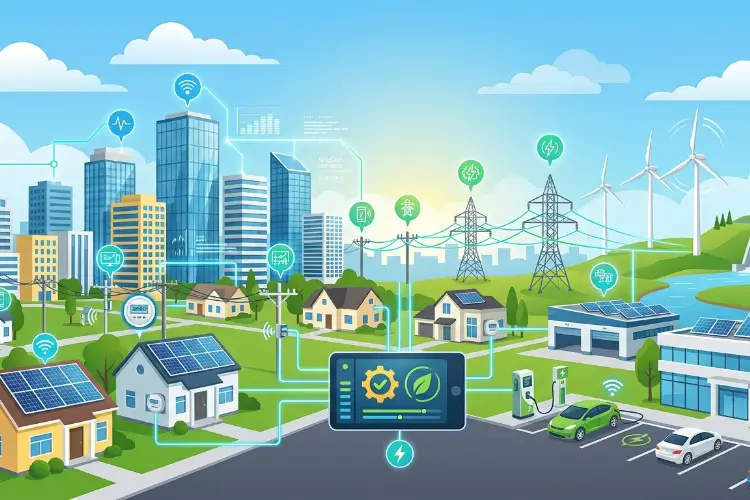
A smart grid runs the same basic path, but with sensors and communication equipment layered on top. It knows how much power is flowing where, how much is being used, and when something looks off.
Here’s the practical result:
| Traditional Grid | Smart Grid |
| One-way power flow | Two-way power and data flow |
| Manual outage reporting | Automated outage detection |
| Fixed, scheduled maintenance | Predictive, condition-based maintenance |
| Limited renewable integration | Built to absorb solar, wind, batteries |
| Slow to respond to demand spikes | Can shift or shed load in real time |
| Meters read monthly by hand | Smart meters report usage hourly or more |
That table is really the whole story. Everything else in this guide is detail on how those six differences get engineered.
How Does a Smart Grid Work?
It works in five layers, stacked on top of each other. Here’s the breakdown.
- Smart meters (AMI). Advanced Metering Infrastructure records your electricity use in intervals as short as an hour, and sends that data back to the utility automatically. No one walks up to your house to read a dial anymore.
- Sensors and phasor measurement units. These devices sit throughout the grid, measuring voltage, frequency, and load thousands of times per second, catching instability long before it becomes a blackout.
- Two-way communication networks. Fiber, cellular, and dedicated grid networks carry all of that sensor and meter data back to control systems, and carry instructions back out.
- Automation and self-healing systems. When a fault is detected, the grid can automatically reroute power around the damaged section, isolating the problem in seconds instead of hours.
- Grid control centers and software. Utilities use SCADA (Supervisory Control and Data Acquisition) systems and increasingly AI-driven analytics to monitor the whole network and make dispatch decisions.
That’s it. Sense, communicate, decide, act. Repeat, constantly, across an entire country’s worth of wires.
Key Components of a Smart Grid
If you’re picturing what actually gets installed to make this happen, it usually comes down to these:
- Smart meters at homes and businesses
- Smart appliances and thermostats that can respond to price or demand signals
- Distribution automation equipment like automated switches and reclosers
- Energy storage systems, from utility-scale batteries to home batteries
- Renewable energy interconnections, letting rooftop solar and wind farms feed power back into the grid (new to panels? Here’s how solar energy works)
- Electric vehicle charging infrastructure, increasingly built to communicate with the grid, not just draw from it
Notice something? A smart meter shows up on that list, but it’s just one item on it. That distinction matters more than people think, and I’ll get to why in a minute.
Benefits of Smart Grids
The simple pitch: fewer outages, lower costs, and a grid that can actually handle solar panels and EVs without falling over.
Here’s how that plays out for different groups.
For utilities
Utilities get real-time visibility into their own network. That means faster fault detection, predictive maintenance instead of guesswork, and better load forecasting during heat waves or cold snaps, which is exactly when the old grid is most likely to fail.
For consumers
You get more accurate bills, based on actual usage instead of estimates. You also get access to time-of-use pricing, which can lower your bill if you shift heavy usage, like laundry or EV charging, to off-peak hours.
For the environment and renewable energy
This might be the biggest one. Whichever way you compare solar vs wind energy, neither is a steady, predictable source like a coal or gas plant. A smart grid is what makes it possible to absorb that variability without destabilizing the whole system.
Stats worth knowing:
- The global smart grid market was valued at about $61 billion in 2025 and is projected to reach roughly $75 billion in 2026, according to Fortune Business Insights. Forecasts differ between research firms, but they all point the same direction: up.
- U.S. utilities had about 119 million advanced metering installations in 2022, roughly 72% of all electric meters, according to the U.S. Energy Information Administration.
- The federal infrastructure law expanded the Department of Energy’s Smart Grid Grant program by $3 billion, according to a DOE fact sheet, and added $5 billion in grid resilience grants for states and tribes, per DOE’s Grid Deployment Office.
- The European Commission says digitalising Europe’s energy systems could deliver 71 billion euros per year in direct consumer savings, according to its digitalisation of energy systems page.
- The International Energy Agency’s Electricity 2026 report found that more than 2,500 gigawatts of renewable, storage, and large-load projects are currently stalled in grid connection queues worldwide, a bottleneck that smarter, faster grid infrastructure is specifically designed to reduce.
That last stat is the one people miss. It’s not just about your house. It’s about whether an entire pipeline of new solar and wind projects can actually get connected and used.
Here’s a way to think about it that makes the whole thing click. Imagine a highway system that was built for the traffic patterns of 1970, then asked to suddenly handle rush hour from a city three times the size, plus a fleet of self-driving cars that need constant real-time coordination to avoid crashing into each other. That’s roughly what’s happening to the power grid right now, except the “traffic” is electricity, and the “self-driving cars” are millions of solar panels, batteries, and EVs all trying to push and pull power at the same time.
A smart grid is the traffic control system for that highway. Not a wider road. A smarter one.
That reframe matters because a lot of the public conversation around grid upgrades focuses on cost, and cost alone. But the real question isn’t “why are we spending money on this.” It’s “what happens if we don’t.” Without better sensing and coordination, adding more Renewable Energy Sources doesn’t translate into a more reliable grid. It just adds more variables to a system that’s already struggling to keep up.
Challenges and Risks of Smart Grids
Nothing this connected is risk-free. Let’s be honest about the tradeoffs instead of pretending they don’t exist.
Cybersecurity
A more connected grid is also a bigger target. More sensors and communication points mean more potential entry points for attackers, from ransomware to nation-state threats.
The fix isn’t ignoring the risk. It’s layered defense: encryption, continuous monitoring, and increasingly, AI-based threat detection built directly into grid software.
Infrastructure cost
Building this out isn’t cheap. Replacing meters, laying communication infrastructure, and upgrading substations requires massive upfront investment, some of which does get passed along to ratepayers over time.
Interoperability and standards
Different vendors, different regions, different decades of equipment. Getting all of it to talk the same language is a genuinely hard engineering and policy problem, which is part of why the National Institute of Standards and Technology has spent years developing smart grid interoperability standards.
Data privacy
Your smart meter knows a lot about your daily routine, from when you’re home to when you’re likely asleep. That data needs real protection, not just a privacy policy nobody reads.
The simple fix? None of these risks are reasons to avoid smart grid technology. They’re reasons to demand it be built properly.
Here’s the thing nobody tells you about grid cybersecurity: the old, “dumb” grid wasn’t actually safer. It was just less visible. Fewer sensors meant fewer entry points for hackers, sure, but it also meant utilities had almost no way to detect a problem until it had already caused an outage. Security through obscurity isn’t security. It’s just a slower discovery process.
The IEA’s Electricity 2026 report flags cyber threats, ageing infrastructure, extreme weather, and physical attacks as growing risks to grid security, and argues that modernizing grid operations and protecting critical infrastructure are no longer optional (Electrek’s coverage of the report).
The standard answer is defense-in-depth: multiple overlapping layers of protection, rather than one single lock on the front door.
Smart Grid vs. Smart Meter: Are They the Same Thing?
No, and this is one of the most common mix-ups out there.
A smart meter is one device in your home that reports your energy usage. A smart grid is the entire system, meters, sensors, communication networks, automation, and control software, working together across an entire region.
A smart meter is one piece of a smart grid, not the whole thing. It’s one sensor in a much larger nervous system.
So if your utility installed a smart meter at your house, that doesn’t necessarily mean you’re on a fully smart grid. It means one small, important piece of the puzzle is in place.
Is the US Electrical Grid a Smart Grid Yet?
Partially, and unevenly. That’s the honest answer.
Smart meter rollout in the U.S. is well underway. By 2022, about 72% of all U.S. electric meters were advanced metering infrastructure, including roughly 73% of residential meters, according to the EIA. But the deeper layers, full automation, self-healing distribution networks, widespread real-time sensing, are still being built out region by region.
Federal funding has accelerated this. The Infrastructure Investment and Jobs Act expanded the DOE’s Smart Grid Grant program by $3 billion, and together with the Inflation Reduction Act it has funded work to increase grid resilience and modernize transmission and distribution systems. There’s real money moving toward closing this gap.
But: modernization is happening at different speeds depending on where you live, which utility serves you, and how much your state has prioritized grid investment. Some regions are years ahead. Others are still catching up.
Real-World Smart Grid Examples
This isn’t theoretical. It’s already running.
- Duke Energy, one of the largest utilities in the U.S., uses self-healing technology that automatically detects outages and reroutes power. It also helped develop OpenFMB, an open framework for getting grid devices from different vendors to work together.
- Enel, a major European energy company, has built out smart grid infrastructure across multiple countries as a core part of its renewable energy integration strategy.
- State Grid Corporation of China has poured tens of billions of dollars a year into transmission and grid modernization under national five-year planning, according to Market.us, making it one of the largest single investors in grid infrastructure globally.
- The European Union published its Strategic Roadmap for Digitalisation and AI in Energy on 3 June 2026, backing AI-enabled grid management. The Commission also plans a 2026 legislative proposal to accelerate smart meter deployment across the EU.
Different countries, different strategies, same underlying push: make the grid smarter, faster, before demand outpaces capacity.
The Future of Smart Grids
So where is the smart grid headed next? Here are three shifts already taking shape.
AI and digital twins
Among the green tech innovations reshaping utilities, digital twins stand out. A digital twin is essentially a live simulation of the physical grid, so operators can test what happens before flipping a switch in the real world. Combined with AI-driven analytics, this is quickly becoming standard practice rather than an experiment.
EV integration
Electric vehicles are both a challenge and an opportunity. A neighborhood full of EVs charging at once can strain local infrastructure. But a smart grid can also use EV batteries as a flexible resource, charging when demand is low and even feeding power back during peak hours.
Decentralized energy
Microgrids and distributed energy resources, think neighborhood-level solar and battery systems that can operate independently if the main grid goes down, are becoming a bigger part of the picture. This is a real shift away from the old model of a handful of massive power plants serving everyone.
Key Takeaways
- A smart grid adds sensors, two-way communication, and automation to the traditional power grid, so it can sense and respond to problems in real time.
- A smart meter is just one component of a smart grid, not the whole system.
- The biggest benefits are fewer outages, more accurate billing, and the ability to absorb solar and wind power at scale.
- The biggest risks are cybersecurity, upfront cost, and interoperability between old and new equipment.
- The U.S. and countries around the world are actively investing billions of dollars into grid modernization right now, but the rollout is uneven.
- This isn’t a future technology. It’s already running, just unevenly distributed, and getting more built out every year.