Quick answer:
- A plastic free morning routine means swapping out the disposable plastic in your first hour awake, not overhauling your whole life.
- Start with three swaps, not thirty. Your toothbrush, your coffee filter, and one skincare product are the easiest places to begin.
- Most swaps cost the same or less over a year, even though the upfront price looks higher.
- You don’t need a fully zero waste bathroom to make a real difference before 8am.
I used to think “plastic free morning” meant some pristine bathroom shelf lined with glass jars and label-free everything.
It doesn’t.
It means fewer bottles in the trash and a few habits that actually stick. That’s it.
So where do you start? Right here, with a simple, realistic walk through your own morning, step by step.
What a Plastic Free Morning Routine Actually Is
A plastic free morning routine is a set of daily habits and product swaps, from your toothbrush to your coffee filter, that removes single use and disposable plastic from the first hour of your day.
That’s the whole definition.
No pledge. No perfection. Just fewer plastic things touching your face, your coffee, and your trash can before you’ve even left the house.
Here’s the truth nobody tells you: most of the plastic in your morning isn’t the dramatic stuff. It’s not the toothbrush you’ll replace every three months. It’s the tiny, invisible packaging you don’t even register anymore. Shampoo bottles. Coffee pod shells. The plastic film on your yogurt lid.
You can’t fight what you can’t see. So the first job isn’t buying anything. It’s noticing.
Why Your Morning Matters More Than You Think
Here’s a number that stopped me in my tracks.
The OECD puts US plastic waste at roughly 221 kilograms, about 487 pounds, per person every year. That’s the highest of any country the OECD tracks, and it’s nearly double the average across other wealthy nations.
Only a small fraction of it gets recycled, too. US plastic recycling has slipped to an estimated 5%, down from 9% a few years ago.
And mornings are a big piece of that pile.
Think about it. Mornings are routine by design. You do the same five or six things, in the same order, almost every day, which makes them one of the easiest places to build sustainable habits that actually stick. Which means:
- Whatever plastic is in your morning, you’re buying it again and again
- Small swaps compound fast, because you repeat them daily
- A habit you build once in the morning tends to stick, because mornings run on autopilot
The simple fix? Change the autopilot, once, and the plastic reduction takes care of itself.
The Plastic Free Morning Routine, Hour by Hour
Let’s walk through an actual morning. Not a theory. An order of operations.
1. Wake Up (Before You Even Get Out of Bed)
This one’s free. Genuinely.
Before you touch a single product, do a thirty second scan of your nightstand and bathroom counter. What’s plastic? What’s not?
You’re not swapping anything yet. You’re just building the habit of noticing, which is the single most useful skill in this whole routine.
2. Bathroom: Teeth and Face
This is where most of your plastic lives, and it’s where most guides start (and stop). Let’s actually get through it.
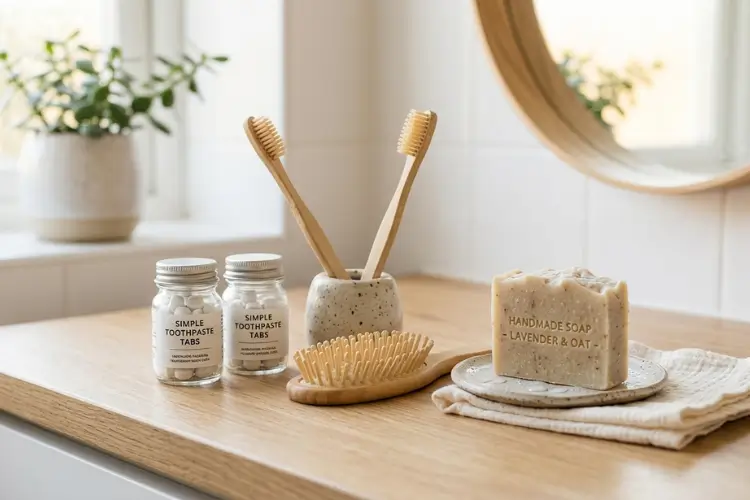
Toothbrush: A bamboo toothbrush breaks down over time, unlike a plastic one that sits in a landfill for centuries. Same brushing motion, same clean feel, one swap.
Toothpaste: Toothpaste tablets or powder in a glass jar skip the plastic tube entirely. Pop one in your mouth, add water, brush like normal.
Face wash and moisturizer: You don’t need to replace these overnight. Finish what you have first. Then look for a bar cleanser or a glass jar option when you run out.
By the way: don’t throw away half full plastic bottles just to feel “plastic free” faster. That’s not zero waste. That’s just waste with better branding. If you want to keep going once these bottles run dry, this list of zero waste bathroom swaps covers the rest of the cabinet.
3. Shower: Shampoo, Conditioner, Body Wash
Here’s where a real swap pays off fastest, because these bottles empty quickly and get repurchased often.
Shampoo and conditioner bars replace the bottle entirely. Most brands claim one bar lasts as long as two to three regular sized bottles, which means fewer purchases, not just less plastic per purchase.
Bar soap or a refillable body wash does the same job as a shower gel bottle, minus the bottle.
A quick trick that costs nothing: turn the water off while you lather up. It’s not a plastic swap, but it’s a habit that belongs in the same conversation, because a plastic free routine and a genuinely lower impact routine usually overlap.
4. Shaving and Deodorant
Razor: A metal safety razor with replaceable blades outlasts a plastic cartridge razor by years, not months. The blades are also fully recyclable, which plastic cartridges are not.
Deodorant: Look for a cardboard tube or a metal tin instead of a plastic push up stick. The formula does the same job. The container is the only thing that changes.
5. Kitchen: Coffee or Tea
Now you’re out of the bathroom, which means you’ve already covered the biggest plastic sources in your morning. Nice work.
Coffee: Single use pods and disposable filters are some of the most repeated plastic purchases in an average kitchen. A reusable metal filter or a refillable pod does the same brew, forever, with zero ongoing plastic.
Tea: Those silky, pyramid-shaped tea bags are often made from nylon or PET mesh, not paper. Researchers at McGill University found that steeping just one of these plastic bags releases billions of microplastic and nanoplastic particles into the cup. Paper tea bags and loose leaf tea don’t have this problem, since there’s no plastic mesh to shed in the first place. A stainless steel infuser with loose leaf tea sidesteps it completely.
6. Breakfast and Out the Door
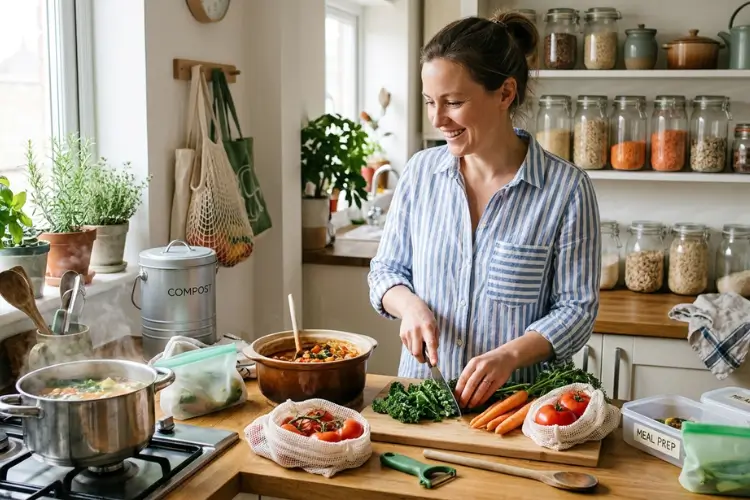
Food storage: If you’re prepping breakfast to go, beeswax wrap or a silicone lid replaces a roll of plastic cling film. And if you’re left with peels, shells, or coffee grounds after, there are plenty of creative ways to reuse food waste instead of tossing them straight in the trash.
Produce bags: If you’re grabbing fruit on your way out, a reusable mesh bag skips the thin plastic produce bag at checkout. It’s one of the simplest eco friendly alternatives to plastic bags you’ll ever adopt, because you barely notice you’re using it.
Water bottle: Grab a steel or glass bottle on your way out instead of buying a plastic one later. If you’re not sure what to actually fill it with, this breakdown of distilled vs spring vs purified water is worth a read. This is the easiest swap on this entire list, and also the one people forget most often.
That’s a full morning, start to finish, without most of the plastic that used to be baked into it.
Plastic Swap Comparison: What Changes, What It Costs
| Item | Plastic Version | Plastic Free Swap | Cost Difference | Effort Level |
| Toothbrush | Plastic handle, replaced every 3 months | Bamboo toothbrush | About the same per unit | Very low |
| Toothpaste | Plastic tube | Tablets or powder in glass | Slightly higher upfront | Low |
| Shampoo | Plastic bottle | Shampoo bar | Cheaper over time (lasts longer) | Low |
| Razor | Plastic cartridge razor | Metal safety razor | Higher upfront, cheaper per shave | Medium |
| Coffee filter | Disposable paper or pods | Reusable metal filter | Pays for itself in weeks | Low |
| Tea bags | Plastic mesh bags | Loose leaf with steel infuser | About the same or cheaper | Low |
| Food wrap | Plastic cling film | Beeswax wrap or silicone lid | Higher upfront, reusable for years | Low |
| Water bottle | Single use plastic bottle | Steel or glass bottle | Pays for itself almost immediately | Very low |
Notice the pattern. Almost nothing on this list costs more once you look past the first purchase. The plastic version is cheap once and expensive forever, because you keep buying it.
What’s Not Worth Replacing Yet
Here’s the truth nobody tells you (part two): you don’t need to replace everything today.
If a product still works and it’s already in your house, using it up is the better environmental choice. Tossing a three quarters full bottle of face wash to buy a “greener” replacement just creates waste in a different direction.
Skip these for now, unless you’re already out:
- Anything you already own and use regularly, even if it’s in plastic
- Makeup and skincare with active ingredients that genuinely work for your skin, unless a plastic free version exists that performs the same
- Big ticket appliances like your coffee maker itself, if it’s still functional
Because: the goal isn’t a perfect bathroom shelf. It’s less plastic waste, over time, without spending money you don’t need to spend.
My Own Plastic Free Morning, Six Weeks In
When I first tried this, I gave myself one rule: swap something only when I ran out of the plastic version, never before.
Week one, I replaced my toothbrush. Trivial. Barely noticed the difference.
Week three, my shampoo bottle finally ran dry, so I picked up a bar instead. That one took some adjusting. It took me longer to get used to rubbing a bar directly on wet hair than I expected, but by the second wash it felt completely normal.
By week six, my bathroom counter had maybe half the bottles it used to. Not because I did a dramatic purge. Because I just kept replacing things as they ran out, with a plastic free version instead of the same one again.
I still haven’t replaced my dish soap. It’s fine. It’s still three quarters full, and I’m not throwing away something that works just to hit some imaginary finish line.
That’s the whole method. Slow, boring, and it actually works.
Start With One Swap This Week
You don’t need a zero waste bathroom to have a plastic free morning. You need three good swaps and a habit.
Pick one thing from this list. The one you’re already about to run out of. Replace it, and only it, this week.
Then do it again next time something runs dry.
That’s the whole routine. Not a lifestyle overhaul. Just a slightly different version of the morning you already have.