The windiest place on Earth is Commonwealth Bay, Antarctica, where average wind speeds hover around 50 mph (80 km/h) year round. That’s not a storm passing through. That’s just Tuesday.
But here’s the thing nobody tells you up front: “windiest place in the world” isn’t one title. It’s at least four.
There’s the windiest place at sea level. The windiest city people actually live in. The highest wind gust ever recorded. And the highest wind speed inside a tornado, which is its own terrifying category.
So which one is “the” windiest place? Honestly, it depends on what you’re asking.
Below are 15 real contenders, ranked and explained, with the actual data behind each one. By the end, you’ll know exactly which title belongs to which place, and why.
What Makes a Place “Windy”?
Wind is just air moving from high pressure to low pressure. Simple in theory. Chaotic in practice.
But a handful of geographic features turn ordinary breezes into something extreme:
- Unobstructed ocean fetch: No mountains, no forests, no buildings to slow the air down.
- Funneling terrain: Straits, valleys, and bays that squeeze wind through a narrow gap, speeding it up the same way water speeds up in a narrow pipe.
- Katabatic flow: Cold, dense air sliding downhill off an ice sheet or mountain, picking up speed the whole way down.
- Storm tracks: Locations that sit directly in the path of repeated cyclones, cold fronts, or jet stream activity.
Most of the places on this list have two or three of these stacked on top of each other. That’s why they’re not just windy. They’re relentlessly windy.
The 15 Windiest Places in the World
Here’s the full breakdown, starting with the windiest spot on the planet.
1. Commonwealth Bay, Antarctica
Average wind speed: ~50 mph (80 km/h) | Peak gusts: 150+ mph (240+ km/h) | Why it’s windy: Katabatic winds pouring off the polar ice sheet
This is the one. The Guinness Book of World Records and the National Geographic Atlas both name Commonwealth Bay the windiest place on Earth, and the data backs it up.
Explorer Douglas Mawson’s Antarctic expedition camped here from 1911 to 1914 and recorded average winds of 45 mph for their entire stay. Some days made it impossible to even stand up outside.
The cause? Cold, dense air rolls off the Antarctic Plateau and picks up speed as it funnels down toward the coast. That’s a katabatic wind, and Commonwealth Bay’s half-moon shaped coastline squeezes it even harder before it hits the water.
2. Cape Denison, Antarctica
Average wind speed: ~43 mph (70 km/h) | Location: Within Commonwealth Bay | Why it’s windy: Same katabatic system, slightly different local terrain
Cape Denison is the exact spot where Mawson built his expedition base, and the huts are still standing today. Over a century of ferocious wind, and they haven’t budged.
The wind here runs a touch lower than the wider bay because of small terrain differences, but make no mistake: this remains one of the most hostile inhabited-in-name-only environments on the planet.
3. Wellington, New Zealand
Average wind speed: ~17 mph (27 km/h) | Peak gusts: 154 mph / 248 km/h, recorded on Hawkins Hill in 1959 and again in 1962 | Why it’s windy: The Cook Strait funnels the Roaring Forties straight into the city
Wellington is the windiest capital city in the world. No asterisk needed.
The city sits at the southern tip of New Zealand’s North Island, right where the Cook Strait squeezes the Roaring Forties (fierce westerly winds circling the globe at 40-50 degrees south latitude) through a 14-mile gap. That gap acts like a hose nozzle for wind.
The result? Gale-force gusts on roughly 173 days a year. Locals have adapted. Some intersections even use horizontal traffic lights, because the vertical ones kept getting blown off their posts.
4. Mount Washington, New Hampshire, USA
Average wind speed: ~35 mph (56 km/h) at the summit | Record gust: 231 mph (372 km/h) in 1934 | Why it’s windy: Sits at the convergence of three major storm tracks
For 62 years, Mount Washington held the world record for the fastest wind gust ever measured by an instrument. That 1934 reading stood until 1996.
The summit experiences hurricane-force winds on more than 100 days a year, and wind chill has dropped as low as -74°C, among the coldest conditions a human has ever survived through.
Why here specifically? Mount Washington sits right where three storm systems collide, and its shape accelerates air flowing over and around the peak. The Mount Washington Observatory has staffed the summit continuously since 1932, so this isn’t guesswork. It’s some of the most consistent long-term wind data on Earth.
5. Barrow Island, Australia
Record gust: 253 mph (408 km/h) in April 1996 | Location: Off the coast of Western Australia’s Pilbara region | Why it’s windy: Cyclone Olivia, full stop
Here’s the record-breaker. In 1996, Cyclone Olivia produced the strongest wind gust not associated with a tornado ever officially recorded: 253 mph.
That’s the number that dethroned Mount Washington. It’s also the number most people actually mean when they ask “what’s the windiest place on Earth,” even though Barrow Island isn’t windy year-round the way Commonwealth Bay is.
This is exactly the distinction worth holding onto. Average windiness and peak windiness are two different competitions.
6. Rio Gallegos, Argentina
Average wind speed: ~19 mph (30 km/h) | Peak gusts: Regularly exceed 60 mph | Why it’s windy: The westerlies of the Southern Ocean, with zero land to slow them down
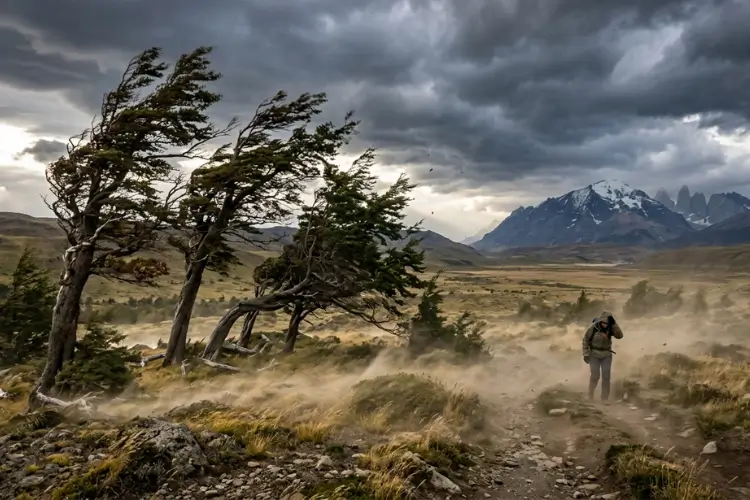
Patagonia doesn’t do gentle breezes. Rio Gallegos sits directly in the path of the Roaring Forties as they sweep across open ocean, and the wind here is less “weather event” and more “permanent condition.”
The evidence is written into the landscape. Trees grow permanently bent eastward. Buildings are built low and heavy on purpose. The same wind that makes daily life a challenge also makes this region one of the most promising spots on Earth for one of the best renewable energy sources around.
7. Punta Arenas, Chile
Average wind speed: ~14.5 mph (23 km/h) | Why it’s windy: Same Patagonian wind belt as Rio Gallegos, just across the border
Punta Arenas is the windiest city in Chile, and the city has literally engineered around it. Ropes are strung between some buildings so pedestrians have something to grab onto during the strongest gusts.
That’s not a quirky travel fact. That’s infrastructure built in direct response to how hard the wind blows here.
8. Baku, Azerbaijan
Winter gusts: Up to 89 mph | Nickname: City of Winds | Why it’s windy: Two distinct seasonal wind systems, the Gilavar and the Khazri
Baku has carried the “City of Winds” nickname for centuries, and it earns it twice over.
In summer, the Gilavar brings warm southern breezes that cool the city down. Pleasant. Welcome, even. But in winter, the Khazri sweeps in from the north and can hit 89 mph. That’s not a breeze anymore. That’s a wind you plan your day around.
9. Gruissan, France
Frequency: 300 days a year with winds over 18 mph | Why it’s windy: The Tramontane, a persistent northwest wind off the Mediterranean coast
Gruissan is a small fishing village on France’s Mediterranean coast, and the Tramontane wind defines almost every day of the year here.
It’s not the strongest wind on this list by peak speed. It’s the most relentless by frequency, and that consistency is exactly why windsurfers and kitesurfers treat this coastline like a second home.
10. Cape Blanco, Oregon, USA
Peak winds: 70-100 mph in winter storms, gusts recorded up to 127 mph | Why it’s windy: Direct exposure to Pacific winter storms
Cape Blanco is one of the westernmost points in the contiguous United States, and it takes the full force of Pacific winter storms with nothing to slow them down first.
During calm months, this stretch of coast is beautiful and mild. During winter storm season, it becomes one of the harshest patches of coastline in the country.
11. St. John’s, Newfoundland, Canada
Average wind speed: ~15 mph (24 km/h) | Why it’s windy: Exposed North Atlantic coastal position
St. John’s has a reputation, and it’s earned: Canada’s foggiest, snowiest, wettest, and windiest city, all at once.
The colorful cliffside homes clustered around the Battery aren’t just charming architecture. They’re a visible response to a coastal climate that never really lets up.
12. Dodge City, Kansas, USA
Average wind speed: ~14 mph (22 km/h) | Why it’s windy: Winds sweeping off the Rocky Mountains into the open Plains
Here’s the fact that surprises people every time: Chicago’s “Windy City” nickname is actually about 19th-century politicians, not the weather. By the numbers, Chicago isn’t even in the top ten windiest US cities.
Dodge City, on the other hand, backs its wind up with data. Consistent gusts, driven by air pouring off the Rockies and across the open Plains with nothing to break it up.
13. Mount Everest Summit, Nepal/China
Record wind speed: 175 mph (282 km/h), recorded February 2004 | Typical winter winds: 100-160 km/h (60-100 mph) | Why it’s windy: The polar jet stream sits directly on top of the summit for most of the year
Everest isn’t just the highest point on Earth. For much of the year, it’s also one of the windiest.
The summit pokes directly into the jet stream, a river of fast-moving air that normally stays miles above ground level everywhere else on the planet. In winter, that jet stream can pin itself right on top of the mountain for weeks at a time, which is exactly why almost nobody attempts a winter summit.
This is also why the entire climbing season narrows down to a handful of days each May, when the jet stream briefly shifts north and the wind finally drops low enough to survive a summit push.
14. Fort Collins, Colorado, USA
Wind speeds: Approaching 40 mph on some days, gusts over 45 mph | Why it’s windy: Downslope winds off the Rocky Mountain foothills
Fort Collins sits close enough to the Rockies to catch strong downslope winds on a regular basis. Walking through town on a windy day here genuinely isn’t a walk in the park, even in the literal park.
It’s also become a useful case study for city planners thinking about how buildings, trees, and public spaces need to be designed differently in a wind-heavy climate.
15. Bridge Creek, Oklahoma, USA
Recorded wind speed: 302 mph, listed by the World Meteorological Organization as the highest wind speed ever measured on Earth | Date: May 3, 1999 | Why it’s windy: Tornado Alley, at its most extreme
This is the outlier on the list, and it deserves its own category entirely.
On May 3, 1999, a mobile Doppler radar unit clocked a tornado near Bridge Creek, Oklahoma at 302 mph. It’s a radar-based reading rather than a ground instrument measurement, and a few sources cite slightly different figures, but the WMO lists it as the highest wind speed ever recorded on the planet.
This isn’t a “windy place” in the way Wellington or Patagonia are windy. It’s a single, catastrophic event. But if the question is “where has the fastest wind on Earth ever been measured,” Oklahoma has to be part of the answer.
Windiest Place in the World at a Glance
Here’s the full list side by side, so you can see how it breaks down before we dig into each one.
| Rank | Place | Country | Avg. Wind Speed | Standout Stat |
| 1 | Commonwealth Bay | Antarctica | ~50 mph (80 km/h) | Windiest place at sea level on Earth |
| 2 | Cape Denison | Antarctica | ~43 mph (70 km/h) | Site of Mawson’s Huts, still standing after a century of gales |
| 3 | Wellington | New Zealand | ~17 mph (27 km/h) | Windiest capital city in the world |
| 4 | Mount Washington | USA | ~35 mph (56 km/h) | Held the world wind speed record for 62 years |
| 5 | Barrow Island | Australia | Seasonal | Holds the all-time highest non-tornado gust: 253 mph (408 km/h) |
| 6 | Rio Gallegos | Argentina | ~19 mph (30 km/h) | One of the windiest inhabited cities on Earth |
| 7 | Punta Arenas | Chile | ~14.5 mph (23 km/h) | Ropes are strung between buildings so people have something to hold onto |
| 8 | Baku | Azerbaijan | Seasonal | Winter’s Khazri wind hits up to 89 mph |
| 9 | Gruissan | France | Seasonal | 300 days a year of winds over 18 mph |
| 10 | Cape Blanco | Oregon, USA | Seasonal | Winter storms push winds past 125 mph |
| 11 | St. John’s | Newfoundland, Canada | ~15 mph (24 km/h) | Canada’s windiest, foggiest, snowiest city |
| 12 | Dodge City | Kansas, USA | ~14 mph (22 km/h) | Windier than “Windy City” Chicago, consistently |
| 13 | Mount Everest summit | Nepal/China | Seasonal | Jet stream winds hit 175 mph in February 2004 |
| 14 | Fort Collins | Colorado, USA | Seasonal | Gusts exceeding 45 mph on some days |
| 15 | Bridge Creek, Oklahoma | USA | Seasonal | Site of the highest tornado wind speed ever confirmed: 302 mph |
Notice something? The “windiest” title jumps around depending on whether you’re measuring a steady average or a single terrifying gust.
Windiest Place vs. Windiest City vs. Highest Wind Gust: What’s the Difference?
Here’s the truth nobody tells you upfront when you search this topic: you’re actually asking four different questions.
The windiest place at sea level, by average wind speed? That’s Commonwealth Bay, Antarctica, hands down.
The windiest city people actually live in? Wellington, New Zealand.
The highest wind gust ever measured by a ground instrument, outside a tornado? Barrow Island, Australia, at 253 mph.
The highest wind speed ever recorded, period, tornado included? Bridge Creek, Oklahoma, at 302 mph, measured by mobile Doppler radar rather than a ground instrument.
Every “top 10 windiest places” list you’ve ever read probably blends these together without saying so. That’s why the numbers seem to contradict each other from one article to the next. They’re not actually contradicting each other. They’re answering different questions and calling it the same question.
What Causes These Extreme Winds?
Katabatic winds form when cold, dense air sits on high, sloped terrain (like an ice sheet) and gravity pulls it downhill. As it descends, it accelerates, sometimes reaching hurricane force by the time it hits the coast. This is the engine behind Antarctica’s extreme winds.
The Roaring Forties are powerful westerly winds that circle the globe between 40 and 50 degrees south latitude, largely uninterrupted by land. Wellington and Patagonia both sit directly in their path.
Pressure funneling happens when wind gets squeezed through a narrow gap, a strait, a valley, a bay, and speeds up the same way water does moving through a narrow pipe. The Cook Strait is the textbook example.
Tornadoes work differently entirely. They’re rotating columns of air generated by specific storm conditions (usually where warm, moist air collides with cold, dry air), and they can produce the highest wind speeds ever measured on Earth, just in a very small, very brief area.
Windiest Places by Country
| Region | Standout Location | What Makes It Unique |
| Antarctica | Commonwealth Bay | Windiest place at sea level, driven by katabatic flow |
| New Zealand | Wellington | Windiest capital city in the world |
| USA | Mount Washington / Bridge Creek | Former all-time wind record holder, and the tornado wind speed record |
| Argentina & Chile | Rio Gallegos, Punta Arenas | Roaring Forties battering Patagonia year-round |
| Australia | Barrow Island | Highest non-tornado gust ever recorded |
| France | Gruissan | Most consistent wind, 300 days a year |
| Azerbaijan | Baku | Two distinct seasonal wind systems |
| Nepal/China | Mount Everest summit | Sits directly in the jet stream’s path |
Is It Safe to Visit the Windiest Places on Earth?
Short answer: most of them, yes. A few of them, only with serious planning.
Easy to visit: Wellington, Rio Gallegos, Punta Arenas, St. John’s, Baku, and Gruissan all have functioning cities, airports, and tourism infrastructure. Expect strong wind as part of daily life, not a reason to cancel your trip.
Visit with planning: Mount Washington and Cape Blanco are accessible but weather-dependent. Check forecasts, dress for sudden temperature and wind swings, and don’t underestimate a summit that once held the world wind speed record.
Expedition-only: Commonwealth Bay, Cape Denison, and the summit of Mount Everest are not casual travel destinations. Getting to any of them requires a dedicated, professionally guided expedition, and conditions can shift from manageable to life-threatening quickly. Everest’s summit winds in particular are exactly why the climbing season narrows to a handful of days a year.
Not a travel destination: Bridge Creek’s 302 mph record came from a single tornado, not an ongoing climate condition. There’s nothing to “visit” here in the windiest-place sense. It’s a historical weather event, not a place people plan trips around.
Key Takeaways
- Commonwealth Bay, Antarctica is the windiest place on Earth at sea level, averaging around 50 mph year-round.
- Wellington, New Zealand is the windiest capital city, thanks to the Cook Strait funneling the Roaring Forties.
- Mount Washington held the world’s fastest wind gust record for 62 years, until Cyclone Olivia broke it in 1996.
- Barrow Island, Australia holds the current record for highest non-tornado gust: 253 mph.
- Bridge Creek, Oklahoma holds the WMO’s record for highest wind speed ever recorded on Earth, tornado included: 302 mph, measured by Doppler radar.
- “Windiest place in the world” isn’t one answer. It depends on whether you’re measuring average speed, city life, peak gusts, or tornado winds.
- Katabatic winds, the Roaring Forties, and coastal funneling are the three big forces behind most of the extreme wind on this list.
If you’re into planet-sized superlatives like this one, you’ll probably enjoy digging into the world’s largest insects, the biggest flowers on Earth, or the world’s largest dog breeds. We’ve also rounded up a batch of surprising animal facts if trivia like this is your thing.