Ask ten people what the “biggest dog breed” is, and you’ll get ten different answers.
Some will say Great Dane. Others will say Mastiff. A few will insist it’s the Irish Wolfhound.
Here’s the truth nobody tells you: they’re all right. Because “largest” isn’t one thing. It’s two.
By weight, the English Mastiff wins. Males can top out at 230 pounds, and the heaviest dog ever officially recorded weighed a staggering 343 pounds.
By height, the Great Dane and the Irish Wolfhound are duking it out, with both breeds capable of standing over 32 inches at the shoulder.
So which one is “the” largest dog breed in the world? Keep reading. We’re going to settle it, and then walk you through the 10 biggest breeds on the planet, ranked, compared, and broken down so you know exactly what you’d be signing up for.
Tallest vs. Heaviest: Why “Largest” Has Two Different Answers
Let’s clear this up first.
When breeders and vets talk about dog size, they’re usually measuring two completely different things: how much a dog weighs, and how tall a dog stands at the shoulder (called the withers).
A dog can be enormous in one category and unremarkable in the other. The Irish Wolfhound is a great example. It’s one of the tallest breeds alive, but its lean, greyhound-like build means it doesn’t come close to touching the scales the way a Mastiff does.
So where do you start if you want a straight answer?
Start with the classification. Dog breeders and veterinary groups typically split big dogs into two tiers:
- Large breeds: roughly 50 to 99 pounds, standing at least 24 inches tall
- Giant breeds: over 99 pounds (about 45 kg), often standing 26 inches or taller
Every breed on this list falls into the giant category. That distinction matters more than you’d think, because giant breeds don’t just need a bigger crate. They come with different growth timelines, different health risks, and different budgets. More on that later.
It’s the same tension you’ll find any time nature gets pulled into a superlative debate, whether it’s ranking the world’s largest insects or arguing over the biggest flowers on Earth. “Biggest” almost never means just one thing.
The Official Guinness World Records Holders
If you want the actual, no-argument answer, this is it.
Heaviest dog ever recorded: Most commonly cited as an English Mastiff named Aicama Zorba, who weighed 343 pounds and stood 37 inches at the shoulder. That’s heavier than most adult humans, times two. (Guinness stopped accepting new submissions for this record in the late 1990s, so it’s effectively permanent, and it’s why you’ll still see it cited today.)
Tallest dog on record: Great Danes have repeatedly held this title. One of the more recent record holders, a Great Dane named Zeus, measured over 3 feet 5 inches at the shoulder, and could reach roughly 7 feet tall standing on his hind legs.
Those are the extremes. Most dogs of these breeds won’t hit record-book numbers. But the averages are still jaw-dropping.
If jaw-dropping animal trivia is your thing, our roundup of surprising animal facts has plenty more where that came from. For now, though, let’s get to the list.
The 10 Largest Dog Breeds, Ranked by Weight
Here are the 10 biggest dog breeds in the world, ranked by average adult male weight, with height and lifespan for each.
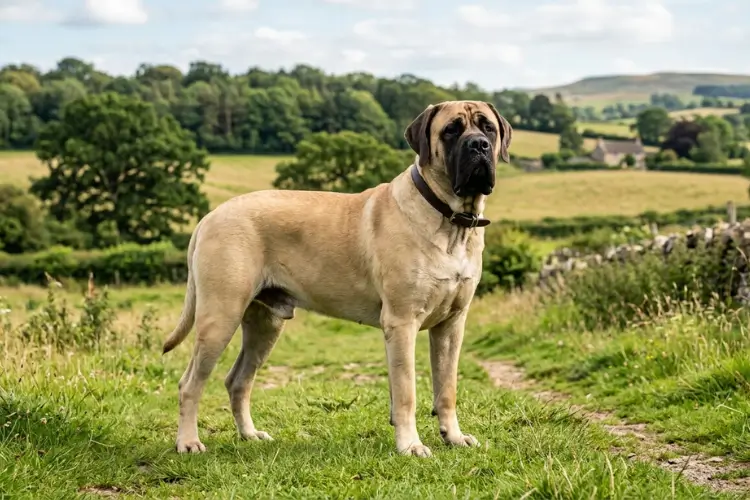
1. English Mastiff
Weight: Up to 230 lbs | Height: Up to 36 in | Lifespan: 6-10 years
The English Mastiff is the heavyweight champion of the dog world, and it’s not close. This is one of the oldest breeds still around today, with a history that stretches back thousands of years as a guard and war dog.
Don’t let the size fool you, though. Mastiffs are famously gentle, patient, and affectionate with their families. They’re not big barkers or big movers. Most are content to nap in the same room as you all day, which is honestly perfect, because a dog this size needs a lot of room to nap in.
The catch? That much mass puts real strain on joints. Hip and elbow dysplasia are common, and Mastiffs don’t reach full physical maturity until around age two or three.
2. Saint Bernard
Weight: Up to 200 lbs | Height: Up to 30 in | Lifespan: 8-10 years
You know the image: a barrel-chested dog with a small cask around its neck, trudging through Alpine snow to rescue stranded travelers. That’s not just branding. Saint Bernards were bred in the Swiss Alps for exactly that job, and they were remarkably good at it.
Today, they’re gentle, loyal family dogs. Slobbery, yes. But compassionate in a way that seems almost intentional, like they know their size could be intimidating and they’re actively working against it.
3. Great Dane
Weight: Up to 200 lbs | Height: Up to 32 in | Lifespan: 7-10 years
The Great Dane is often called the tallest dog breed in the world, and depending on the individual, that title is well earned. Nicknamed the “Apollo of dogs,” Great Danes carry themselves with an almost regal posture.
Here’s the thing people don’t expect: Great Danes think they’re lap dogs. Seriously. A 150-pound Great Dane will absolutely try to climb into your lap, and act confused when it doesn’t fit.
The trade-off for that height is heartbreaking: Great Danes have one of the shorter lifespans on this list, often living just 7 to 10 years, with heart conditions like dilated cardiomyopathy a real risk.
4. Neapolitan Mastiff
Weight: Up to 200 lbs | Height: Up to 31 in | Lifespan: 7-9 years
If you’ve ever seen a dog with deep wrinkles, loose jowls, and a slow, deliberate walk that somehow still looks powerful, that’s a Neapolitan Mastiff. Originating in southern Italy, this breed was built for guarding property, and it looks the part.
Neapolitan Mastiffs are calm, loyal, and protective without being aggressive. But that wrinkled skin needs real upkeep. Skin folds trap moisture, which means regular cleaning is non-negotiable, not optional.
5. Newfoundland
Weight: Up to 150 lbs | Height: Up to 28 in | Lifespan: 9-10 years
The Newfoundland is a Canadian working breed built for one thing above all: water rescue. Their thick double coat, webbed feet, and sheer strength let them pull people out of freezing water when it counts.
That same strength makes them incredible family dogs. Newfoundlands are consistently ranked among the most patient, gentle giant breeds you can bring home, especially around kids.
6. Leonberger
Weight: Up to 170 lbs | Height: Up to 31 in | Lifespan: 7-9 years
The Leonberger has a lion-like mane, and honestly, the resemblance doesn’t stop there. This German breed was originally developed as a companion for European royalty, which is a fairly unusual origin story for a giant breed. Most were bred for guarding or working, not sitting in a palace.
Leonbergers eventually became farm and draft dogs too, but that companion-first history shows in their temperament. They’re loyal, easygoing, and genuinely people-focused.
7. Great Pyrenees
Weight: Up to 120 lbs | Height: Up to 32 in | Lifespan: 10-12 years
Bred to guard livestock in the mountains between France and Spain, the Great Pyrenees is independent, watchful, and built to work through the night without much supervision. That instinct doesn’t disappear just because your dog lives in a suburban backyard now.
Fair warning: Great Pyrenees dogs bark. A lot. It’s how they’ve guarded flocks for centuries, and it’s not a habit that trains out easily.
8. Bernese Mountain Dog
Weight: Up to 115 lbs | Height: Up to 27.5 in | Lifespan: 7-10 years
Originally bred to pull carts and drive cattle in the Swiss Alps, the Bernese Mountain Dog is strong, muscular, and strikingly good looking, with a signature tricolor coat that makes it one of the most recognizable breeds on this list.
Bernese Mountain Dogs are famously good with families. The downside is a shorter lifespan and a higher-than-average cancer risk, something any potential owner should ask a breeder about directly.
9. Irish Wolfhound
Weight: Up to 180 lbs | Height: Up to 35 in | Lifespan: 6-8 years
This is the breed most likely to out-tower a Great Dane, and it’s not particularly close on paper. Irish Wolfhounds are lean, long-legged, and built like oversized greyhounds, because that’s essentially what they are.
They’re also calm, affectionate homebodies, which surprises people expecting a dog bred to hunt wolves to be intense. Most Irish Wolfhounds would rather stretch out on your couch than chase anything. (If you’ve ever wondered what a group of wolves, or any other animal, is officially called, our full list of animal group names has the answer.)
The hard part: this breed has one of the shortest average lifespans of any dog, often just 6 to 8 years, with a higher rate of heart disease and bloat than most breeds on this list.
10. Tibetan Mastiff
Weight: Up to 150 lbs | Height: Up to 26 in | Lifespan: 10-14 years
The Tibetan Mastiff is ancient, guarding homes and monasteries in the Himalayas for centuries before most modern breeds even existed. That guardian instinct is still fully intact. This is not a casual, friendly-with-strangers breed.
Tibetan Mastiffs are aloof, independent, and deeply loyal to their own family. The upside? They tend to live noticeably longer than most giant breeds, often reaching into their early teens.
Comparison Table: All 10 Breeds at a Glance
Here’s every breed side by side, so you don’t have to scroll back through ten profiles to compare them.
| Breed | Max Weight | Max Height | Lifespan | Origin |
| English Mastiff | 230 lbs | 36 in | 6-10 yrs | England |
| Saint Bernard | 200 lbs | 30 in | 8-10 yrs | Switzerland |
| Great Dane | 200 lbs | 32 in | 7-10 yrs | Germany |
| Neapolitan Mastiff | 200 lbs | 31 in | 7-9 yrs | Italy |
| Newfoundland | 150 lbs | 28 in | 9-10 yrs | Canada |
| Leonberger | 170 lbs | 31 in | 7-9 yrs | Germany |
| Great Pyrenees | 120 lbs | 32 in | 10-12 yrs | France/Spain |
| Bernese Mountain Dog | 115 lbs | 27.5 in | 7-10 yrs | Switzerland |
| Irish Wolfhound | 180 lbs | 35 in | 6-8 yrs | Ireland |
| Tibetan Mastiff | 150 lbs | 26 in | 10-14 yrs | Tibet |
Notice something? The heaviest breeds and the shortest-lived breeds overlap a lot. That’s not a coincidence, and it’s worth understanding before you fall in love with a puppy photo.
What It’s Actually Like to Own a Giant Dog Breed
The simple fix for avoiding a bad surprise? Know these three things before you bring one home.
Space, Exercise, and Food Costs
Giant breeds need room. Not just to sleep, but to turn around, stretch out, and move without knocking your coffee table over.
By the way: most giant breeds actually need less intense exercise than people expect. Mastiffs and Saint Bernards are famously low-energy. But “low energy” still means daily walks, just not sprinting.
Then there’s the food bill. A giant breed dog typically eats four to six cups of food a day, depending on size and activity level. Run the math on that over a year, and it’s easily double or triple what a medium-sized dog costs to feed.
Common Health Issues in Giant Breeds
Because: Bigger bodies mean more strain on joints, hearts, and bones. It’s simple physics, and it shows up consistently across every breed on this list.
The health issues to know about, in plain terms:
- Hip and elbow dysplasia: joints that don’t form correctly, causing pain and mobility issues over time
- Bloat (GDV): a life-threatening stomach twist that giant, deep-chested breeds are especially prone to
- Dilated cardiomyopathy: an enlarged, weakened heart, seen more often in Great Danes and a handful of other giant breeds
- Shortened lifespan: most giant breeds live 6 to 10 years, well under the 10-15 years common in smaller dogs
None of this means giant breeds are bad choices. It means going in with your eyes open, and finding a vet who’s actually treated giant breeds before.
Average Lifespan by Breed
Look back at the comparison table above. Great Pyrenees and Tibetan Mastiffs, the two breeds with the smallest builds on this list, also have the longest lifespans by a wide margin.
Irish Wolfhounds and English Mastiffs, the biggest of the big, have the shortest. That pattern holds across giant breeds generally, not just the ten here.
Are Giant Dog Breeds Good Family Pets?
Yes, and it might be the most surprising thing about this whole list.
Despite the size, most giant breeds are famously gentle with kids. Newfoundlands and Leonbergers in particular are consistently described as patient, tolerant, and almost instinctively careful around small children.
But:
Size still matters practically. A 150-pound dog that means no harm can still knock a toddler over with an enthusiastic tail wag. Supervision and training aren’t optional here, they’re the whole game.
So, Which Breed Should You Actually Get?
There’s no single “biggest dog breed” answer, and now you know why.
If you’re chasing weight, the English Mastiff wins. If you’re chasing height, it’s a real fight between the Great Dane and the Irish Wolfhound.
What matters more than the title, though, is fit. A giant breed is a decade-long commitment to a lot of space, a lot of food, and a lot of love, in roughly that order.
So before you fall for the biggest puppy in the litter, ask yourself the real question: not “which breed is the largest,” but “which of these gentle giants actually fits my life.”