A duck is a small to medium sized waterfowl in the family Anatidae, known for its webbed feet, waterproof feathers, and flattened bill.
That’s the textbook version.
But if you’ve ever actually watched one up close, you know there’s a lot more going on under those feathers. Ducks sleep with one eye open. They talk to their siblings before they’ve even hatched. One mallard was hit by a jet at 21,000 feet.
So let’s get into it.
Quick Answers: The Duck Questions Everyone Searches For
Short on time? Here’s the fast version.
- A group of ducks is called a paddling (on water), a raft (also on water), or a flock (anywhere).
- A baby duck is called a duckling. A male is a drake. A female is a hen.
- Ducks can live up to about 20 years with good care. Wild mallards typically live 5 to 10 years.
- Ducks can fly, and most migrate at 200 to 4,000 feet.
- Ducks don’t have teeth. They have bristles instead.
Want the full story behind each one? Keep going.
What Is a Duck, Exactly?
Ducks belong to the biological family Anatidae, the same family that includes geese and swans.
That’s the easy part. Here’s where it gets interesting: “duck” isn’t one species. It’s a whole category, split into groups like dabbling ducks (mallards tip forward to feed in shallow water) and diving ducks (which go underwater to hunt).
So when someone asks “what’s a fact about ducks,” the honest answer is: which duck?
Duck vs. Goose vs. Swan: What’s the Difference?
People mix these up constantly. Here’s the breakdown.
| Duck | Goose | Swan | |
| Size | Smaller | Larger than ducks | Larger than ducks |
| Neck | Short | Longer | Longer |
| Typical sound | Quack, whistle, growl | Honk | Varies by species |
The simple fix for telling them apart from a distance? Look at the neck. Short and stout points to a duck. Longer points to a goose or swan.
Duck Body Facts (The Anatomy Nobody Explains Well)
This is where most “duck facts” lists stop at “they have webbed feet” and move on.
Not here.
Why Duck Feathers Never Get Wet
Ducks have a gland near the base of their tail called the uropygial gland, or preen gland. It produces oil, which the duck spreads across its feathers with its beak.
The result? A waterproof outer layer. Even when a duck dives, the downy layer right next to its skin stays completely dry.
Think about that for a second. A bird that spends its whole life in water never actually gets wet where it counts.
Why Ducks’ Feet Never Get Cold
Ever wonder why a duck can swim in cold water without catching a chill?
It comes down to plumbing. The blood vessels in a duck’s legs sit close together, so warm blood heading down to the feet passes its heat to the cooler blood coming back up before that heat escapes. Biologists call this countercurrent heat exchange.
Because of that setup, the duck keeps its body heat where it needs it. No extra effort required.
How Ducks See (and Sleep)
Ducks have their eyes on the sides of their heads, which gives them a very wide, nearly panoramic field of view. Almost nothing sneaks up on a duck.
Now here’s the part that surprises people.
In 1999, researchers at Indiana State University filmed mallards sleeping in a row and recorded their brain activity. What they found:
- Ducks can sleep with one eye open and half the brain awake, a state called unihemispheric slow wave sleep.
- Ducks at the exposed ends of the row showed about 150% more of this half-brain sleep than ducks in the middle.
- End ducks kept the eye facing away from the group open far more often, roughly 86% of the time versus about half for the middle ducks.
- Even asleep, the ducks reacted quickly to a threat shown to the open eye.
That’s not a fun fact for its own sake. That’s evolution solving a very real problem: how do you rest when something might be hunting you?
Do Ducks Have Teeth?
No. And it’s a little unsettling once you know what they have instead.
Ducks have a row of bristle-like structures along their bills that act as a scoop and filter, letting them separate food from water and mud.
Duck Behavior Facts
Duck behavior comes down to two things: how ducks talk to each other and how they live together.
How Ducks Talk to Each Other
The quack you know? That’s the female. Drakes rarely quack. Instead, they whistle, growl, croak, purr, squeak, or stay silent, depending on the species and the moment.
Then there’s the famous myth: “a duck’s quack doesn’t echo.”
It does.
In 2003, acoustics researcher Trevor Cox at the University of Salford tested the claim with the help of a duck named Daisy. A quack echoes just like any other sound. It’s just quiet, so the echo is hard to hear.
Ducks Are Deeply Social
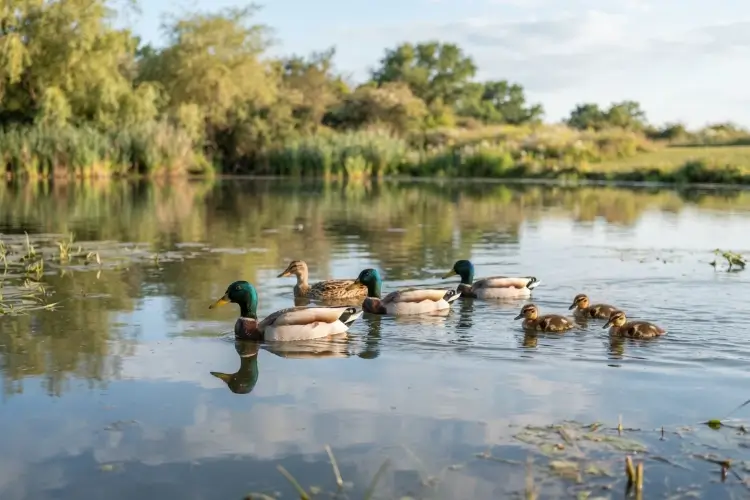
Ducks are happiest in groups. On the water, that group is called a paddling, and the extra eyes help protect against predators.
Curious what other animals call their crews? Here are more animal group names from A to Z.
There’s one major exception: the Muscovy duck, which tends to live solo, in pairs, or in small groups.
Duck Life Cycle Facts
A duck’s life cycle runs from a coordinated hatch to a lifespan that can reach about two decades.
From Egg to Duckling: What Actually Happens
Here’s the timeline, step by step. These figures are for mallards unless noted.
- Eggs are laid. A hen lays about one egg per day, with an average clutch of 8 or 9 eggs.
- Incubation waits. It doesn’t start until the last egg is laid, so every duckling develops on the same schedule.
- Incubation lasts about 28 days. Muscovy ducks take longer, closer to 35 days.
- Ducklings communicate inside the egg, which helps them hatch together.
- Ducklings walk within hours of hatching, and can even leap.
- The hen tends her brood for about 8 weeks, by which point the ducklings can fly.
That fourth step is the one that gets people. Ducklings are coordinating their own birth.
How Long Do Ducks Live?
It depends on the species and the circumstances.
Well cared for ducks can live up to about 20 years. In the wild, mallards typically live 5 to 10 years, though the oldest documented wild mallard, a banded drake, was at least 27.
The gap comes down to predators, disease, and food scarcity.
Duck Flight, Speed, and Migration Facts
Ducks at a glance:
- About 30 mph: typical cruising speed for a mallard. Recorded bursts range from roughly 55 to 70 mph depending on the source.
- 200 to 4,000 feet: typical migration altitude for most ducks.
- 21,000 feet: the altitude at which a jet struck a mallard over Nevada, the highest documented flight by North American waterfowl.
- About 200 feet: how deep long-tailed ducks can dive, according to the Cornell Lab of Ornithology. Ducks Unlimited cites a reported catch of more than 80 of them in fishing nets at 240 feet.
- Millions: the number of migrating ducks and geese that jammed radar and grounded flights in Omaha and Kansas City after a November 1995 blizzard.
So who’s the best diver of all North American waterfowl? That title goes to the long-tailed duck, which spends three to four times longer underwater than at the surface while feeding.
What Ducks Eat (and What You Should Never Feed Them)
Ducks are omnivores. In the wild, that means:
- Grass and aquatic plants
- Insects
- Fruit and seeds
- Fish and crustaceans
Why Bread Is Bad for Ducks
Here’s the truth nobody tells you at the park: that loaf of bread you’re tossing is doing real harm.
Wildlife agencies link bread to a condition called angel wing, where the wrist joint grows at the wrong angle and the wing feathers stick out sideways. Birds with angel wing can’t fly. The Indiana Department of Natural Resources notes that most cases are caused by bread handed out by well-meaning people.
The simple fix? If you want to feed ducks, offer a mix of corn, peas, oats, lettuce, or bird seed instead.
And if that bread was just leftovers, there are plenty of ways to reuse food waste that work better for everyone.
Duck Breeds and Types
Ducks fall into two broad camps, wild and domestic, and nearly every domestic breed traces back to the mallard.
Wild vs. Domestic Ducks
| Wild Ducks | Domestic Ducks | |
| Origin | Naturally occurring species | Descended from the mallard or the Muscovy |
| Domestication | None | Estimates range from about 500 to about 3,000 years |
| Common purpose | N/A | Eggs, meat, feathers, pets |
Key Breeds to Know
- Mallard: the ancestor of nearly all domestic duck breeds, with the Muscovy as the exception.
- Pekin: the most popular domestic duck breed in the U.S.
- Muscovy: domesticated separately from the mallard, and more solitary than most ducks.
Fun and Surprising Duck Facts
A few more, just because they’re too good to leave out.
- Ducklings can walk, and even leap, just hours after hatching.
- A duck’s bill has many touch receptors, similar to our fingertips.
- Mallard drakes shed all their flight feathers at once and stay flightless for about a month.
- Feathers make up roughly one sixth of a duck’s body weight.
- Waterfowl can have as many as 12,000 separate skin muscles for feather control.
- In 1973, hundreds of ducks fell from the sky onto Main Street in Stuttgart, Arkansas, most likely killed by hail.
Still hungry for trivia? Here are more random animal facts that may surprise you.
Ducks and Humans
Humans have kept ducks for a very long time. Estimates for domestication range from about 500 years to around 3,000, depending on the source and what counts as “domesticated.”
That relationship has a conservation side too. Habitat loss is considered the greatest threat to mallards. And the Labrador duck, once found in North America, went extinct. Biologists suspect new predators or changes in its food supply.
Because here’s the thing: ducks aren’t just backyard birds and park visitors. They depend on healthy wetlands, and they’re easy to take for granted until those wetlands are gone.
Key Takeaways
If you remember nothing else, remember this.
Ducks sleep with one eye open to watch for predators. They keep their body heat even in cold water. They coordinate their own hatching. Some dive around 200 feet down, and one mallard was struck by a jet at 21,000 feet.
And none of it happens by accident. Every strange, surprising duck fact on this list is really just evolution solving a problem, one wetland at a time.