You’re outside. Something big swoops overhead. Your brain fires off one question immediately.
Hawk or falcon?
Here’s the truth nobody tells you: even experienced birders pause on this one sometimes. Hawks and falcons look like cousins from a distance. Same hooked beak. Same sharp talons. Same predatory silhouette cutting across the sky.
But they’re not cousins. Not really.
Once you know what to look for, telling them apart takes about three seconds. This guide breaks down exactly how.
Hawk vs Falcon: The Quick Answer
Hawks and falcons are both birds of prey, but they’re not closely related. Hawks belong to the family Accipitridae and have broad, rounded wings built for soaring. Falcons belong to the family Falconidae and have long, pointed wings built for speed.
The fastest way to tell them apart in flight? Look at the wings.
Broad and rounded means hawk. Long and pointed means falcon.
That’s the one rule that works from farther away than any other field mark on this page. Everything below builds on it.
Here’s the fast comparison, side by side:
| Trait | Hawk | Falcon |
| Family | Accipitridae | Falconidae |
| Wing shape | Broad, rounded | Long, pointed |
| Body length | 18 to 30 inches (varies by species) | 8 to 26 inches (varies by species) |
| Top dive speed | Up to about 120 mph | Up to about 240 mph |
| Hunting style | Ambush from a perch, kills with talons | Aerial pursuit, kills with its beak |
| Tail shape | Long, fanned, rounded | Narrower, straight-edged |
Keep that table in your back pocket. We’ll come back to almost every row.
Are Hawks and Falcons Even Related?
Not as closely as you’d think.
Hawks and falcons look alike because of convergent evolution, not shared ancestry. They both needed to become efficient hunters of the sky, so nature gave them similar tools: hooked beaks, sharp talons, keen eyesight. But they arrived at those tools from two completely different branches of the bird family tree.
Different Families, Different Order
Hawks sit in the family Accipitridae, under the order Accipitriformes. This family also includes kites, buzzards, and harriers. Falcons sit in a separate family entirely: Falconidae, under the order Falconiformes.
Genetically, falcons are actually closer to parrots and songbirds than they are to hawks.
I know. It’s one of those animal unusual facts that surprises almost everyone the first time they hear it.
Why People Confuse Them Anyway
Because “hawk” gets used loosely.
In everyday conversation, especially in North America, people say “hawk” to describe almost any mid-sized bird of prey they see circling overhead. It’s an informal catch-all, not a strict scientific label. That’s a big part of why the confusion sticks around.
So if you’ve ever pointed at a falcon and called it a hawk, don’t feel bad. You’re in good company. But now you get to be the person in the group who actually knows the difference.
7 Ways to Tell a Hawk from a Falcon
This is the part you came for. Here are the seven field marks that actually work, ranked in the order you’ll be able to spot them.
1. Wing Shape (the fastest ID method)
Start here. Every time.
Hawks have broad, rounded wings with “fingered” tips, meaning the primary feathers spread apart like fingers at the edge. This shape is built for soaring and catching thermal currents, letting a hawk glide for long stretches without flapping.
Falcons have long, pointed wings with a sleek, unbroken outline. This shape is built for one thing: speed. There’s no better silhouette for cutting through the air fast.
If you remember nothing else from this article, remember this: broad and rounded means hawk, long and pointed means falcon.
2. Tail Shape and Length
The tail backs up whatever the wings already told you.
Hawks typically have long, wide, fan-shaped tails. That tail acts like a rudder, giving them the maneuverability to twist through trees and dodge branches while chasing prey through wooded terrain.
Falcons have narrower, straighter-edged tails built for stability at high speed, not tight turns.
3. Body Size
Size alone is not a reliable identifier, and here’s why: a small hawk species can look about the same size as a large falcon species.
But as a general pattern, hawks run bigger. Body length across the many types of hawks ranges from roughly 18 to 30 inches. Falcons typically run from about 8 to 26 inches.
The simple fix? Use size as a tiebreaker, never as your first clue. Wing shape gets you there faster and more reliably.
4. Flight Pattern
Watch how the bird moves, not just what it looks like standing still.
Hawks tend to fly in a “flap-flap-glide” rhythm. A few slow wingbeats, then a long, soaring glide. It’s an efficient, energy-conserving style built for a bird that spends a lot of time waiting and watching.
Falcons fly with quick, tight wingbeats and short bursts of gliding. Their movement reads as sharper and more urgent, because it is. Falcons chase prey in open air, and that requires constant acceleration.
5. Beak Shape (the “falcon tooth”)
Look closely at the beak, and you’ll find one of the clearest anatomical differences between these two birds.
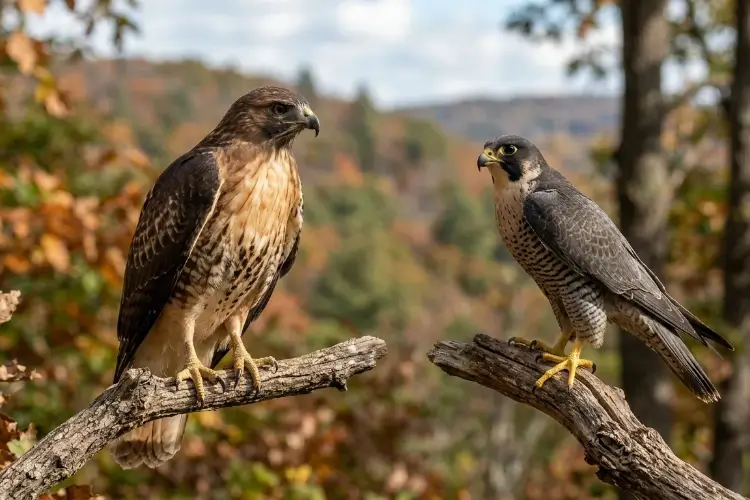
Falcons have a small notch, sometimes called a “tomial tooth,” near the tip of the upper beak. It looks like a tiny hook within the hook. Falcons use it to sever the spine of prey they’ve caught mid-air, killing quickly and cleanly during flight.
Hawks don’t have this notch. Their beak is a smooth curve, and they rely far more on their feet than their beak to finish the job.
6. Hunting Style
This is where the two birds diverge the most in behavior.
Hawks typically hunt by ambush. They perch quietly, scan the ground, then dash out to grab prey with their talons. A red-tailed hawk killing prey almost exclusively with its feet is a textbook example of this style.
Falcons hunt on the wing, meaning they catch and often kill prey while both birds are still in the air. That high-speed dive you’ve probably seen in nature documentaries, called a stoop, is a falcon hunting technique. Hawks don’t really do this.
7. Face and Eye Markings
The last clue is the subtlest, and the one most people never notice until it’s pointed out.
Falcons frequently show a dark “mustache” mark, a vertical streak below the eye that looks almost like war paint. This marking is thought to help reduce glare during high-speed daytime hunting, similar to the eye black athletes wear.
Hawks generally lack this marking, and their facial coloring tends to be more uniform.
Speed Showdown: Which Is Faster, a Hawk or a Falcon?
Falcon, and it’s not particularly close.
The peregrine falcon holds the title of fastest animal on Earth, not just the fastest bird. In a hunting stoop, a peregrine falcon can exceed 200 miles per hour, with some measurements putting the top speed even higher.
Compare that to a red-tailed hawk, one of the fastest hawk species, which tops out around 120 miles per hour in a dive.
Both numbers are genuinely fast. But one bird is built for sustained straight-line speed, and the other is built for controlled bursts. That difference in purpose is the whole story here.
Because: falcons evolved to chase birds through open sky, where raw speed wins. Hawks evolved to ambush prey on the ground or in trees, where agility and timing matter more than top speed.
Common North American Species to Know
Field marks are useful, but nothing cements identification like knowing the actual birds you’re most likely to see.
Red-Tailed Hawk
The red-tailed hawk is the hawk most North Americans have already seen, whether they realized it or not. Look for a broad, rust-colored tail (hence the name), broad rounded wings, and a habit of perching on highway light poles, scanning fields for rodents.
Cooper’s Hawk
A woodland specialist. Cooper’s hawks are built to chase smaller birds through dense trees, which is why you’ll often spot one near a backyard bird feeder, patiently waiting for an easy meal.
Peregrine Falcon
The speed record holder. Once endangered, the peregrine falcon has made a strong comeback and now nests on tall buildings and bridges in major cities, treating skyscrapers like the cliff faces its ancestors used.
American Kestrel
North America’s smallest falcon, and one of the most colorful raptors you’ll ever see. Look for a compact body, rust and slate-blue coloring, and a habit of hovering in place over open fields while scanning for insects and small prey.
Hawk vs Falcon vs Eagle
Quick detour, because this question comes up almost every time.
Eagles are the largest of the three, with wingspans that can top seven feet. Where hawks and falcons rely on speed, agility, or ambush, eagles rely on raw size and power, often overwhelming prey rather than outmaneuvering it.
So where do you start when you’re not sure which of the three you’re looking at?
- If it’s enormous and looks almost too big to be real, it’s probably an eagle.
- If the wings are broad and rounded and it’s soaring in slow circles, it’s probably a hawk.
- If it’s sleek, fast, and cutting a straight line across the sky, it’s probably a falcon.
Habitat and Nesting Differences
Where a bird chooses to raise its young says a lot about how it lives the rest of its life too.
Hawks generally prefer to nest in trees, building sturdy stick nests high in the canopy. Some species will nest on cliffs or even the ground, but trees remain the most common choice. Their eggs tend to be off-white, marked with brown spots.
Falcons take a different approach. Many species nest in tree cavities or directly on cliff ledges, often skipping nest-building altogether and simply laying eggs on a bare ledge. Falcon eggs tend to range from dull white to a darker tan, marked with reddish-brown spots.
By the way: this cliff-nesting instinct is exactly why peregrine falcons adapted so well to cities. A skyscraper ledge looks a lot like a cliff if you’re a falcon.
Quick Recap: Your 10-Second Field Check
Next time something swoops overhead, run through this list.
- Check the wings first. Broad and rounded means hawk. Long and pointed means falcon.
- Look at the tail. Wide and fanned means hawk. Narrow and straight-edged means falcon.
- Watch the flight pattern. Slow flap-flap-glide means hawk. Quick, sharp wingbeats mean falcon.
- If you’re close enough, check the face. A dark “mustache” mark points to falcon.
- When in doubt, size up the moment, not just the bird. Ambush from a perch is a hawk move. A high-speed dive out of nowhere is a falcon move.
You don’t need a field guide in your pocket for this one anymore. You just need to know where to look.
Because once you see the difference between a hawk and a falcon clearly, one time, you’ll never confuse them again.