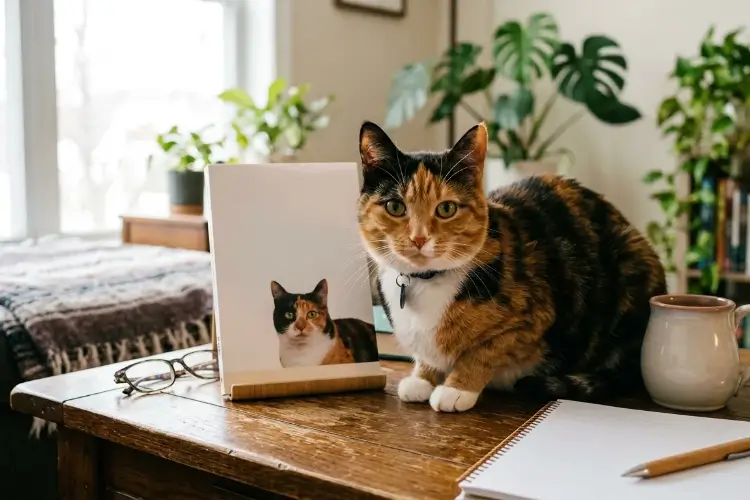
You’ve probably heard it before: calico cats are basically always girls.
It sounds like one of those old wives’ tales people repeat without ever checking. A little too neat to be real.
But it is real. And the science behind it is even more interesting than the myth.
The short answer: only about 1 in 3,000 calico cats is male. It comes down to how coat color genes ride along the X chromosome. When you understand that one detail, the whole mystery unlocks.
So let’s break it down. No dense genetics textbook, just the simple version.
What Makes a Cat Calico in the First Place
A calico isn’t a breed. It’s a coat pattern.
Here’s the truth nobody tells you: you could have a calico Persian, a calico Maine Coon, or a scrappy calico barn cat with no pedigree at all, and none of that changes the pattern. Calico just means a coat with distinct patches of white, black, and orange.
Why it matters here: because that pattern is a genetic event, not a breed trait, it can be studied the same way across every single cat on the planet. That’s how scientists eventually cracked it.
The Colors Live on the X Chromosome
Here’s the part that actually explains everything.
The genes that control black and orange fur sit on the X chromosome. Not just “related to” it. Literally coded on it.
That single fact is the whole reason male calicos are rare.
Why Almost Every Calico Is Female
Female cats have two X chromosomes.
That’s the key. One X chromosome can carry the instructions for orange. The other can carry the instructions for black.
During development, each cell in a female cat’s body randomly shuts off one of her two X chromosomes. Some patches of skin keep the orange X active. Others keep the black X active.
The result? Patchwork. That’s your calico.
Male cats, on the other hand, have one X and one Y. One X chromosome means one color instruction, not two. A typical male cat simply doesn’t have the genetic real estate to show both orange and black at once.
By the way: this is also why orange tabby cats are so often male. Same X-linked gene, just a different starting setup. It’s the kind of detail that shows up a lot once you start digging into random animal facts, nature has a habit of hiding its strangest logic in plain sight.
So How Does a Male Calico Cat Happen?
If male cats only have one X chromosome, how does a male calico exist at all?
Two ways. Both are genuinely rare.
Klinefelter Syndrome (XXY)
This is the main cause, and it’s the same basic condition that shows up in humans under the same name.
Some male cats are born with an extra X chromosome. Instead of the usual XY, they end up XXY.
That extra X is enough. It gives him two color instructions to work with, just like a female cat, while the Y chromosome still makes him male.
The catch? Klinefelter males are almost always sterile. That extra chromosome disrupts normal reproductive development, so it’s not a trait that can be intentionally bred for.
Chimerism, the Rarer Second Cause
Occasionally, a male calico happens a completely different way.
Two separate embryos, each with different genetics, fuse together very early in development into a single cat. That cat ends up with two distinct sets of cells living side by side in one body.
If one embryo was genetically “orange” and the other was “black,” you get a calico male with a totally normal XY chromosome pair. No Klinefelter syndrome involved at all.
This is far less common than the XXY route, but it does happen.
How Rare, Exactly?
Numbers help make this real. Here’s what the data says:
- Roughly 1 in 3,000 calico cats is male
- Of those rare males, only about 1 in 10,000 is fertile
- Most male calicos are the result of Klinefelter syndrome (XXY), not chimerism
That second stat is worth sitting with for a second. It means a fertile male calico isn’t just rare. It’s rare within rare.
The 2025 Discovery That Finally Solved the Mystery
For over a hundred years, scientists suspected the orange color gene lived on the X chromosome. They just couldn’t find it.
That changed in May 2025.
Two independent research teams, one at Kyushu University in Japan and one at Stanford University, published studies in the journal Current Biology identifying the exact gene responsible. It’s called ARHGAP36.
Here’s the surprising part. The mutation isn’t in a part of the gene that changes the protein itself. It’s a small deletion in a non-coding region nearby, one that ramps up the gene’s activity specifically inside pigment-producing skin cells.
The simple fix, translated into plain English: that deletion tells pigment cells to “turn up” orange coloring wherever it’s present. Combine that with two X chromosomes and random X-inactivation, and you get the calico patchwork.
Interestingly, ARHGAP36 wasn’t even on scientists’ radar for coat color before this. It’s a gene known mostly for its role in development and cell signaling elsewhere in the body. Nobody expected it to be the answer.
Why does this matter beyond the cat trivia? Because ARHGAP36 is active in a lot of places in the body, not just skin. Researchers are now curious whether this same gene quirk might connect to other traits, though that part of the story is still unfolding.
Can Male Calico Cats Have Kittens?
Almost never.
Because most male calicos have Klinefelter syndrome, they’re typically sterile. The extra X chromosome interferes with normal sperm production.
The rare exceptions are usually chimeric males, since their reproductive systems aren’t affected by an extra chromosome the same way.
Bottom line: if you have a male calico, don’t expect kittens. And that’s fine. It doesn’t make him any less special.
Are Male Calico Cats Worth More Money?
This is where the internet loves to exaggerate.
You’ll see claims that male calicos are worth thousands of dollars. It’s mostly folklore, and it doesn’t hold up.
Here’s the truth nobody tells you: rarity alone doesn’t create market value. Breeding value does. And since male calicos can’t reproduce, breeders have no reason to pay a premium for one.
That said, there’s real cultural history behind the idea that they’re lucky. In Japan, calico cats inspired the maneki-neko, the “beckoning cat” figure placed near business entrances for good fortune. Sailors historically kept calicos on ships, and male calicos were considered especially lucky charms because of how rare they were.
So are they lucky? Maybe, in the folklore sense. Are they valuable in dollars? Not really. A male calico is a genuinely rare cat, not a lottery ticket.
Calico vs. Tortoiseshell: What’s the Difference?
People mix these up constantly. Here’s the clean breakdown:
| Trait | Calico | Tortoiseshell | Male Calico |
| Base pattern | White, orange, and black in distinct patches | Orange and black blended, minimal to no white | Same as calico, just in a male body |
| Typical sex | Female | Female | Male (XXY or chimeric) |
| White fur | Present, often 25 to 75% of the coat | Little to none | Present, same as calico |
| Fertility | Fully fertile | Fully fertile | Usually sterile |
Same underlying genetics. The difference between calico and tortoiseshell mostly comes down to the white-spotting gene layering on top of the orange/black pattern.
Do Male Calico Cats Have Health Problems?
Sometimes, yes, and it’s worth knowing about honestly rather than glossing over it.
Klinefelter syndrome in cats can come with a few extra health considerations, similar to how it works in humans. These can include a higher chance of certain metabolic issues and a slightly shorter average lifespan compared to typical cats.
None of this means a male calico can’t live a full, happy life. Most do. It just means routine veterinary care matters, the same as it would for any cat with a known genetic condition.
One important note: even though male calicos are almost always sterile, they should still be neutered. It prevents unwanted territorial behavior and lowers the risk of certain health issues down the line.
Which Cat Breeds Can Be Calico?
Because calico is a pattern and not a breed, it shows up across a wide range of cats, including:
- Persian
- Maine Coon
- American Shorthair
- British Shorthair
- Manx
- Japanese Bobtail
- Turkish Van
It also shows up constantly in mixed-breed and shelter cats. In fact, that’s where most calicos, male or female, actually come from.
Key Takeaways
- Calico is a coat pattern, not a breed, caused by two X chromosomes each carrying a different color instruction.
- Only about 1 in 3,000 calico cats is male.
- Male calicos happen through Klinefelter syndrome (XXY) or, more rarely, chimerism.
- A 2025 study finally identified the exact gene involved: ARHGAP36.
- Most male calicos are sterile, so the “worth thousands of dollars” claim is mostly myth.
- Male calicos can have a few extra health considerations and should still be neutered.
Male calico cats aren’t magic, and they’re not a hidden jackpot. They’re a genuinely rare genetic event, backed by real science that only got fully explained in the last couple of years. It’s the same kind of quiet, beautiful rarity you’ll find elsewhere in nature, like white peacocks, where an unusual genetic twist creates something nobody expects to see. If you ever meet a male calico, you’re looking at something that happens in roughly 1 in every 3,000 calico births.
That’s worth appreciating for exactly what it is.