Quick take:
- Moths outnumber butterflies by roughly 9 to 1, with about 160,000 species worldwide compared to roughly 17,500 butterfly species.
- Several of those species rival or beat butterflies for color, pattern, and sheer size.
- This list walks through 21 standout moths, what makes each one worth stopping for, and how you can actually go see one for yourself.
Butterflies get all the glory. Moths get the porch light and a bad reputation.
That’s the deal we’ve all quietly accepted.
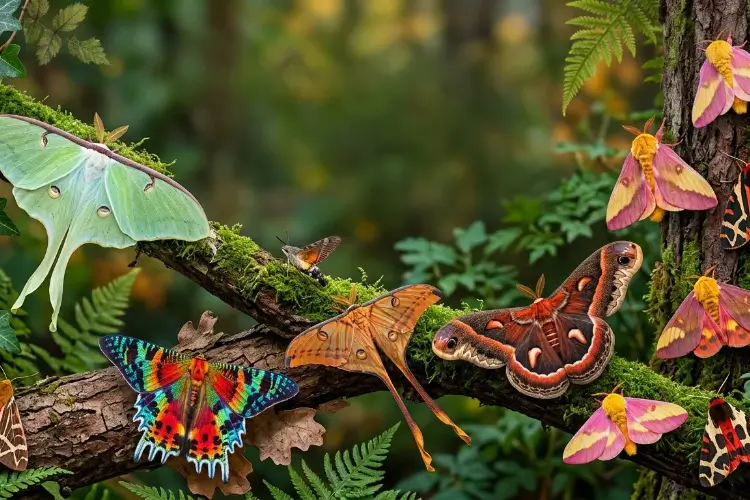
But here’s the truth nobody tells you: some of the most visually stunning insects on Earth are moths, not butterflies. The Madagascan sunset moth. The luna moth. The atlas moth, which is so big it’s genuinely been mistaken for a bat mid-flight.
So where do these ideas about “boring brown moths” even come from?
Mostly from the ones we notice. The sweater-eaters. The ones bashing themselves against your porch light at 11pm. Those species exist, sure. But they’re a tiny, unglamorous slice of a much bigger, much stranger, much more colorful family.
I started paying attention to moths a few years ago, almost by accident, after a cecropia moth landed on my screen door one night and I genuinely thought it was a bat at first glance. That single moment changed how I look at every moth I see now.
Below are 21 species that prove moths deserve their own spotlight. Not a runner-up spot behind butterflies. Their own.
Are Moths Really More Beautiful Than Butterflies?
Short answer? Some of them, yes. Easily.
Moths and butterflies both belong to the insect order Lepidoptera. They’re cousins, not rivals, even though we’ve turned them into a beauty contest.
Here’s the thing: butterflies are diurnal, meaning they’re active during the day, right when we’re around to see them. Most moths fly at night, which is exactly why we assume they’re dull. We’re simply not seeing them at their best.
But: Plenty of moths are day-flying, too. And when they are, they’re often just as vivid as any butterfly, sometimes more so.
That vivid coloring isn’t random, by the way. In species like the Madagascan sunset moth, those iridescent rainbow wings aren’t there to look pretty for us. They’re a warning. The moth is toxic, and its coloring tells predators to back off. Nature’s version of a hazard sign, just dressed up like a stained-glass window.
The simple fix? Stop judging the whole group by the ones you’ve seen circling a lightbulb. This list is the reintroduction.
How Moths and Butterflies Actually Differ
Before we get into the list, it helps to know what you’re actually looking at when you spot one of these in the wild.
| Feature | Moths | Butterflies |
| Antennae | Feathery or threadlike | Thin with a club-shaped tip |
| Wings at rest | Usually flat or tented over the body | Usually held upright, folded together |
| Active hours | Mostly nocturnal, some day-flying | Almost always diurnal |
| Body | Often thicker, fuzzier | Usually slimmer, smoother |
| Life stage cocoon | Silk cocoon | Hard chrysalis |
Keep that table in your back pocket. Once you know what to check, telling the two apart takes about two seconds.
The 21 Most Beautiful Moth Species in the World
Ready to meet them? These 21 moths prove the stereotype wrong.
1. Luna Moth (Actias luna)
The luna moth is the moth that made me a moth person.
Pale green wings, long trailing hindwing tails, a wingspan that can stretch past four inches. Found across the eastern United States, it’s a member of the Saturniidae family, better known as the giant silk moths.
Here’s the wild part: adult luna moths don’t eat at all. They live for about a week, just long enough to mate and lay eggs, running entirely on energy stored up as a caterpillar.
2. Atlas Moth (Attacus atlas)
The atlas moth is one of the largest moths on the planet and a contender for the largest insect in the world, with a wingspan that can hit 10 to 11 inches.
That’s not an exaggeration. People genuinely mistake atlas moths for bats when they’re in flight. Found across Southeast Asia’s tropical and subtropical forests, its wings are burnt orange, rust, and black, with striking curved wingtips that look almost like a snake’s head, a trick that helps ward off predators.
Even its cocoon is famous. In Taiwan, they’ve historically been repurposed into small purses.
3. Madagascan Sunset Moth (Chrysiridia rhipheus)
If one moth was built to make you rethink the whole “moths are dull” thing, it’s this one.
The Madagascan sunset moth flies during the day, has iridescent, rainbow-colored wings, and is frequently mistaken for a butterfly on sight. It was so prized during Queen Victoria’s era that people used its wings to make jewelry.
Here’s the twist: that dazzling color isn’t decoration. It’s a warning. This moth is toxic, and its shimmering wings tell predators exactly that.
4. Spanish Moon Moth (Graellsia isabellae)
Also called the stained-glass moth, and once you see it, you’ll understand why.
Its pale green wings look almost translucent, with delicate patterns that catch light the way antique glass does. Found in the mountains of France and Spain, it’s often considered the most beautiful moth species in Europe, and it’s among the few moth species granted protected status. Its larvae feed exclusively on pine trees.
5. Madagascan Moon Moth / Comet Moth (Argema mittrei)
Another Madagascar native, and another saturniid with serious tail envy.
Its hindwings trail out into long, ribbon-like tails that resemble a comet’s streak, which is exactly where the nickname comes from. Argema, its genus name, is Greek for “speckled eye,” a nod to the prominent eyespots on its wings.
6. Rosy Maple Moth (Dryocampa rubicunda)
The rosy maple moth looks like it was designed by a candy company.
Pink and yellow wings, a fluffy little body, and it’s the smallest of the North American silk moths. Don’t let the size fool you, though: this is one of the most photographed and shared moths on the internet, and for good reason. It looks unreal in person.
7. Cecropia Moth (Hyalophora cecropia)
This is North America’s largest native moth, and it’s the one that started my whole moth obsession.
Reddish-brown wings with white crescent markings and bold eyespots. Adult males can find females from over a mile away, tracking pheromones through the night air like something out of a nature documentary.
If you ever watch one emerge from its cocoon and dry its wings for the first time, you won’t forget it.
8. Polyphemus Moth (Antheraea polyphemus)
Named after the one-eyed giant from Greek mythology, thanks to its enormous eyespots.
Found across nearly all of North America, the Polyphemus moth has a wingspan that can reach up to 6 inches. Its forewing eyespots are small and yellow, while the hindwing eyespots are larger, yellow, and ringed in black and white, giving the whole moth a startling, almost owl-like face when its wings are spread.
9. Io Moth (Automeris io)
Another eyespot specialist, and one of the most dramatic examples in the moth world.
The Io moth’s forewings are a soft yellow or reddish-brown, but flip to the hindwings and you’ll find two massive, dark eyespots ringed in black and blue. When threatened, it flashes those hindwings suddenly, a startle tactic aimed squarely at predators who’d rather not stare down what looks like a much bigger animal’s eyes.
10. Garden Tiger Moth (Arctia caja)
Bold, patterned, and unmistakable. The garden tiger moth’s forewings are a chocolate-brown maze of cream markings, while its hindwings flash bright orange with dark spots when exposed.
Found across Europe, it belongs to the Erebidae family. Its caterpillar is just as memorable: a fuzzy, spiky “woolly bear” that looks like a tiny mutant porcupine.
11. Elephant Hawk-Moth (Deilephila elpenor)
The adult moth is a striking mix of pink and olive green, but the name actually comes from the caterpillar, which has a trunk-like front end that genuinely resembles a small elephant when it retracts its head.
It’s a common sight across much of Europe and Asia, and its coloring makes it one of the most photogenic hawk moths out there.
12. Oleander Hawk-Moth (Daphnis nerii)
Sometimes called the army green moth, and it’s easy to see why once you look at the streaky, camouflage-like pattern across its wings.
Despite its name, the oleander hawk-moth doesn’t stick strictly to oleander. It’ll happily nectar on honeysuckle, petunias, and plenty of other flowering plants, making it a fairly common sight across warm regions of Europe, Africa, and Asia.
13. Death’s-Head Hawkmoth (Acherontia atropos)
Yes, this is the moth from The Silence of the Lambs. It earns its ominous name honestly, thanks to a skull-shaped marking right on its thorax.
Beyond the horror-movie fame, it’s a genuinely striking insect: large, richly patterned in browns and golds, and capable of a surprising trick. It can squeak audibly when disturbed, which is not something you expect from a moth.
14. White Ermine Moth (Spilosoma lubricipeda)
Not every beautiful moth needs bold color to earn the title.
The white ermine’s wings are crisp white, dotted with small black spots, giving it a look somewhere between elegant and understated. It’s a common species across Europe, and it’s proof that sometimes simplicity is its own kind of striking.
15. Bella Moth / Ornate Moth (Utetheisa ornatrix)
Also known as the rattlebox moth, the bella moth is unusual for one big reason: it’s diurnal, flying readily in daylight rather than hiding until dark like most of its relatives.
Its wings are a patchwork of pink, yellow, and white, with a pattern that looks almost hand-painted. Because it flies by day, it’s one of the more commonly seen beautiful moths, rather than one you have to go looking for at night.
16. Joseph’s Coat Moth (Agarista agricola)
Named after the biblical coat of many colors, and it absolutely earns the reference.
Black wings streaked and blotched with yellow, white, iridescent blue, and red, with a yellow thorax that looks almost like a cape draped over its shoulders. Found in the woodlands of Australia and New Guinea, it’s a day-flying species with a wingspan up to 2.75 inches.
17. Eight-Spotted Forester (Alypia octomaculata)
Small, fast, and frequently mistaken for a bumblebee at first glance, which tells you a lot about how unusual this moth looks compared to its relatives.
Found across much of North America, it has dark wings marked with bold cream-colored spots. Keep an eye on dogwood blossoms in spring. That’s often where you’ll catch one nectaring.
18. Cinnabar Moth (Tyria jacobaeae)
Bright, bold, and impossible to miss. The cinnabar moth’s forewings carry elegant red markings, while its hindwings are a solid, scarlet red.
Common across Europe, its caterpillars feed on poisonous ragwort leaves, and that toxicity gets passed along to the adult moth. The bright coloring is, once again, a warning label written in red.
19. Calleta Silkmoth (Eupackardia calleta)
Found across Mexico, Guatemala, and the American Southwest, the calleta silkmoth is a saturniid with rich, dark wings and pale, eye-catching markings.
Like several moths on this list, adults don’t eat at all once they emerge. Every bit of energy they’ll ever use came from their caterpillar stage.
20. Achemon Sphinx (Eumorpha achemon)
Large brown wings marked with prominent, squarish dark spots make the Achemon sphinx easy to identify at rest. Spread those wings, though, and it reveals a surprise: bright pink hindwings hidden underneath.
Found across most of the US except the Pacific Northwest, it’s known among vineyard owners as a pest thanks to its voracious appetite for grape leaves. Beautiful and destructive, apparently, aren’t mutually exclusive.
21. Southern Flannel Moth (Megalopyge opercularis)
The southern flannel moth looks almost too soft to be real, with a dense, fuzzy yellow body and pink legs that make it look more like a tiny stuffed animal than an insect.
A quick word of caution here: don’t touch one. Underneath all that soft-looking fuzz are hidden stinging hairs that can deliver a genuinely painful sting. Found across the southeastern US, it’s a great reminder that beautiful doesn’t always mean harmless.
Where to Actually See Beautiful Moths Near You
So how do you go from reading about these to actually seeing one?
It’s easier than you’d think.
Best times to look:
- Most species are active from dusk until a couple hours after dark
- Warm, humid, low-wind nights tend to bring out the most activity
- A handful of species on this list, like the bella moth, sunset moth, and Joseph’s coat moth, fly during the day, so daylight garden-watching works too
A simple setup I’ve used myself:
- Hang a white bedsheet outside near a garden or wooded edge
- Point a UV or mercury vapor light at the sheet (a regular porch light works in a pinch, just less effectively)
- Turn it on right after dusk and check back every 20 to 30 minutes
- Bring a camera with a flash, since most photos turn out best up close
Give it one clear night. You’ll likely be surprised by how much shows up.
Give Moths Their Moment
Butterflies didn’t earn their reputation by being better looking. They earned it by showing up when we’re awake to notice.
Moths have been quietly outdoing them in color, pattern, and sheer scale this whole time. You just had to know where, and when, to look.
Next warm evening, try the sheet-and-light setup above. Or just pay closer attention to what’s circling your porch light tonight.
You might be standing three feet from a luna moth and not even know it.