Laundry day doesn’t feel like an environmental issue. It’s just a chore.
But it is one. Every load uses water, energy, and, more often than not, a plastic bottle you’ll throw away in a few weeks.
Zero waste laundry is about closing those gaps. Not perfectly. Not overnight. Just with a handful of swaps that actually stick.
Here’s what that looks like.
Quick summary:
- Zero waste laundry means cutting plastic, water, and energy waste from your wash routine, not buying a cabinet full of “eco” products.
- Cold water, full loads, and washing less often do more for your footprint than almost any product swap.
- A few one-time changes (detergent sheets, a microfiber bag, wool dryer balls) handle the rest.
- None of this requires starting from scratch. Use what you already own first.
What “Zero Waste Laundry” Actually Means
Zero waste laundry is the practice of doing your washing in a way that produces as little landfill trash, plastic packaging, and wastewater pollution as possible.
That’s it. It’s not a purity test.
Zero waste vs. eco-friendly vs. green: these terms get used interchangeably, but they’re not the same thing.
- Eco-friendly usually means a single product claim, like “biodegradable formula.”
- Green is marketing language, often with nothing behind it.
- Zero waste looks at the whole routine: the packaging, the water, the energy, and what happens to your clothes at the end of their life.
So when I talk about a zero waste laundry routine, I mean all of it. Not just which detergent bottle you buy.
If you’ve already started making zero waste swaps in your bathroom, or picked up a few zero waste cleaning hacks around the house, this will feel familiar. It’s the same principle, just applied to the laundry room.
Why Your Laundry Routine Matters More Than You Think
Here’s the truth nobody tells you: laundry isn’t just a water-and-electricity problem. It’s a plastic problem too.
The numbers:
- Only about 29% of HDPE plastic bottles, the kind most detergent comes in, actually get recycled in the US (EPA, 2018 data).
- Wool dryer balls can last over 1,000 loads, or roughly 2 to 4 years, before they’re compostable at end of life.
- Switching a full dryer cycle to a lower heat setting, or skipping it for air drying, meaningfully cuts your household’s energy use, since dryers are one of the most energy-hungry appliances you own.
None of that means you need to overhaul your routine tomorrow. It means small, repeated choices add up. That’s the whole game.
The 10 Zero Waste Laundry Tips
None of these require a full routine overhaul. Just pick one and start.
1. Wash clothes less often
Not everything needs a wash after one wear.
Jeans, sweaters, and jackets can go multiple wears before they actually need cleaning. Workout gear and anything visibly stained is the obvious exception.
The fix? Before you toss something in the hamper, ask if it’s actually dirty, or just worn.
2. Switch to cold water
Cold water gets most everyday laundry just as clean as warm, for a fraction of the energy.
Most modern detergents contain enzymes designed to work in cool temperatures. Save warm water for genuinely soiled loads, cloth diapers, or when someone in the house is sick.
3. Only run full loads
A half-empty machine still uses close to a full load of water and energy.
Wait until you have enough for a full wash. If you live with others, this is the easiest habit to build together: one shared hamper, one full load, less waste all around.
4. Choose plastic-free detergent
Liquid detergent in a plastic jug is mostly water. You’re paying to ship water, and that jug is heading to a landfill more often than not.
Better options:
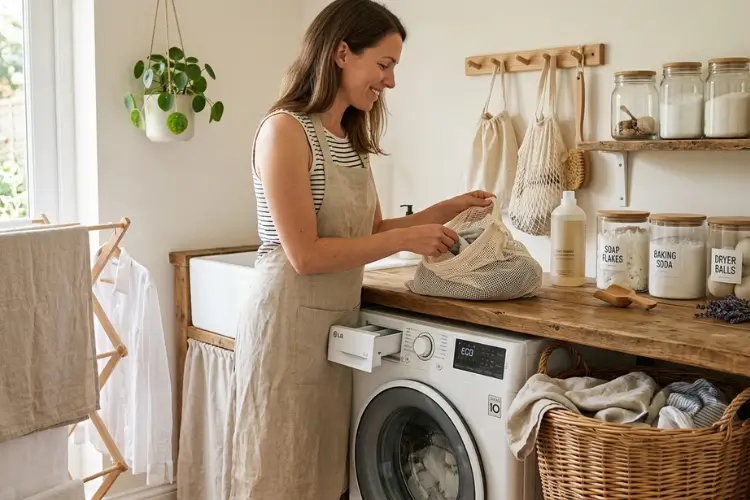
- Detergent sheets that dissolve completely, no bottle required
- Concentrated powder or paste in cardboard packaging
- Refillable detergent from a bulk or local shop, if you have one nearby
By the way: sheets can be slow to dissolve in very cold water. Dissolve them in a splash of warm water first, then top off with cold.
Detergent residue builds up inside the machine itself over time, too, which can slow everything down and even cause odors. A DIY washing machine cleaner routine every few months keeps the machine running efficiently.
5. Catch microfibers before they reach the ocean
Every wash releases tiny plastic fibers from synthetic fabric, and most treatment plants can’t filter them out.
A microfiber-catching wash bag or an in-drum ball reduces how much of that ends up in wastewater. A peer-reviewed comparison of microfiber-catching devices found reductions averaging around 54%, with results ranging from roughly 39% to 78% depending on the device.
Use one specifically for polyester, acrylic, and nylon items. That’s where the shedding happens.
6. Air-dry whenever you can
The simple fix? Skip the dryer when the weather cooperates.
Hanging clothes uses zero extra energy, and it’s gentler on fabric, which means your clothes last longer too. Indoor drying racks work fine when it’s raining or you don’t have outdoor space.
7. Swap dryer sheets for wool dryer balls
Dryer sheets are single-use and coated in synthetic fragrance and chemicals. Wool dryer balls do the same job (reducing static, softening fabric) without the waste.
They also cut drying time, by roughly 30 to 50% depending on your dryer and load, because they help separate clothes and improve airflow inside the dryer.
8. Read the care label
Those little symbols aren’t decoration.
Washing on the wrong setting causes unnecessary fabric shedding and wears clothes out faster, which means more frequent replacement, which means more waste. Two minutes of label-reading saves you money over the life of the garment.
9. Treat stains immediately
A fresh stain, treated right away, rarely needs a full rewash.
Keep a stain stick or a simple vinegar and baking soda mix on hand. Catching it early means you’re not running an extra cycle just because of one mark.
10. Repair instead of replace
This is the one people skip, and it’s arguably the biggest lever.
A loose button, a small tear, a stretched-out waistband. Most of these are fixable in minutes with a basic sewing kit. Fast fashion has trained us to toss and rebuy instead of mend. Leaning into ethical fashion habits, buying less and choosing better, works hand in hand with a zero waste laundry routine, one repair at a time.
Cold Water vs. Warm Water: Which Should You Actually Use?
| Cold Water | Warm Water | |
| Best for | Everyday loads, dark and delicate fabrics | Heavily soiled items, synthetic fabrics |
| Energy use | Low | Higher |
| Fabric impact | Less fading, less shrinking | Can wear out fabric faster over time |
| Germ control | Fine for normal wear | Better when someone in the house is sick |
| Stain removal | Good for fresh, light stains | Better for set-in or greasy stains |
The short version: default to cold. Reach for warm only when the load actually needs it.
How Often Should You Really Wash Your Clothes?
| Item | Suggested Wash Frequency |
| Workout clothes | After every wear |
| Bras | Every 3-4 wears |
| T-shirts, blouses | Every 1-2 wears |
| Jeans | Every 4-6 wears |
| Sweaters | Every 4-6 wears |
| Pajamas | Every 2-3 wears |
| Blazers, suits | Every 5-6 wears |
Use this as a starting point, not a rule. Climate, activity level, and personal comfort all shift these numbers.
Zero Waste Laundry Mistakes to Avoid
- Buying a full set of “eco” products before you need them. Use up what you already own first. Zero waste isn’t about a shopping list.
- Overloading the machine to “save water.” It backfires. Clothes don’t get properly clean, and you end up rewashing.
- Assuming natural fabrics never shed. They shed less than synthetics, but a microfiber catcher still helps with mixed loads.
- Skipping the care label because it’s “just a t-shirt.” Small habits compound. This is one of the cheapest ones to fix.
You Don’t Need a New Routine, Just a Better One
Zero waste laundry isn’t about buying more. It’s about wasting less with what you already have.
Start with one tip. Cold water, or full loads, or just washing less often. Add the next one when the first one feels automatic.
And if you’re ready to carry that mindset past the laundry room, a plastic free morning routine is a natural next place to look.
You don’t need a new wardrobe of eco-products to start. You need three or four better habits, and a willingness to build them slowly.