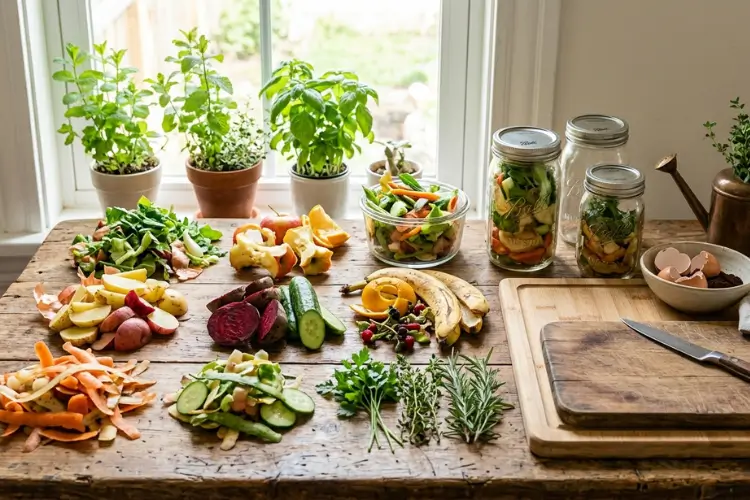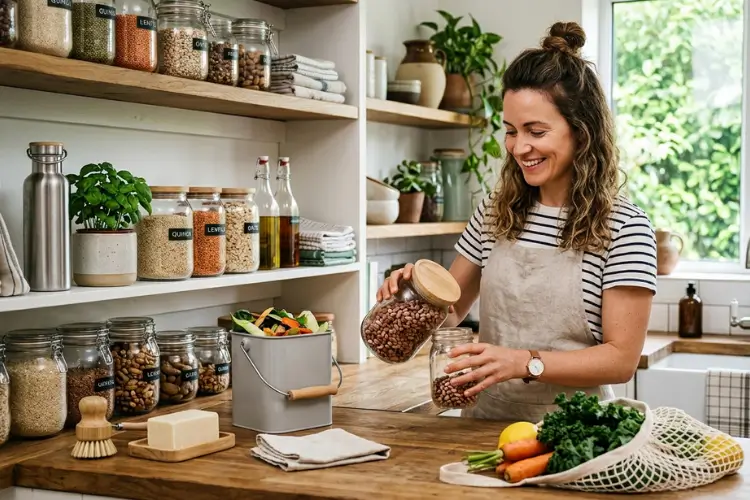
TL;DR: A zero waste kitchen isn’t about producing literally zero trash. It’s about auditing what you actually throw away, then fixing it in order: food first, plastic second, everything else after. Here’s the whole system: audit, shopping, storage, composting, cooking, and a one-week routine to make it stick.
So what does “zero waste kitchen” actually mean?
Not what Pinterest wants you to think.
It doesn’t mean a spotless glass-jar pantry with zero visible packaging. It means your kitchen is set up to send as little as possible to landfill, mostly by wasting less food, replacing single-use plastic where it’s easy, and composting the rest. It’s one piece of a bigger zero waste lifestyle, just scoped to the room where most of your trash actually starts.
That’s it. That’s the whole definition.
Here’s why it matters more than you’d think: food is the single largest category of stuff going into U.S. landfills, bigger than plastic, bigger than paper, bigger than anything else in your trash can.[1] So if you’ve been agonizing over reusable straws while throwing out half a bag of spinach every week, you’ve been solving the wrong problem.
A few numbers worth sitting with:
- The average U.S. household wastes around 73 kg (roughly 160 lbs) of food every single year.[2]
- Food waste makes up close to a quarter of everything sent to municipal landfills.[3]
- The U.S. has a national goal to cut food waste in half by 2030, from a 2016 baseline of 328 lbs per person down to 164 lbs. Right now, we’re nowhere close.[4]
- Most of that wasted food still ends up in landfills, where it breaks down and releases methane, a greenhouse gas far more potent than CO2 in the short term.[5]
That last one’s the part people miss. Composting isn’t a nice-to-have. It’s the difference between food waste being a climate problem and food waste being, well, just dirt again.
Okay. Let’s build the system.
The 5 R’s Framework (And Why Most People Start Backwards)
You’ve probably seen the zero waste “5 R’s” before: Refuse, Reduce, Reuse, Recycle, Rot.
Here’s the truth nobody tells you: most people start at Recycle. That’s backwards. Recycling is the last resort in this list, not the first move.
The order matters, because it’s ranked by impact:
- Refuse what you don’t need: the free sample container, the extra plastic bag at checkout.
- Reduce what you buy: this is where meal planning lives.
- Reuse what you already have, before buying a single “zero waste” product.
- Recycle what’s left, correctly, because most people recycle wrong.
- Rot: compost anything organic instead of trashing it.
Most kitchens I’ve seen jump straight to buying beeswax wrap and mason jars (Reuse) without ever doing the Reduce step first. That’s like buying a gym membership before figuring out why you stopped moving in the first place.
So before you buy anything: audit.
Start Here: A 15-Minute Kitchen Waste Audit
You can’t fix what you haven’t measured. This step gets skipped constantly, and it’s the one that actually changes behavior.
Here’s how to do it:
- Grab a notepad or your phone’s notes app.
- For one week, before you throw anything away (food scraps, packaging, leftovers), jot down what it was and why it happened.
- Don’t change your habits yet. Just observe.
- At the end of the week, sort everything into three buckets: food that spoiled unused, food that was over-prepped, and packaging waste.
How to read your results:
If most of your trash is spoiled produce, your problem is shopping and storage, not lack of willpower.
If it’s over-prepped food, your problem is portioning, not planning.
If it’s packaging, your problem is what you’re buying, not how you’re using it.
By the way: whichever bucket is biggest, fix that one first. Don’t try to overhaul everything at once. That’s how zero waste attempts die by week three.
Zero Waste Food Shopping & Meal Planning
Here’s the tip that does more heavy lifting than every reusable product combined: plan before you shop, not after.
A simple system that actually works:
- Before making a list, check what’s already about to go bad. Build this week’s meals around it.
- Shop with a list and stick to it. Impulse buys are where food waste starts.
- Buy in bulk only for things you’ll actually use up (rice, oats, dried beans). Bulk buying isn’t automatically zero waste if half of it goes stale.
- If you have a bulk store nearby, bring your own containers. If you don’t, buying the largest package size still beats five small ones.
The “use-it-up” system:
Keep one shelf in your fridge, just one, reserved for food that needs to be eaten in the next two days. Nothing else goes on that shelf. It becomes your first stop every time you’re deciding what to cook.
The simple fix? Make the almost-expired food impossible to ignore.
Zero Waste Food Storage: What Actually Replaces Plastic
This is where most “zero waste kitchen” content stops: swap your plastic wrap, done. But not every swap is equal, and some of them aren’t worth it.
| Storage Option | Upfront Cost | Lifespan | Best For | Dishwasher Safe | Compostable at End of Life |
| Plastic wrap | Low, per-use | Single use | Covering bowls short-term | No | No |
| Beeswax wrap | Medium | 6–12 months | Cheese, bread, wrapped produce | No (hand wash) | Yes, if plastic-free |
| Silicone reusable bags | Medium-high | Years | Freezer storage, liquids | Yes | No |
| Glass containers | Medium-high | Indefinite | Leftovers, meal prep | Yes | No, but infinitely reusable |
The honest take: glass containers you already own are the real zero waste MVP, not the trendy beeswax wrap. Reuse what’s in your cupboard before buying anything new. That’s Reuse before Recycle, remember? If you want more swaps like this outside the kitchen, we’ve rounded up more zero waste swaps worth trying.
Composting Without a Backyard
Because: not everyone has a yard. And that shouldn’t be the reason composting stays off the table.
Options that work in an apartment:
- Countertop electric composters: break down scraps in hours, no odor, no outdoor space needed.
- Bokashi bins: a fermentation method that handles meat and dairy scraps most compost systems can’t.
- Community drop-off programs: many U.S. cities now run curbside or drop-off composting; check if yours does.
- Freeze-and-drop: keep a bag of scraps in the freezer, drop it at a farmers market or community garden compost bin weekly.
Here’s the truth nobody tells you: you don’t need a backyard, a tumbler, or a green thumb to compost. You need a container and somewhere to put what’s in it. One thing to watch for once you start: food scraps sitting around can attract pests. If you notice a trail forming, here’s how to get rid of ants without reaching for a chemical spray.
Zero Waste Cooking: Using the Whole Ingredient
This is where the fun actually starts.
Step-by-step: building a scrap stock system
- Keep a gallon freezer bag in your freezer labeled “stock scraps.”
- Every time you cook, add vegetable ends, onion skins, carrot tops, and herb stems to the bag.
- Once it’s full, simmer the contents in water for an hour with a bay leaf and peppercorns.
- Strain, cool, and freeze in portions. That’s instant, free vegetable stock.
Bones work the same way for meat stock. Stems and peels aren’t garbage. They’re flavor you already paid for.
A few more moves worth adopting:
- Broccoli stems and carrot peels roast just as well as the “good” parts.
- Stale bread becomes croutons or breadcrumbs, not trash.
- Herb stems go into stock, not the compost bin, if you’re not composting that week.
Cutting Packaging Waste at the Grocery Store
Because your kitchen’s waste problem often starts before you even get home.
- Choose paper or cardboard packaging over plastic when the product is otherwise identical.
- Buy produce loose instead of pre-bagged. It’s usually cheaper per pound, too.
- Bring your own mesh produce bags; they take up zero extra space in your cart.
- Support farmers markets when you can: less packaging, fresher food, shorter supply chain.
Zero Waste Cleaning & Dishwashing
Quick section, but it counts.
- Swap disposable sponges for a compostable loofah or a washable dish cloth.
- Make an all-purpose cleaner from vinegar, water, and citrus peels you’d otherwise toss. For a more heavy-duty job, this DIY cleaner using vinegar and baking soda handles stuck-on grease and grime without a single toxic ingredient.
- Buy dish soap in bulk refills where available instead of a new plastic bottle every time.
Zero Waste Kitchen on a Budget: What It Actually Costs You (and Saves You)
Because: is this actually cheaper, or just a nicer story we tell ourselves?
| Swap | Upfront Cost | Estimated Annual Savings | Payback Time |
| Meal planning (free) | $0 | $500–$1,500 (less spoiled food) | Immediate |
| Reusable produce bags | $10–$15 | Minimal direct savings | N/A, mostly waste reduction |
| Glass storage containers | $30–$60 | $50–$100 (fewer plastic replacements) | 6–12 months |
| Countertop composter | $150–$400 | Varies by local trash fees | 1–3 years |
| Bulk buying staples | Varies | $100–$300 | Ongoing |
The simple fix that saves the most money? It’s not a product. It’s meal planning. That one’s free.
Common Zero Waste Kitchen Mistakes (What Doesn’t Actually Help)
Here’s the part most articles skip, because it’s less exciting than a product list.
Buying “zero waste starter kits” you’ll never fully use. A drawer full of unused reusable items is still waste. It’s just waste that cost you money.
Composting the wrong things. Meat, dairy, and oily foods can attract pests or slow down a standard compost bin. Bokashi or municipal programs handle these; a backyard pile usually doesn’t.
Treating recycling as a fix for over-buying. Recycling correctly is good. Needing less to recycle in the first place is better.
Going all-in overnight. The kitchens that actually stay low-waste are the ones that changed one habit at a time, not the ones that threw out every plastic item in a single weekend.
If any of this still sounds too good to be true, or too hard to be worth it, it’s worth reading through these common zero waste myths before you decide it’s not for you.
A Sample One-Week Zero Waste Kitchen Routine
- Day 1: Do the 15-minute waste audit. Start the notes list.
- Day 2: Check the fridge, build a “use-it-up” shelf, plan 3 meals around what’s already there.
- Day 3: Grocery shop with a list and your own bags.
- Day 4: Start a scrap bag in the freezer.
- Day 5: Try one new storage swap. Glass containers from your own cupboard count.
- Day 6: Simmer your first batch of scrap stock.
- Day 7: Review the week. What actually stuck? Keep that. Drop the rest.
Progress, not perfection. That’s the whole game.
Zero Waste Is a System, Not a Finish Line
A zero waste kitchen isn’t a finished state. It’s not a photo of an empty trash can.
It’s a system: audit first, fix food waste before plastic, reuse before you buy, and compost what’s left. Start with the one habit that’ll move the needle most for your kitchen, not the one that looks best on Instagram.
Small, honest changes, kept up for months, beat a perfect week that burns out by day ten.
Start with the audit this week. Everything else builds from there. And if the kitchen goes well, our beginner’s guide to zero waste living is the natural next stop for taking it into the rest of your home.