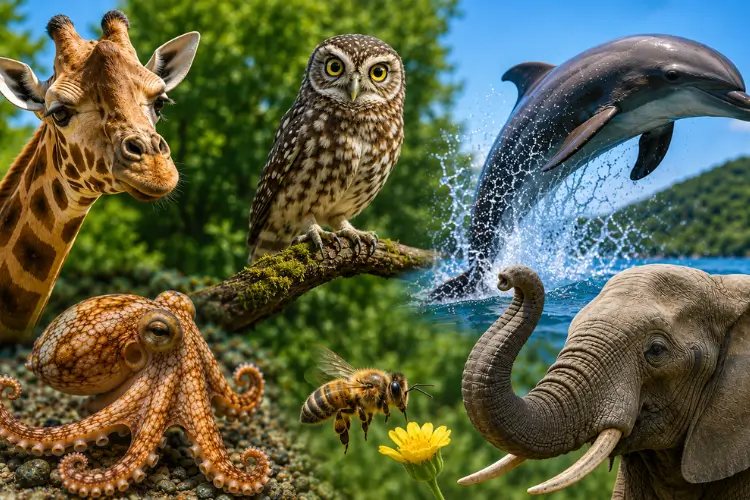
The short answer: Nature is stranger than anything we could make up. Octopuses have three hearts. A shrimp can punch harder than a bullet moves. A jellyfish can turn back into a baby version of itself. Every fact below is real, sourced, and organized so you can actually find the one you’re looking for later.
- 50 verified facts, grouped by theme so you’re not scrolling through chaos
- Real sources named where the claim needs backup
- A stats box and a comparison table if you just want the highlights
- An FAQ section answering the questions people actually ask about weird animals
How we checked these facts
Here’s the truth nobody tells you about “you won’t believe” animal lists: most of them just copy each other.
We didn’t want to do that. Every fact below is checked against a named study, a wildlife organization, or a recognized science publication. Where the science is still debated, we say so.
We’re big on separating myth from fact around here. If you like this kind of debunking, we did the same thing for common bell pepper myths, including the one about counting bumps to tell male from female.
Facts about animal bodies that sound made up
1. Octopuses have three hearts, and one of them stops when they swim. Two hearts pump blood to the gills. The third pumps it to the rest of the body, but it actually stops beating when the octopus swims. That’s part of why octopuses would rather crawl than swim: crawling doesn’t exhaust them the way swimming does.
2. The platypus is one of only two mammals that lay eggs. It has fur. It nurses its young. And it still lays eggs, like a reptile. The only other egg-laying mammal is the echidna, and both belong to a tiny, ancient group called monotremes.
3. A mantis shrimp can throw a punch harder than a .22 caliber bullet leaves the barrel. Researchers at UC Berkeley clocked a mantis shrimp’s strike at 23 meters per second, generating over 1,500 newtons of force, more than 2,500 times its own body weight. The strike is so fast it boils the water around it and can crack aquarium glass.
4. Giraffes have blue-black tongues, and scientists think it’s sunscreen. Giraffes spend hours a day with their tongues out, wrapped around thorny branches. The dark pigment is believed to protect the exposed tissue from sunburn, the same way melanin protects human skin.
5. Tigers have striped skin, not just striped fur. Shave a tiger and you’d still see the pattern underneath. Each tiger’s stripe pattern is unique, the same way a human fingerprint is.
6. Polar bears have black skin under white fur. The fur itself isn’t even white. It’s translucent, and it only looks white because it scatters visible light the way snow does. The black skin underneath helps soak up heat from the sun.
7. A blue whale’s tongue can weigh as much as an elephant. Blue whales are the largest animals to have ever existed, full stop, bigger than any dinosaur. Their tongue alone can weigh around 2.7 metric tons, roughly the weight of an adult African elephant.
Facts about how animals eat, and get eaten
8. Flamingos have to eat with their heads upside down. Their beaks are built to filter food out of muddy water, but the filtering mechanism only works when the beak is inverted. So every flamingo you’ve ever seen feeding was doing it head-down, on purpose.
9. Parrotfish sleep inside a bubble of their own mucus. At night, some parrotfish secrete a mucus cocoon around their entire body. It takes about 30 minutes to form and is thought to mask their scent from predators like moray eels while they sleep.
10. A dung beetle can navigate in a straight line using the Milky Way. When there’s no moon, dung beetles use the band of light from the Milky Way to keep their dung ball rolling in a straight path, avoiding competitors. It’s the first known example of an insect using the stars to navigate.
By the way: if the only insects you’re dealing with are less “Milky Way navigator” and more “marching across your kitchen counter,” here’s how to get rid of ants naturally, no harsh chemicals required.
11. Vampire bats have heat sensors on their nose. These sensors let them find blood vessels close to the surface of an animal’s skin in total darkness, which is how they feed without waking their host.
12. Sea otters use rocks as tools to crack open shellfish. A 2017 study published in Biology Letters suggests otters have likely been doing this for millions of years, tucking a favorite rock into a pouch of loose skin under their arm to use again later.
13. Cats physically cannot taste sweetness. Unlike humans and dogs, cats are missing the taste receptor gene for sweet flavors. So the reason your cat ignores your dessert isn’t pickiness, it’s biology.
14. Giant anteaters can eat up to 30,000 insects a day. Their tongue can extend up to two feet outside their mouth, and that visible length is only about a third of the tongue’s total size, which can retract up to six feet inside their body.
Facts about animal sex, birth, and parenting
15. Seahorses are one of the only species where the males give birth. The female deposits eggs into a pouch on the male’s body. He fertilizes them, carries them, and eventually gives birth to fully formed baby seahorses.
16. Platypuses feed their babies milk without nipples. They don’t have them. Instead, milk seeps out through pores on the mother’s skin, and the babies lap it up.
17. Some female ferrets can die if they don’t mate during their heat cycle. Unlike most mammals, a female ferret’s heat cycle doesn’t end on its own without mating or medical intervention, and prolonged high estrogen levels can become fatal. It’s a big part of why unspayed female ferrets need careful management.
18. Red squirrels almost never adopt orphaned young, and when they do, it’s only family. A long-term study found only five cases of adoption across 20 years of observation. Every single one involved a niece, nephew, sibling, or grandchild of the adopting squirrel.
19. Komodo dragons can reproduce without a male. Female Komodo dragons are capable of parthenogenesis, producing offspring from unfertilized eggs when no male is available. It’s rare, but it’s been documented in captivity more than once.
20. Emperor penguin dads incubate the egg alone, for about two months, without eating. The mother heads out to sea after laying the egg. The father balances it on his feet, keeps it warm under a fold of skin, and survives on fat reserves through brutal Antarctic winters until she returns.
21. Chimpanzees have been observed getting mildly drunk on fermented fruit. A 2015 study in Royal Society Open Science documented wild chimpanzees in Guinea consuming fermented palm sap with enough alcohol content to produce measurable behavioral effects.
Facts about animal senses and communication
22. Elephants can “hear” through their feet. They pick up low-frequency vibrations traveling through the ground, sometimes from herds miles away, using sensitive nerve endings in their feet and trunk.
23. Dolphins call each other by name. Each dolphin develops its own unique signature whistle early in life. Other dolphins learn and use that whistle specifically to address that individual, essentially a name.
24. Owls can’t move their eyes, so they rotate their entire head instead. An owl’s eyes are fixed tube shapes in its skull, not round balls that swivel. To compensate, owls can turn their heads up to 270 degrees.
25. Crows can recognize individual human faces, and hold a grudge for years. Researchers at the University of Washington tagged crows with a specific mask while trapping them, then released the birds. Years later, those crows still scolded anyone wearing that same mask, and they’d taught the behavior to other crows who’d never even been trapped.
26. Elephants can distinguish human languages, ethnicities, and even gender by voice alone. A study on elephants in Kenya found they reacted with more fear to recordings of Maasai men’s voices, a group associated with historical conflict with elephants, than to Kamba men’s voices or women’s and children’s voices from either group.
27. Bees can learn to recognize individual human faces. Despite having a brain the size of a grass seed, honeybees have been trained in lab studies to associate specific human faces with a reward, and to distinguish between different faces afterward.
28. Pistol shrimp make one of the loudest sounds in the ocean, with their claw. Snapping its claw shut creates a cavitation bubble that collapses violently, producing a sound louder than 200 decibels and a flash of light, briefly hotter than the surface of the sun in that microscopic point.
Facts about animal survival tricks and defenses
29. Honey badgers are famously fearless because their skin is incredibly loose and thick. That loose skin lets them twist around and bite an attacker even while being held by the neck, which is a major reason predators tend to leave them alone.
30. Some sea cucumbers eject their internal organs to scare off predators. It’s called evisceration. The sea cucumber survives, and slowly regrows the lost organs over the following weeks.
31. Wood frogs survive winter by freezing almost solid. Up to about 65 percent of the water in their body can turn to ice. Their heart stops. Their breathing stops. Come spring, they thaw out and hop away.
32. The immortal jellyfish can reverse its own aging. Turritopsis dohrnii can revert from its adult form back into an immature polyp stage after reaching maturity, essentially restarting its life cycle. In theory, this could repeat indefinitely, which is why it’s earned the “immortal” nickname, even though individuals still die from disease or predation in practice.
33. Bombardier beetles fire a boiling, chemical spray at attackers. They mix two chemicals stored separately in their abdomen, triggering a reaction that heats the mixture to around the boiling point of water and blasts it out in rapid pulses.
34. Hagfish can produce enough slime to suffocate a shark trying to eat them. A single hagfish can release enough slime in under a second to clog the gills of a predator, forcing it to let go or risk suffocating itself.
35. Axolotls can regrow entire limbs, and even parts of their brain. Unlike most vertebrates, axolotls can regenerate lost limbs, spinal cord tissue, and portions of their brain and heart, with almost no scarring, which is exactly why they’re a major focus of regenerative medicine research.
Facts about animal intelligence and social behavior
36. Cows form close friendships, and get measurably stressed when separated. Studies on cattle social behavior have found cows form preferred companions and show elevated heart rate and stress-related behavior when those companions are removed.
37. Rats laugh, in their own way, when they’re tickled. Researchers have recorded rats producing high-frequency chirps in response to being tickled, a sound linked to positive emotional states, similar to laughter.
38. Octopuses can open jars, solve mazes, and recognize individual people. Multiple aquariums have documented octopuses distinguishing between staff members, showing affection for some and squirting water at others, purely from repeated interaction.
39. Orangutans have been observed treating their own wounds with medicinal plants. In 2022, researchers documented a wild orangutan in Sumatra chewing a specific plant known for anti-inflammatory properties and applying it directly to an open wound, the first such recorded case in a wild great ape.
40. Ravens can plan for the future, not just react to the present. A study published in Science found ravens would choose a tool over an immediate food reward, if that tool let them access a better reward later, a level of forward planning once thought unique to great apes and humans.
41. Dolphins have been seen deliberately getting high off pufferfish toxin. Some researchers have observed dolphins gently handling pufferfish, which release toxins as a defense mechanism, and passing the fish between each other afterward in a way that looks intentional and recreational rather than accidental.
42. African grey parrots will help each other get food, with nothing in it for them. A 2020 study in Current Biology found African grey parrots would voluntarily give tokens to a partner bird so that partner could get a food reward, even when the helper got nothing back.
Facts about animal size, speed, and physical extremes
43. The peregrine falcon is the fastest animal on Earth, in a dive. When stooping for prey, a peregrine falcon can exceed 240 miles per hour, faster than a Formula 1 car at top speed.
44. Tardigrades can survive the vacuum of space. In 2007, tardigrades were sent into orbit and exposed directly to the vacuum and radiation of space. Most survived, and some even reproduced afterward.
45. Greenland sharks can live for centuries, possibly over 400 years. Radiocarbon dating of eye tissue on Greenland sharks, published in Science in 2016, estimated one individual’s age at roughly 392 years, with a possible range up to nearly 500, making it the longest-lived vertebrate known.
46. Elephants are among the only animals confirmed to recognize themselves in a mirror. Along with great apes, dolphins, and magpies, elephants have passed the mirror self-recognition test, a benchmark researchers use to study self-awareness in animals.
47. Hummingbirds’ hearts can beat over 1,200 times a minute during flight. Their wings can flap up to 80 times per second, and they’re the only birds capable of true hovering flight and flying backward.
48. Cheetahs can go from a standstill to 60 miles per hour in about three seconds. That’s faster acceleration than most sports cars, and cheetahs use a flexible spine like a spring to make it possible.
49. Naked mole rats barely age, and almost never get cancer. They can live over 30 years, roughly ten times longer than similarly sized rodents, and researchers studying their unusually cancer-resistant cells hope the findings could eventually inform human cancer research.
50. The colossal squid has the largest eyes of any known animal, roughly the size of a soccer ball. Those enormous eyes are believed to help it detect the faint bioluminescent glow of predators, like sperm whales, in the pitch-black depths where it lives.
Animal kingdom by the numbers
- 2.1 million+: species described by science so far, with new ones identified every year
- 392 years: estimated age of the oldest known Greenland shark
- 1,500 newtons: peak force of a mantis shrimp’s strike
- 240 mph: top diving speed of a peregrine falcon, the fastest animal on Earth
- 1,200+ beats per minute: a hummingbird’s heart rate during flight
- 65 percent: the share of a wood frog’s body water that can freeze solid and still let it survive
Comparison: most bizarre adaptation by animal category
| Category | Animal | Bizarre Adaptation | Why It Matters |
| Mammal | Naked mole rat | Near-immunity to cancer and extreme longevity for its size | Studied directly for human cancer research |
| Bird | Peregrine falcon | Dives over 240 mph | Fastest confirmed animal on the planet |
| Marine | Immortal jellyfish | Can revert to an earlier life stage | One of the only documented cases of biological age reversal |
| Insect | Mantis shrimp | Strikes with over 1,500 newtons of force | Inspired new materials for armor and helmets |
| Reptile | Komodo dragon | Can reproduce without a mate | Demonstrates parthenogenesis in a large vertebrate |
One more thing
Here’s what stays with me after digging into all fifty of these: almost every “bizarre” trait on this list isn’t nature being random. It’s a solution to a very specific survival problem, tested over millions of years.
That’s the real reason these facts don’t get old. If this kind of “nature is wilder than you think” stuff is your thing, our piece on the world’s oldest living trees is a good next stop, some of them were already centuries old when the Greenland shark from fact 45 was born.
And if watching animals survive on so little makes you want to do more with less yourself, start with what a zero waste lifestyle actually looks like, then browse a few easy zero waste swaps to try this week.
Which fact surprised you most?