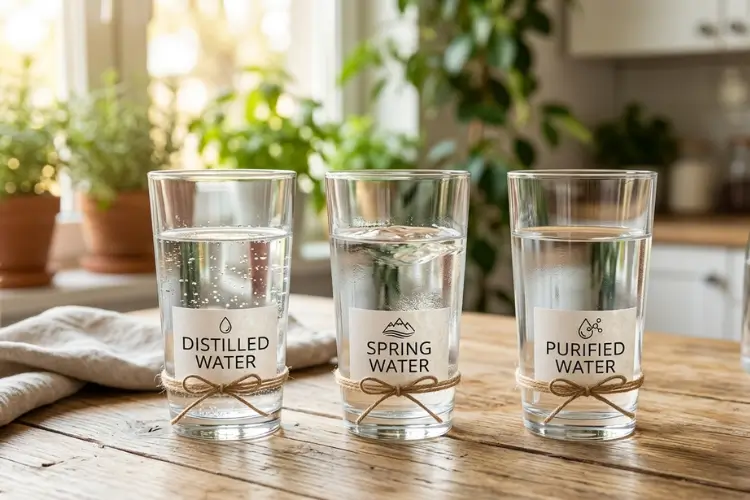
Standing in the water aisle, staring at a wall of labels that all promise “pure” water?
You’re not alone.
Here’s the truth nobody tells you: these words aren’t marketing fluff. They’re legal terms, defined down to the letter by the FDA. And once you know what they actually mean, choosing the right water for you stops being a guessing game.
The short answer: spring water is defined by where it comes from. Purified and distilled water are defined by what’s been done to it. That one distinction unlocks everything else in this guide.
Quick Answer, No Scrolling Required
- Spring water comes from an underground source and keeps its natural minerals.
- Purified water can start from any source, but it’s been treated (by distillation, reverse osmosis, or deionization) to strip out dissolved solids.
- Distilled water is one specific type of purified water, made by boiling water into steam and condensing it back into liquid.
- All three are safe to drink. The right one depends on your body, your appliances, and your priorities.
Let’s break each one down properly.
What Do “Distilled,” “Spring,” and “Purified” Actually Mean?
So where do these definitions even come from?
The FDA. Specifically, 21 CFR 165.110, the federal standard of identity for bottled water. Every label on that shelf has to earn its name under this rule.[1]
What Is Distilled Water?
Distilled water starts as regular water, usually from a municipal source. It gets boiled until it turns to steam.
That steam is then captured and cooled back into liquid.
Because minerals, heavy metals, and most contaminants don’t evaporate at water’s boiling point, they get left behind. What comes out the other end is about as close to pure H2O as you can get.
The trade-off? Taste. Without minerals, distilled water often tastes flat or a little bland. Some people notice it immediately. Others don’t care either way.
By the way: distillation can take several hours to produce even a single gallon, which is part of why distilled water tends to cost more than tap or filtered water.
What Is Spring Water?
Spring water comes from an underground aquifer or spring, and it has to flow naturally to the earth’s surface to legally carry the name.
It’s collected either right at the spring or through a borehole tapping that same underground source.
Because it travels through layers of rock and soil on its way up, spring water usually retains natural minerals like calcium, magnesium, and potassium. That’s what gives it a crisper, more textured taste compared to distilled water.
Here’s the part that surprises people: most spring water isn’t actually bottled right at the spring. It’s often pumped into tanker trucks and transported to a bottling facility, where it’s chlorinated for transit and then filtered again before it’s packaged.
That doesn’t make it dirty. It just means “spring” tells you about the source, not the entire journey the water took to reach your fridge.
What Is Purified Water?
Purified water is the broadest category of the three, and it’s the one most people misunderstand.
It’s not defined by where the water comes from. It’s defined by how it’s treated.
Water earns the “purified” label if it’s been processed through one of these methods:
- Reverse osmosis, which forces water through a membrane to filter out dissolved solids
- Deionization, which removes charged mineral particles
- Distillation, the boil-and-condense process covered above
- Carbon filtration, often paired with the methods above for extra clarity
Because it’s a treatment category, purified water can start as tap water, well water, or even spring water. The source doesn’t matter. What matters is that it ends up meeting the FDA’s purified water standard, generally under 10 parts per million of total dissolved solids. [2]
Distilled vs. Spring vs. Purified Water, Side by Side
Sometimes a table says more than three paragraphs ever could.
| Feature | Distilled Water | Spring Water | Purified Water |
| Defined by | Treatment method | Source | Treatment method |
| Typical TDS | 0 to 5 ppm | 50 to 500+ ppm | Under 10 ppm |
| Natural minerals | Almost none | Yes, retained | Minimal, often removed |
| Taste | Flat, neutral | Crisp, mineral-forward | Neutral, clean |
| Best for | Appliances, medical uses | Everyday drinking | Everyday drinking, sensitive systems |
| Regulatory category | Subtype of purified | Its own FDA category | Broad treatment category |
The simple fix? If you’re comparing labels at the store, check for the word “purified” alongside a process (reverse osmosis, distilled, deionized). That combination tells you exactly what you’re getting, no guesswork needed.
Which One Is Healthiest?
This is the question everyone actually wants answered.
And honestly? All three are safe to drink. The differences that matter come down to minerals and your specific situation.
Mineral Content and Why It Matters
Spring water naturally carries minerals your body can use in small amounts, things like calcium and magnesium. Distilled and most purified water strip those out.
Does that make distilled water bad for you?
Not exactly. Your body gets the vast majority of its minerals from food, not water. A glass of distilled water isn’t going to leave you deficient.
What the WHO Actually Says About Distilled Water
The World Health Organization has flagged one specific concern: relying on distilled or demineralized water as your only source of hydration, long-term, isn’t ideal. It’s not about acute danger. It’s about missing out on trace minerals that water can normally contribute over months and years.[3]
The bottom line: if distilled water is your daily go-to, it’s not dangerous. If it’s your only water source for extended periods, mixing in some mineral-rich water isn’t a bad idea.
Which One Should You Drink, By Situation
Because the right answer isn’t the same for everyone.
For Everyday Drinking
Spring water or purified water both work well here. Pick based on taste preference and cost, not fear.
For Babies and Infant Formula
Purified water is generally the go-to recommendation, since it minimizes exposure to contaminants and doesn’t introduce unpredictable mineral or sodium levels into a developing system. Always check with your pediatrician before choosing a specific water for formula.
For CPAP Machines, Humidifiers, and Appliances
Distilled water wins here, hands down.
Why? Because minerals build up inside these machines over time, clogging parts and shortening their lifespan. Distilled water’s near-zero mineral content prevents that buildup entirely.
The same mineral buildup shows up in other appliances too. If your washing machine is already dealing with hard-water residue, our DIY washing machine cleaner guide walks through fixing it, and cleaning with vinegar and baking soda covers simple ways to tackle mineral deposits around the rest of your home.
For People With Kidney Issues or Low-Sodium Needs
This is worth a real conversation with a doctor, not a blog post. But broadly, lower-mineral water (purified or distilled) is often preferred for people managing sodium or mineral intake closely, since it removes a variable rather than adding one.
Cost and Environmental Comparison
Here’s the truth nobody prints on the label: your water choice has a real cost, and it’s not just financial.
Cost Per Gallon
| Water Type | Approximate Cost per Gallon |
| Tap water | About $0.008 |
| Home-filtered or RO tap water | $0.05 to $0.30 |
| Home-distilled water | $0.30 to $0.68 (mostly electricity) |
| Bottled spring water | $0.80 to $2.00 |
| Bottled distilled water | Around $1.25 |
The pattern is clear: the more processing and bottling involved, the higher the price per gallon. A home filtration or distillation setup pays for itself fast if you’re going through bottled water regularly.
Plastic Waste and Carbon Footprint
Bottled water, regardless of type, usually means single-use plastic. That plastic doesn’t just disappear. It piles up in landfills and waterways, and the transportation involved (especially for spring water trucked from source to bottling facility) adds a real carbon cost too.
Because: a reusable bottle filled from a home filtration or distillation system sidesteps almost all of that. If cutting bottled water out of your routine sounds appealing, our zero waste swaps guide has more easy changes worth making.
Common Myths, Debunked
Let’s clear a few things up. (If you like myth-busting, our zero waste living myths piece clears up a few more misconceptions worth knowing.)
Myth: Spring water is automatically the purest option because it’s “natural.” Not quite. Natural doesn’t mean untouched. Spring water still travels through transport and filtration before it reaches your bottle, and it can carry trace natural contaminants depending on the source.
Myth: Distilled water is dangerous to drink. It’s not. It’s simply low in minerals. Safe for daily use, just not ideal as your only water source for months on end without any dietary minerals elsewhere.
Myth: “100% pure” on a spring water label means the water itself is pure. That phrase almost always refers to the source, meaning 100% of the water came from a spring or underground source. It says nothing about what happened to it after collection.
So, Which Water Should You Actually Choose?
Spring water is about where it came from. Purified and distilled water are about what’s been done to it.
Once that distinction clicks, the water aisle stops feeling overwhelming.
Pick spring water if you want natural minerals and don’t mind a bit more texture in the taste. Pick purified water for a clean, neutral everyday option. Pick distilled water when purity matters most, whether that’s for your CPAP machine, your humidifier, or your own peace of mind.
There’s no universally “best” water here. Just the right one for what you actually need.
And if this has you thinking about cutting down on bottled water altogether, our beginner’s guide to starting a zero waste lifestyle is a good next stop.