Here’s the truth nobody tells you: mixing vinegar and baking soda together in a spray bottle doesn’t make a super-cleaner.
It makes a weak, salty puddle.
I know, I know. We’ve all seen the fizzy volcano and assumed that’s the magic. But the fizz isn’t the cleaning power. It’s actually the two ingredients canceling each other out. The real magic happens when you use them one after the other, each doing its own job.
So where do you start? Right here. Below are 15 tested ways to use vinegar and baking soda around your home, with exact ratios, honest notes on what worked and what didn’t, and the one safety rule you genuinely can’t skip.
Quick summary before we dive in:
- Vinegar and baking soda work best used separately, in sequence, not premixed
- They’re brilliant for grease, grime, odors, and mineral buildup
- They’re not miracle workers on heavy-set stains or grout that’s years overdue
- Never, ever mix vinegar with bleach (more on that below)
What Actually Happens When You Mix Vinegar and Baking Soda
Let’s get the science out of the way, because it changes how you should actually use these two.
Vinegar is a mild acid. Baking soda is a mild base. When they meet, they react fast, producing water, carbon dioxide, and something called sodium acetate. That’s the fizz you remember from grade-school volcanoes.
Here’s the part that surprised me when I first learned it: that fizzy reaction isn’t what cleans your surfaces. It’s basically just salt water once it’s done reacting.
The actual cleaning power comes from each ingredient acting on its own, before they meet:
- Baking soda is a mild abrasive. It physically scrubs away grime and neutralizes odors on contact.
- Vinegar is acidic enough to dissolve mineral deposits, cut through grease, and kill a solid chunk of household bacteria.
Why premixing in a spray bottle wastes their power
If you’ve ever mixed vinegar and baking soda together in advance, only to find your “cleaner” barely worked, this is why.
By the time the fizzing stops, the reaction has already finished. You’re left applying a diluted, mostly-spent liquid to your counters.
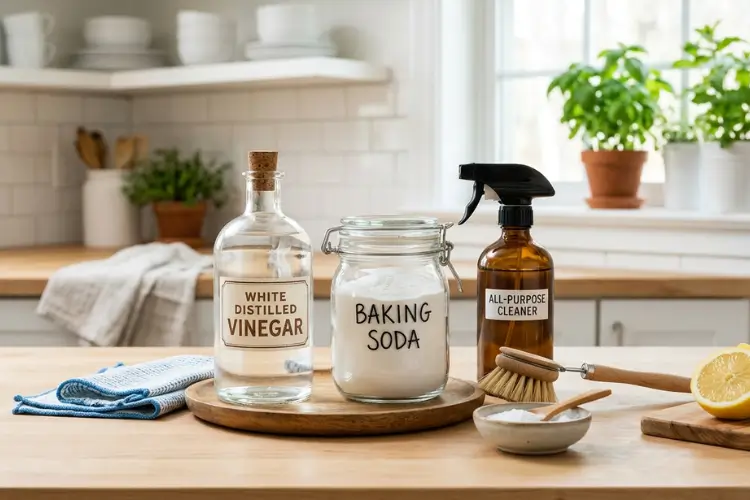
The fix? Use baking soda first, as a dry paste or sprinkle. Let it sit. Then spray vinegar directly on top, right before you scrub. The reaction happens on the surface, where you actually need it, not in the bottle, where you don’t.
“Vinegar and baking soda work best used one after the other, not mixed together in advance.”
If you like busting cleaning myths as much as we do, you’ll enjoy our zero waste living myths piece too.
The One Rule to Know Before You Start
Before we get to the 15 methods, two quick warnings. Because a natural cleaner isn’t automatically a safe-for-everything cleaner.
Surfaces to never use vinegar or baking soda on
- Natural stone (marble, granite, limestone): vinegar’s acidity can etch and dull the surface permanently
- Waxed or unsealed wood: vinegar can strip finish over repeated use
- Cast iron: vinegar will strip seasoning and can encourage rust
- Aluminum: repeated vinegar exposure can cause pitting
If you’re cleaning wood floors or furniture, see our full wood-cleaning guide for safer methods that won’t damage the finish.
What never to mix with vinegar
Never combine vinegar with bleach. Not a little, not “just to boost it.”
The reaction releases chlorine gas, which is toxic even in small amounts indoors. This isn’t a natural-cleaning myth. It’s basic chemistry, and it’s worth remembering every single time you reach for both bottles.
“Never mix vinegar with bleach. The combination releases toxic chlorine gas.”
Okay. Safety covered. Let’s get to the good part.
15 Surprising Ways to Clean with Vinegar and Baking Soda
Let’s start where most people first reach for these two: the drain.
1. Unclog and freshen a slow drain
The fix: Pour ½ cup baking soda down the drain, followed by 1 cup vinegar. Cover the drain (a wet cloth works) and let it fizz for 10 to 15 minutes. Flush with a kettle of boiling water.
I tried this on a bathroom sink drain that had been draining slower and slower for weeks. It didn’t fix a fully clogged drain overnight, but on a slow, gunky drain, it noticeably sped things back up, and the sink stopped smelling.
Worth knowing: this is maintenance, not a plumber replacement. A fully blocked drain needs a snake, not a science experiment.
2. Descale a kettle or coffee maker
The fix: Boil equal parts water and vinegar in your kettle. Dump it out, scrub any loose bits, then boil a round of plain water to rinse. For coffee makers, run a brew cycle with the same 50/50 mix, then two cycles of plain water.
Limescale doesn’t stand a chance against this. It’s the single most satisfying use on this list. You’ll see the difference immediately.
3. Deep-clean a microwave in five minutes
The fix: Microwave a bowl of 1 cup water with 2 tablespoons vinegar for 3 to 5 minutes, until it steams up the interior. Let it sit for 2 minutes, then wipe. Baked-on splatters wipe away with barely any scrubbing.
I use this one weekly now. It’s the lowest-effort, highest-payoff trick on this entire list. The steam does almost all the work for you.
4. Strip baked-on grease from oven interiors
The fix: Make a paste of ½ cup baking soda and a few tablespoons of water. Spread it over greasy areas (avoiding heating elements), let it sit overnight, then wipe clean and spritz any leftover residue with vinegar to lift the last of it.
Be patient here. This is the one method where “let it sit longer” genuinely makes a real difference. Don’t rush the overnight step.
5. Scrub grout back to white
The fix: Make a thick baking soda paste, spread it into grout lines with an old toothbrush, let sit 10 minutes, then spritz lightly with vinegar and scrub.
Full disclosure: on grout that’s years overdue, this took two full rounds to get close to white, not one. Think of it as a strong assist, not a miracle eraser.
6. Remove rust stains from metal or fabric
The fix: Spray vinegar directly on the rust stain, let sit 5 to 10 minutes, then blot (don’t rub) with a paper towel. For stubborn spots, sprinkle baking soda on top first for extra abrasive power.
7. Deodorize and refresh carpets
The fix: Sprinkle baking soda liberally over the carpet, let sit for at least 30 minutes (overnight for stronger odors), then vacuum thoroughly. For actual stains, follow with a vinegar-and-water solution and blot.
8. Clean and descale a washing machine
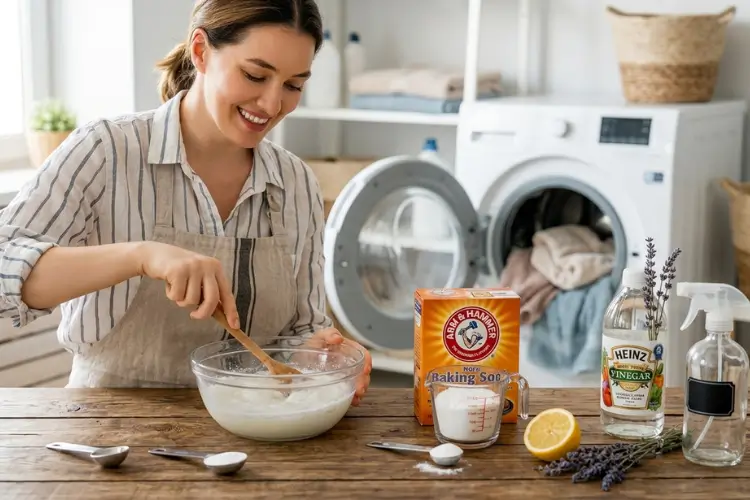
The fix: Run an empty hot-water cycle with 2 cups of vinegar. Wipe down the door seal and detergent tray with a baking-soda paste afterward to lift any leftover mildew smell.
For a deeper monthly reset, try our DIY washing machine cleaner recipe.
9. Whiten and brighten laundry naturally
The fix: Add ½ cup baking soda to your regular detergent for a whitening boost, or add ½ cup vinegar to the rinse cycle as a natural fabric softener. (Don’t do both in the same load; add them at different cycle stages.)
10. Clean silver and remove tarnish
The fix: Make a baking soda paste, rub gently onto tarnished silver with a soft cloth, rinse, and buff dry. No vinegar needed for this one. Baking soda alone does the job.
11. Unclog and deodorize a toilet
The fix: Pour 1 cup baking soda into the bowl, followed by 2 cups vinegar. Let it fizz for 10 minutes, scrub with a toilet brush, and flush.
I use this as a monthly reset even when there’s no visible ring. It keeps the bowl noticeably brighter between deep cleans.
12. Scrub a stained coffee or tea mug
The fix: Sprinkle baking soda directly into the mug, add a splash of water to make a paste, scrub with a sponge, rinse. Stubborn stains get a vinegar rinse afterward.
13. Clean and deodorize a garbage disposal
The fix: Pour ½ cup baking soda down the disposal, followed by 1 cup vinegar. Let it fizz for 5 minutes, then run cold water with the disposal on.
14. Freshen a mattress
The fix: Sprinkle baking soda over the entire mattress surface, let sit for at least an hour (longer for musty smells), then vacuum thoroughly with an upholstery attachment.
15. Make a soft-scrub paste for tubs and sinks
The fix: Mix baking soda with a small amount of liquid dish soap and just enough water to form a spreadable paste. Scrub onto the surface, then rinse. For extra shine, follow with a vinegar wipe-down.
Bonus use: vinegar also disrupts ants’ scent trails, making it a handy natural deterrent. See our natural ant remedies guide for the full method.
Vinegar and Baking Soda Ratios: Quick Reference
Bookmark this table. It’s the one page you’ll actually come back to.
| Task | Vinegar | Baking Soda | Sit Time | Rinse? |
| Drain freshening | 1 cup | ½ cup | 10-15 min | Yes, boiling water |
| Kettle/coffee maker | Equal parts w/ water | n/a | Full boil cycle | Yes, plain water |
| Microwave | 2 tbsp | n/a | 2 min after steaming | Wipe only |
| Oven interior | Light spritz | ½ cup paste | Overnight | Yes |
| Grout | Light spritz | Thick paste | 10 min | Yes |
| Rust stains | Direct spray | Optional sprinkle | 5-10 min | Blot only |
| Carpet odor | Optional follow-up | Liberal sprinkle | 30 min-overnight | Vacuum |
| Washing machine | 2 cups | Paste for seal | Full hot cycle | N/A |
| Laundry whitening | ½ cup (rinse cycle) | ½ cup (with detergent) | N/A | N/A |
| Silver | n/a | Paste | Until tarnish lifts | Yes |
| Toilet bowl | 2 cups | 1 cup | 10 min | Flush |
| Coffee mug | Rinse only | Paste | Scrub time | Yes |
| Garbage disposal | 1 cup | ½ cup | 5 min | Run water |
| Mattress | n/a | Liberal sprinkle | 1+ hour | Vacuum |
| Tub/sink paste | Wipe-down finish | Paste base | Scrub time | Yes |
Real Cost and Environmental Savings Comparison
Here’s the part that made me a permanent convert: the math.
| Store-bought Cleaner | Vinegar + Baking Soda | |
| Cost per use (approx.) | $0.30 to $0.75 | $0.03 to $0.08 |
| Plastic bottles per year (avg. household) | 6-10 single-use sprays | 1-2 refillable bottles |
| VOCs released | Often present | None |
| Shelf life | 1-2 years, degrades | Indefinite (both ingredients) |
A single gallon of white vinegar and a large box of baking soda cost less than one bottle of name-brand spray cleaner. Between them, they’ll outlast it on nearly every task on this list.
That’s not a marketing claim. That’s just what’s on the price tag.
Curious what else you can swap out? Check our zero waste swaps guide for more easy changes like this one. And if you want to see the bigger picture, here’s what a zero waste lifestyle actually looks like day to day.
Two Ingredients, One Cleaner Home
You don’t need a cabinet full of single-purpose sprays to keep your home clean.
Two ingredients, used correctly, not mixed, but sequenced, will handle drains, ovens, grout, laundry, and everything in between.
The simple fix? Stop reaching for the spray bottle combo. Start reaching for each one, one at a time, exactly when it’s needed.
Your wallet, and the recycling bin, will thank you.