Quick answer: There isn’t one single “smallest animal.” It depends on what you’re measuring.
By weight, the smallest mammal is the bumblebee bat, at about 2 grams. By length, many scientists give that title to the Etruscan shrew instead. If you’re talking about the smallest animal most people picture when they hear the phrase, that’s probably the bee hummingbird. And if you go strictly by biology, the true record holder might be something you’ve never heard of: a microscopic parasite called a myxozoan, barely visible without a microscope.
So which one is right? Honestly, all of them. It depends on the question you’re actually asking.
Below, I’ve ranked 15 of the smallest animals on Earth, one for nearly every major group, mammal, bird, reptile, fish, insect, and more. Real measurements. Real sources. No made-up “cutest tiny animal” fluff.
Let’s get into it.
How We Ranked This List
Here’s the honest version of how this list came together.
I focused on recognized species with real, documented measurements, not folklore or exaggerated internet claims. Where two animals compete for the same title (looking at you, bumblebee bat and Etruscan shrew), I included both and explained the disagreement instead of pretending it doesn’t exist.
I also tried to cover as many different animal groups as possible. A list of 15 tiny mammals would be interesting. A list of 15 tiny animals across mammals, birds, reptiles, fish, insects, and amphibians tells you a lot more about how small life can actually get.
One more thing: I left out true microorganisms like myxozoans from the main ranked list. They’re technically animals, and they’re technically smaller than everything below. But most people asking “what’s the smallest animal” want something they could picture, not a single-celled parasite. I still cover the microorganism angle later, because it matters for the full picture.
Smallest Animals at a Glance
Here’s the whole list in one place before you scroll through it.
| Category | Animal | Size | Weight | Found In |
| Mammal (by weight) | Bumblebee bat | ~2.9 cm (1.1 in) | ~2 g | Thailand, Myanmar |
| Mammal (by length) | Etruscan shrew | ~4 cm (1.6 in) body | ~1.8 g | Europe, Asia, North Africa |
| Bird | Bee hummingbird | ~5 cm (2 in) | ~1.6–2 g | Cuba |
| Reptile | Brookesia nana chameleon | ~1.35 cm (0.53 in) | Under 1 g | Madagascar |
| Vertebrate overall | Paedophryne amauensis frog | ~7.7 mm (0.3 in) | Under 1 g | Papua New Guinea |
| Fish | Paedocypris progenetica | ~7.9 mm (0.3 in) | Under 1 g | Southeast Asian peat swamps |
| Shark | Dwarf lanternshark | ~20 cm (7.9 in) | Under 60 g | Caribbean, off South America |
| Tortoise | Speckled padloper tortoise | 6–10 cm (2.4–4 in) shell | ~100 g | South Africa |
| Monkey | Pygmy marmoset | ~12–15 cm (5–6 in) body | ~100–140 g | South American rainforest |
| Antelope | Royal antelope | ~25 cm (10 in) tall | ~1.5–3 kg | West Africa |
| Snake | Barbados threadsnake | ~10 cm (4 in) | A few grams | Barbados |
| Insect | Fairyfly (wasp) | As small as 0.15 mm | Negligible | Worldwide |
| Seahorse | Pygmy seahorse | 1.4–2.7 cm (0.5–1 in) | A few grams | Indo-Pacific coral reefs |
| Primate | Madame Berthe’s mouse lemur | ~9.2 cm (3.6 in) body | ~30 g | Madagascar |
| Rodent | Baluchistan pygmy jerboa | ~4–5 cm (1.6–2 in) body | A few grams | Central Asian deserts |
Now let’s meet each one properly.
The 15 Smallest Animals
Here are 15 of the world’s tiniest animals, ranked by their remarkably small size, with each one showcasing unique adaptations that help it survive.
1. Bumblebee Bat (Kitti’s Hog-Nosed Bat)
The bumblebee bat is, by weight, the smallest mammal on the planet. It weighs about 2 grams. That’s lighter than a single sheet of paper.
Also known as Kitti’s hog-nosed bat, it lives in limestone caves in Thailand and Myanmar. It’s genuinely tiny, roughly the size of a large bumblebee, which is exactly where the name comes from.
Here’s the twist: it flies. This is a fully functional, echolocating, insect-hunting mammal that fits in the palm of your hand. It’s currently listed as Near Threatened, mostly because it exists in such a small, specific range.
If tiny, odd-looking bats are your thing, there’s a whole roundup of cute bat species worth a look.
2. Etruscan Shrew
If you measure by length instead of weight, the title of “smallest mammal” often goes to the Etruscan shrew instead.
It weighs around 1.8 grams, technically lighter than the bumblebee bat, but its body runs a bit longer. This is the actual root of the ongoing “smallest mammal” debate, and I’ll dig into it more below.
What makes the Etruscan shrew wild isn’t just its size. It’s its metabolism. This shrew eats roughly its own body weight in insects every single day, just to survive. Its heart can beat over 1,500 times a minute. For an animal this small, staying alive is basically a full-time job.
3. Bee Hummingbird
The bee hummingbird is the smallest bird in the world, and honestly, the animal most people picture when someone says “smallest animal.”
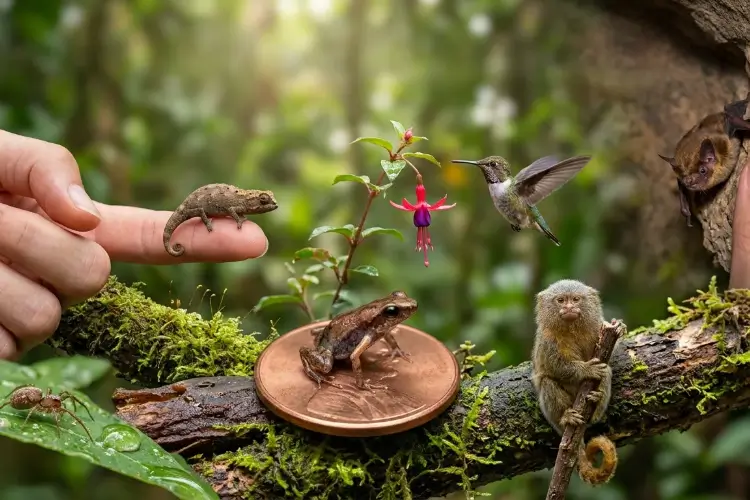
Found only in Cuba, it weighs about 1.6 to 2 grams and measures around 5 centimeters long. Despite that, it’s a fully capable hummingbird: it hovers, it darts between flowers, and it beats its wings dozens of times per second.
It’s also a working pollinator. As it feeds on nectar, it picks up pollen and carries it from flower to flower, which makes it a genuinely important part of its local ecosystem, not just a novelty.
4. Brookesia Nana (Nano-Chameleon)
Discovered in Madagascar, Brookesia nana might be the smallest reptile ever recorded. Males measure around 13.5 millimeters, small enough to perch comfortably on the tip of your finger.
It’s part of a broader group of leaf chameleons that have evolved to be extremely small, likely as an adaptation to living in dense leaf litter on the forest floor, where being tiny means better camouflage and access to smaller prey.
Madagascar keeps producing discoveries like this. New “smallest of its kind” species show up here more often than almost anywhere else on Earth.
5. Paedophryne Amauensis
This is the smallest known vertebrate on the planet, full stop. Not just the smallest frog. The smallest vertebrate of any kind.
Found in the leaf litter of Papua New Guinea’s rainforests, it averages just 7.7 millimeters long. Picture a frog that could sit inside a grain of rice with room to spare.
It’s nocturnal and extremely hard to spot, which means it was only formally described in 2012. There are likely more animals this small still waiting to be found.
6. Paedocypris Progenetica
The smallest known fish, and it’s a strange one. This tiny species lives in the acidic peat swamps of Southeast Asia, water so harsh that few other fish can survive in it at all.
At around 7.9 millimeters, it’s roughly tied with Paedophryne amauensis for “smallest vertebrate” honors, depending on which measurement study you’re reading. Its small size looks like a direct adaptation to a brutal, low-oxygen environment where being tiny may actually be a survival advantage.
7. Dwarf Lanternshark
Yes, this is a real shark, and yes, it can fit in your hand. The dwarf lanternshark tops out at around 20 centimeters, making it the smallest known shark species.
It lives in deep water off the coast of South America and has bioluminescent organs along its belly, which it uses to blend in with faint light from above, hiding its silhouette from predators lurking below.
It’s a good reminder that “smallest of its kind” doesn’t mean less impressive. This is still a shark, with a shark’s whole toolkit, just built at a fraction of the size.
8. Speckled Padloper Tortoise
Native to South Africa’s Namaqualand region, the speckled padloper tortoise is the smallest tortoise species in the world, with a shell length of roughly 6 to 10 centimeters.
Its small size lets it squeeze into rock crevices for shelter, something larger tortoises simply can’t do. In an arid, exposed environment, that’s a real survival edge, not just a cute quirk.
9. Pygmy Marmoset
The pygmy marmoset is the smallest monkey on Earth, weighing around 100 to 140 grams and measuring roughly 12 to 15 centimeters, not counting its tail.
Native to the rainforests of South America, it’s a skilled climber that spends most of its life in trees, feeding largely on tree sap and small insects. It also communicates through an unusually wide range of vocalizations, some pitched too high for humans to hear at all.
10. Royal Antelope
Here’s one that surprises people: the smallest antelope species stands only about 25 centimeters tall at the shoulder, roughly the height of a large house cat.
The royal antelope lives in the dense forests of West Africa. Its small size and quick reflexes let it dart through thick undergrowth, where a full-sized antelope would struggle to move at all.
11. Barbados Threadsnake
The Barbados threadsnake is one of the smallest snake species known, at around 10 centimeters long, and it’s endemic to a single island: Barbados.
Despite the name, it’s not delicate. It’s a capable predator of small invertebrates, hunting through leaf litter and soil where its slim body gives it access predators many times its size can’t reach.
12. Fairyfly
Fairyflies aren’t flies at all. They’re a family of parasitic wasps, and they include the smallest known insects on the planet, some measuring as little as 0.15 millimeters.
At that scale, they’re smaller than many single-celled organisms you’d need a microscope to see clearly. Despite their size, fairyflies play a real ecological role, helping naturally control populations of other insects.
It’s a strange thought experiment: somewhere on the exact opposite end of the scale sits the largest insect in the world, thousands of times heavier than a fairyfly could ever be.
13. Pygmy Seahorse
Pygmy seahorses measure only 1.4 to 2.7 centimeters and live camouflaged directly on coral in Indo-Pacific reefs, matching the coral’s exact color and texture so precisely that divers often miss them entirely, even when looking right at them.
Their size and camouflage combined make them one of the hardest reef animals to spot in the wild, which is part of why they weren’t formally documented until relatively recently.
14. Madame Berthe’s Mouse Lemur
This is the smallest primate in the world, full stop, smaller even than the pygmy marmoset. It measures about 9.2 centimeters and weighs around 30 grams.
Found only in Madagascar, it’s solitary and nocturnal, foraging alone at night and avoiding the larger predators that share its forest. Like a lot of Madagascar’s smallest species, its size seems closely tied to the island’s unique, isolated evolutionary pressures.
15. Baluchistan Pygmy Jerboa
Rounding out the list, the Baluchistan pygmy jerboa is one of the smallest rodents on Earth, with a body around 4 to 5 centimeters long, not counting its long tail.
It lives in the deserts of central Asia, where its tiny size helps it conserve water and stay hidden from predators in wide, exposed terrain. Big ears, long hind legs, and a body built almost entirely for sudden, quick escapes.
Smallest Animals by Category
Want the quick answer for a specific category? Here you go.
Smallest mammal: Contested between the bumblebee bat (smallest by weight, ~2 g) and the Etruscan shrew (smallest by length in some measurements). More on this below.
Smallest bird: The bee hummingbird, found only in Cuba, at roughly 5 centimeters and under 2 grams.
Smallest reptile: Brookesia nana, a nano-chameleon from Madagascar, with males measuring around 13.5 millimeters.
Smallest fish: Paedocypris progenetica, at roughly 7.9 millimeters, found in Southeast Asian peat swamps.
Smallest insect: The fairyfly, a parasitic wasp species that can measure as little as 0.15 millimeters.
Smallest amphibian and smallest vertebrate overall: Paedophryne amauensis, a Papua New Guinea frog averaging 7.7 millimeters.
The Debate Nobody Settles: Bumblebee Bat vs. Etruscan Shrew
Here’s the truth nobody tells you upfront: “smallest mammal” doesn’t have one clean answer.
The bumblebee bat wins on weight. At around 2 grams, it’s lighter than the Etruscan shrew’s roughly 1.8 to 2.7 grams, depending on the individual. But the Etruscan shrew is often shorter in body length, excluding its tail.
So which one actually wins?
It depends entirely on which measurement you care about. A 2012 study published in the journal Mammal Review looked at exactly this question and found the title genuinely split between the two species, one for mass, one for length. Neither claim is wrong. They’re just answering slightly different questions.
This is honestly true across a lot of this list. “Smallest” is doing a lot of quiet work in that word. Smallest by weight, by length, by shell size, by body excluding tail, these are all different measurements, and different sources sometimes pick different ones without saying so.
Why Do Some Animals Evolve to Be So Small?
Small size isn’t random. In a lot of these cases, it’s a direct evolutionary strategy.
On islands, animals often shrink over generations, a well-documented pattern called island dwarfism. Limited food and space favor smaller bodies that need less energy to survive, which is likely part of why Madagascar alone produced three entries on this list.
In extreme or harsh environments, like the acidic swamps that Paedocypris calls home, being small can mean surviving in conditions that would kill a larger animal outright. And for predators hunting in tight spaces, like the royal antelope’s dense forest floor, a smaller body simply moves faster through terrain a bigger animal can’t navigate at all.
Size isn’t the only extreme nature plays with, either. Some species take the opposite approach entirely, like the animals with the longest gestation period, carrying offspring for nearly two years before birth.
Being tiny, in other words, is rarely an accident. It’s usually the answer to a very specific problem.
If records like this fascinate you, it’s worth browsing a few more unusual animal facts while you’re here.
The Real Takeaway
So, what’s the smallest animal in the world?
Honestly, that’s the wrong question. The better one is: smallest by what measure?
By weight, it’s the bumblebee bat. By length, a lot of scientists hand that title to the Etruscan shrew instead. By what most of us picture when we hear the phrase, it’s probably the bee hummingbird. And if you go strictly by biology, the real record might belong to a microscopic parasite you’ll never see with your own eyes.
None of these answers cancel each other out. They’re just answering slightly different versions of the same question.
What I find most interesting isn’t the ranking itself, it’s how many different ways “small” can actually show up. A 2-gram bat that flies. A frog that fits inside a grain of rice. A monkey you could hold in one hand. Fifteen completely different survival strategies, all built around the same basic idea: sometimes, smaller wins.
Next time someone asks you what the smallest animal in the world is, you’ll have a better answer than they were expecting.