An apex predator is an animal at the top of its food chain with no natural predators of its own.
No enemies. No fear. Nothing hunting them back.
That’s the short version. The longer, more interesting version is that “apex predator” isn’t just a cool nature-documentary label. It’s a role. And when that role gets removed from an ecosystem, everything underneath it starts to wobble.
So where do you find these animals? Land, sea, and air, in almost every corner of the planet.
Below are 15 of the fiercest apex predators in the world, ranked by hunting power, ecological dominance, and the kind of stats that actually back up the hype. Bite force. Speed. Size. The stuff most “top predator” lists skip right past.
Let’s get into it.
What Is an Apex Predator? (Quick Answer)
An apex predator is a species that sits at the top of the food chain and has no natural predators as an adult.
That’s the whole definition. But there’s a bit more nuance worth knowing before you scroll through the list.
Apex predator vs. keystone species. These two terms get mixed up constantly, and they’re not the same thing.
- An apex predator is defined by its position at the top of the food chain. No natural predators, period.
- A keystone species is defined by its impact. It’s a species whose removal would reshape the entire ecosystem, even if that species isn’t at the top of the food chain.
Here’s the overlap: many apex predators are also keystone species. Wolves are both. Sea otters, on the other hand, are a keystone species but not an apex predator.
One more distinction worth knowing: apex predators occupy the highest trophic level in their environment. Ecologists call this “tertiary consumer” status. It sounds technical, but it just means energy in that food chain flows up to them, and stops.
Now, onto the ranking.
How We Ranked the Fiercest Apex Predators
No single stat tells the whole story. A great white shark isn’t stronger than an orca, but it’s still terrifying for different reasons.
So this list weighs four things:
- Hunting power. Bite force, speed, and physical weaponry (teeth, claws, venom).
- Ecological dominance. Does this animal genuinely have zero natural predators, or just very few?
- Range and adaptability. How widely does this species dominate across its habitat?
- Real, sourced data. Not vibes. Every stat below is grounded in published research or wildlife-conservation data, not recycled blog numbers.
Because here’s the truth nobody tells you: most “fiercest predator” lists just copy each other’s numbers. We didn’t want to do that.
Apex Predators at a Glance
Before the full breakdown, here’s how these 15 animals stack up side by side.
| Animal | Habitat | Bite Force (PSI, approx.) | Top Speed | Weight (max, approx.) | Conservation Status |
| Saltwater Crocodile | Land/Water | 3,700+ | 18 mph (water) | 2,200 lbs | Least Concern |
| Orca | Ocean | N/A (crush/tear) | 34 mph | 12,000 lbs | Data Deficient |
| Great White Shark | Ocean | ~4,000 | 35 mph | 5,000 lbs | Vulnerable |
| Siberian Tiger | Land | ~1,000 | 50 mph | 660 lbs | Endangered |
| African Lion | Land | ~650 | 50 mph | 550 lbs | Vulnerable |
| Polar Bear | Land/Ice | ~1,200 | 25 mph | 1,700 lbs | Vulnerable |
| Komodo Dragon | Land | ~600 | 13 mph | 350 lbs | Endangered |
| Grizzly Bear | Land | ~975 | 35 mph | 800 lbs | Least Concern |
| Jaguar | Land | ~1,500 | 50 mph | 250 lbs | Near Threatened |
| Gray Wolf | Land | ~400 | 40 mph | 145 lbs | Least Concern |
| Harpy Eagle | Air | N/A (talon grip) | 50 mph (dive) | 20 lbs | Near Threatened |
| King Cobra | Land | N/A (venom-based) | N/A | 13 lbs | Vulnerable |
| Leopard Seal | Ocean | ~1,000 (bite pressure est.) | 24 mph | 1,300 lbs | Least Concern |
| Golden Eagle | Air | N/A (talon grip) | 150 mph (dive) | 15 lbs | Least Concern |
| Bull Shark | Ocean | ~1,350 | 25 mph | 500 lbs | Vulnerable |
A few of these numbers are estimates. Bite force in wild animals is genuinely hard to measure, and most figures come from strain-gauge tests or computational jaw modeling, not a live crocodile biting a scale on command. Treat these as best-available, not exact.
Now let’s meet each one.
The 15 Fiercest Apex Predators in the World
Ready to meet them? Here are the 15 animals that earned their spot at the very top of the food chain.
1. Saltwater Crocodile
Scientific name: Crocodylus porosus
The saltwater crocodile has the strongest bite force of any living animal on Earth.
That’s not an exaggeration. Researchers using strain-gauge devices recorded bite forces exceeding 3,700 PSI in large males, and some estimates put the true ceiling even higher.
Males can grow past 20 feet and weigh over 2,200 pounds. They hunt using a stealth-and-ambush strategy, waiting motionless near the water’s edge before exploding into a “death roll” that drowns and dismembers prey. Their diet includes fish, birds, buffalo, and occasionally larger mammals that wander too close to the water.
They’re rated Least Concern by the IUCN, mostly thanks to strict hunting regulations introduced after decades of population collapse from the skin trade.
2. Orca (Killer Whale)
Scientific name: Orcinus orca
Orcas are the only known natural predator of the great white shark.
Let that sink in for a second. The animal most people picture as the ocean’s scariest creature has its own natural enemy, and it’s the orca.
Orcas hunt in coordinated family pods, using strategy that looks almost eerily human. If you’re curious what other species’ groups are called, our full list of Animal Group Names covers everything from a pride of lions to a murder of crows. They’ve been documented working together to create waves that wash seals off ice floes, and more recently, footage emerged of orca pods hunting adult blue whales, the largest animals to ever exist.
They can grow past 30 feet and weigh up to six tons. Their intelligence, teamwork, and total lack of natural predators make a strong case for “most dominant apex predator on the planet,” full stop.
3. Great White Shark
Scientific name: Carcharodon carcharias
The great white shark’s bite force is estimated at around 4,000 PSI, generated by jaws lined with up to 300 serrated teeth at any given time.
They can reach speeds of 35 mph in short bursts, detect a single drop of blood in the water from remarkable distances, and take down prey as large as seals, sea lions, and other sharks.
Here’s the thing most people get wrong: shark attacks on humans are genuinely rare, and great whites are classified as Vulnerable, largely due to overfishing and accidental bycatch. The ocean’s most feared predator is, ironically, one that needs protecting.
4. Siberian Tiger
Scientific name: Panthera tigris altaica
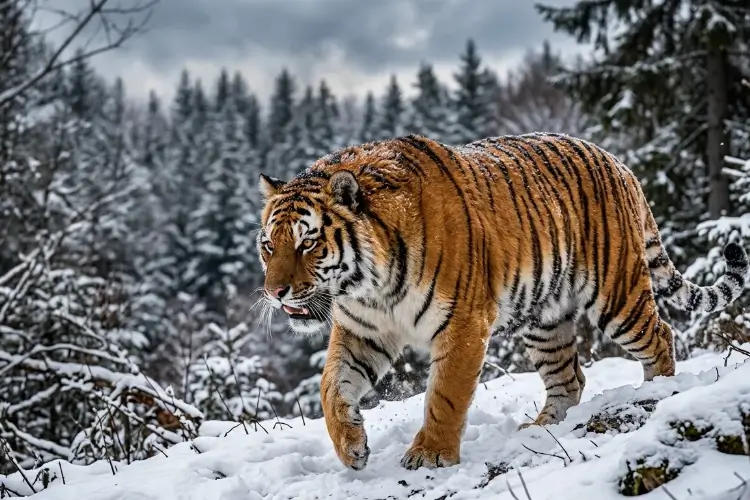
Also known as the Amur tiger, this is the largest of all tiger subspecies, found in the forests of eastern Russia and northeastern China.
Males can weigh up to 660 pounds and deliver a bite force estimated around 1,000 PSI, enough to crush bone. They’re solitary, territorial hunters relying on stealth over stamina, capable of taking down prey several times their own size.
Fewer than 600 Siberian tigers remain in the wild, making them Endangered. Every individual matters here, which is part of why conservation programs in the Russian Far East have become a global priority.
5. African Lion
Scientific name: Panthera leo
The African lion is the only truly social big cat, living in prides and hunting cooperatively, usually led by females.
Their bite force lands around 650 PSI, less than a tiger’s, but their advantage comes from teamwork. A coordinated pride can bring down animals as large as adult buffalo and even young elephants.
Lions have been feared, worshipped, and mythologized by human cultures for thousands of years. But: their population has dropped by over 40% in the last few decades, and they’re now classified as Vulnerable across most of their African range.
6. Polar Bear
Scientific name: Ursus maritimus
The polar bear is the largest land carnivore on Earth, and it’s built almost entirely around one hunting strategy: waiting.
They can weigh up to 1,700 pounds and deliver a bite force around 1,200 PSI. Most of their hunting happens on sea ice, where they wait motionless near a seal’s breathing hole for hours, sometimes days, before striking.
Here’s the uncomfortable part. Melting Arctic sea ice is shrinking their hunting grounds faster than most other apex predators are losing habitat, which is why polar bears are classified as Vulnerable and treated as a climate-change bellwether species.
7. Komodo Dragon
Scientific name: Varanus komodoensis
The Komodo dragon is the largest living lizard on Earth, and its bite alone can be a death sentence.
Their saliva carries toxic bacteria and mild venom, meaning prey that escapes the initial attack often dies from infection or blood loss within 24 hours. Growing up to 10 feet long and 350 pounds, they hunt deer, water buffalo, wild pigs, and occasionally other Komodo dragons.
They exist naturally on only five Indonesian islands, and that extremely limited range is exactly why they’re classified as Endangered despite having virtually no natural predators.
8. Grizzly Bear
Scientific name: Ursus arctos horribilis
The simple fix for surviving a grizzly encounter? Don’t get close enough to test its bite force, which sits around 975 PSI, nearly half a ton of jaw pressure.
Grizzlies are technically omnivores. Most of their diet is nuts, berries, roots, and salmon. But they’re fully capable of taking down prey ranging from rodents to full-grown moose when the opportunity arises.
They’re currently Least Concern globally, though regional populations in the lower 48 U.S. states remain federally protected due to habitat loss.
9. Jaguar
Scientific name: Panthera onca
Pound for pound, the jaguar has the strongest bite force of any big cat, estimated around 1,500 PSI.
Its killing method is unusual for a cat. Instead of going for the neck like a lion or tiger, jaguars typically bite directly through the skull, piercing the brain in a single, brutal motion.
They’re the only member of the “big three” cats native to the Americas, comfortable hunting both on land and in water. Habitat fragmentation across South America has pushed them to Near Threatened status.
10. Gray Wolf
Scientific name: Canis lupus
The gray wolf is proof that teamwork beats raw power.
Individually, a wolf’s bite force lands around 400 PSI, far below a big cat’s. But wolves rarely hunt alone. A coordinated pack can bring down elk, bison, and moose many times a single wolf’s size, using stamina and strategy instead of brute strength.
Because: when wolves disappear from an ecosystem, the damage cascades fast. More on that in a minute, because Yellowstone gives us the clearest real-world example on record.
11. Harpy Eagle
Scientific name: Harpia harpyja
The harpy eagle isn’t the fastest or the strongest predator on this list. It’s arguably the most terrifyingly equipped.
Its talons can grow longer than a grizzly bear’s claws, and its grip strength is powerful enough to crush bone instantly. Native to the Amazon rainforest, it hunts monkeys, sloths, and other tree-dwelling mammals by snatching them directly off branches mid-flight.
Deforestation across the Amazon has made the harpy eagle Near Threatened, and its survival is closely tied to how much old-growth canopy remains standing, one of many reasons why forests are important far beyond the species living in them.
12. King Cobra
Scientific name: Ophiophagus hannah
The king cobra is the longest venomous snake on Earth, capable of growing past 18 feet.
Its venom isn’t the most potent by volume, but the sheer quantity delivered in a single bite is enough to kill an adult elephant if struck near a vein. Unusually for a snake, king cobras primarily eat other snakes, including venomous species.
They’re classified as Vulnerable, with populations declining due to habitat loss across South and Southeast Asia.
13. Leopard Seal
Scientific name: Hydrurga leptonyx
Most people picture seals as prey, not predators. The leopard seal breaks that assumption completely, proving that some of the best animal unusual facts come from flipping the food chain upside down.
Found in Antarctic waters, it’s one of the very few seal species that actively hunts other seals, along with penguins, fish, and squid. Its long, reptilian-looking head and powerful jaws make it look almost out of place among its cuter, more familiar cousins.
Its only real threat comes from orcas, which puts it firmly in apex-predator territory for nearly everything else in its ecosystem.
14. Golden Eagle
Scientific name: Aquila chrysaetos
The golden eagle can hit speeds of up to 150 mph during a hunting dive, making it one of the fastest predators on the entire planet, in the air or otherwise.
It hunts rabbits, marmots, and occasionally prey as large as young deer, using powerful talons to strike with lethal precision. Found across the Northern Hemisphere, it’s one of the most widely distributed apex predators on this list.
Currently Least Concern, though it remains protected in many countries due to historical population declines from hunting and habitat disruption.
15. Bull Shark
Scientific name: Carcharhinus leucas
The bull shark might be the most underrated name on this entire list.
Its bite force, estimated around 1,350 PSI, is proportionally one of the strongest of any shark relative to its size. What makes it genuinely unique is its ability to survive in both saltwater and freshwater, meaning bull sharks have been documented hundreds of miles up the Mississippi River, well beyond where most people expect a shark to be able to go. For more on what else calls that river home, check out these mississippi river facts.
That adaptability, combined with an aggressive hunting style, makes it one of the species most frequently involved in shark encounters with humans in coastal and river environments.
Land, Sea, and Air: How Apex Predators Differ by Habitat
Not every apex predator hunts the same way. The habitat shapes the strategy.
Land predators tend to rely on either raw power (grizzly bears, tigers) or coordinated teamwork (lions, wolves). They generally have the most competition from other apex predators, since large territories often overlap.
Ocean predators rely on size, speed, and sensory advantages most land animals don’t have, like a shark’s ability to detect electrical fields. Water also allows for genuinely massive body size, which is why the two largest apex predators on this entire list, the orca and the great white shark, both live in the ocean.
Aerial predators trade size for speed and precision. No flying predator matches a lion’s weight or a crocodile’s bite force, but nothing on land can dive at 150 mph either.
Three environments. Three completely different survival strategies. Same result: total dominance over everything beneath them.
What Happens When an Apex Predator Disappears? (Trophic Cascades)
Here’s the part most “fiercest animals” lists skip entirely, and it’s arguably the most important one.
A trophic cascade is an ecological chain reaction that occurs when a top predator is removed from, or reintroduced to, an ecosystem.
The clearest real-world example is Yellowstone National Park. Gray wolves were hunted to local extinction there by the 1930s. Here’s what happened next:
- Elk populations exploded with no wolves left to hunt them.
- Overgrazing followed, especially of young aspen and willow trees along riverbanks.
- Beaver populations declined, since beavers depend on willow to survive winter.
- Riverbank erosion increased, without beaver dams stabilizing the water systems.
Wolves were reintroduced to Yellowstone in 1995. Elk behavior changed almost immediately, since they could no longer safely graze in the open for hours at a time. Vegetation began recovering. Beaver populations rebounded. River systems stabilized.
One species, removed and then restored, reshaped an entire landscape.
This is the effect ecologists call mesopredator release: when a top predator vanishes, the mid-level predators underneath it (coyotes, for example, after wolves were removed from much of the American West) surge in number and disrupt the balance even further down the chain.
Remove one apex predator from an ecosystem, and the entire food chain can wobble for decades.
Are Humans Apex Predators?
Short answer: not really, and the actual data might surprise you.
Ecologists measure trophic level on a scale where plants sit near 1 and top ocean predators like orcas sit around 5.5. A published global study estimated humans sit at roughly 2.21, closer to an anchovy or a pig than to a lion or a wolf.
But: that number only reflects diet. It doesn’t reflect impact.
Humans hunt more top predators than any other species on the planet, and by some estimates, kill terrestrial carnivores at roughly nine times the rate that natural predation would. So while our biology places us closer to the middle of the food chain, our behavior gives us apex-level influence over nearly every ecosystem on Earth.
Ecologically, we’re closer to herbivores than lions are. Functionally, we shape food chains more than any apex predator on this list.
Why Apex Predators Matter
Apex predators aren’t just the animals at the top of nature documentaries. They’re the animals holding entire ecosystems together, whether we notice it or not.
Take one away, and the damage doesn’t stop at the top. It ripples all the way down, through prey populations, vegetation, rivers, and eventually landscapes.
That’s the real story behind every animal on this list. Not just fierce. Necessary.