Let’s clear something up right away.
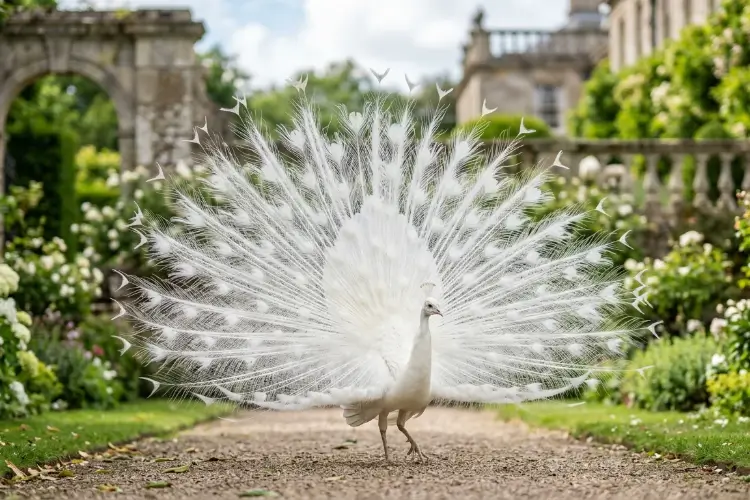
A white peacock is not a separate species. It’s not albino either, even though almost every caption you’ve ever scrolled past says otherwise.
It’s an Indian peafowl, the exact same species behind every familiar blue-and-green peacock, born with a genetic condition called leucism. And if you landed here looking for the butterfly instead, quick redirect: that’s a completely different creature called Anartia jatrophae, common across Florida and the southeastern US. This article is about the bird.
So what’s actually going on with these birds? Why are they white? Are they rare, or just rarely seen? And why does practically every culture on earth attach some kind of spiritual weight to them?
Here’s everything, backed by real facts, not folklore dressed up as biology.
What Is a White Peacock, Really?
Start here: “peacock” technically only means the male. The females are peahens, the babies are peachicks, and the whole group is called peafowl (see more Animal Group Names). You’ll see me use “peacock” the way most people search for it, but that’s the real breakdown.
There are three species of peafowl in the world: the Indian peafowl, the green peafowl, and the Congo peafowl. White peacocks come from the Indian peafowl, Pavo cristatus, the species most people picture when they hear the word “peacock” at all.
They’re not a fourth species. They’re not a rare import from somewhere exotic. They’re the same bird as your local zoo’s blue peacock, just missing the pigment in its feathers.
That’s the whole mystery, really. Not a new animal. A color variation.
Are White Peacocks Albino? The Leucism Explanation
Short answer: no.
White peacocks aren’t albino, they’re leucistic. That one distinction clears up almost every myth floating around about this bird.
Here’s the difference, because it actually matters:
- Albinism is a total absence of melanin production. It affects the whole body, including the eyes, which usually turn pink or red.
- Leucism is different. The bird still produces pigment. It just doesn’t get deposited into the feathers. Everything else, including eye color, stays normal.
That’s why a white peacock still has striking blue-grey eyes instead of pink ones. If you ever want a fast way to tell a leucistic bird from a true albino, the eyes are your answer.
Leucism removes color from the feathers but leaves the eyes untouched. That’s the whole mechanism in one sentence.
Peachicks aren’t even born white, by the way. They hatch with soft yellow down. Over the following weeks, that yellow fades out and pure white feathers grow in as they mature. So if you ever see a photo of a “white baby peacock” that’s snow white the day it hatches, be skeptical. That’s not how the biology works, and it’s exactly the kind of claim that’s shown up in fake AI-generated bird videos circulating online.
How Rare Are White Peacocks?
Uncommon, yes. A new species, no. Those are two very different claims, and people mix them up constantly.
White peafowl can be seen in the wild in India, but a fully white peacock is not something you stumble across.
Here’s the thing: a lot of the white peacocks you’ll see today were bred that way, on purpose. The RSPB, the UK’s bird charity, has said exactly that, noting that many white peacocks are bred for their coloring and used at events and weddings.
Once you have two white peafowl, breeding them together typically produces white offspring. That’s why you’ll see white peacocks at zoos, botanical gardens, event venues, and private collections far more often than you’d ever spot one loose in a forest in South Asia.
So when someone finds a white peacock wandering their neighborhood, as has happened in places like Hertfordshire, England and a suburb outside Montreal, it’s usually an escaped or abandoned bird, not a wild sighting. More on that a little further down.
White Peacock Facts at a Glance
| Fact | Detail |
| Species | Indian peafowl (Pavo cristatus), same species as the standard blue peacock |
| Cause of white coloring | Leucism, not albinism |
| Eye color | Blue-grey, unaffected by leucism |
| Native range | South Asia |
| Wild occurrence | Seen in the wild in India; many others are bred for their coloring |
| Breeding pattern | White x white typically “breeds true,” producing white offspring |
| Chick coloring at birth | Yellow down, turning white as they mature |
| Lifespan | Commonly cited as 15 to 20 years for peafowl (varies by source and care) |
Where Do White Peacocks Come From?
Their native range traces back to the Indian peafowl’s homeland across South Asia, where the species has lived (and been sought after by people) for centuries.
But odds are, you’re not going to spot a white peacock wandering wild anywhere near you. Today, they mostly live in:
- Zoos and wildlife parks, where they’re a reliable crowd favorite
- Botanical gardens and estates, often kept specifically for the visual effect
- Private aviaries and hobby farms, raised by breeders who specialize in peafowl genetics
- Event venues, since white peafowl are sometimes used decoratively at weddings and photo shoots
So where you’ll actually see one has very little to do with where the species originally comes from. That’s worth remembering next time you read a caption implying these birds are just quietly roaming some exotic jungle.
How White Peacocks Are Bred
This is where it gets genuinely interesting, and it’s the part most facts pages skip entirely.
Do white peacocks “breed true”? Mostly, yes. Breed two white peafowl together, and the offspring are typically white as well. That predictability is exactly why breeders were able to establish white peafowl as a stable, sought-after variety in the first place, rather than a one-off genetic fluke.
Cross a white peacock with a standard Indian Blue peahen, though, and the genetics get more layered. The offspring often carry the white gene without displaying it, something breeders call being “split” to white. Those birds look like ordinary blue peafowl but can still pass the white trait to future generations, sometimes showing up as a telltale white patch on the throat.
Here’s what a peachick’s development actually looks like, stage by stage:
- Hatching: Peachicks are born with soft yellow down, not white feathers.
- First days: White tips begin appearing at the edges of the wings.
- Growing in: Over the following weeks, the yellow down is gradually replaced by pure white feathers.
- Around 12 months: Males and females look nearly identical up to this point, making early sexing difficult.
- 12 to 14 months: Males start developing the longer legs and the elaborate feathery tail coverts that will eventually become their full train.
By the time a white peacock reaches maturity, it’s grown one of the most striking variations in the entire bird world, and it got there through a slow, specific developmental sequence, not an overnight transformation.
White Peacock vs. Blue Peacock: Key Differences
Same species. Different look, and a few real biological distinctions worth knowing.
| Trait | White Peacock | Blue Peacock |
| Feather color | Pure white | Iridescent blue and green |
| Cause of coloring | Leucism (pigment not deposited in feathers) | Normal pigmentation and structural coloration |
| Eye color | Blue-grey, normal | Blue-grey, normal |
| Rarity | Rare in the wild, common in captivity | Common, both wild and captive |
| Native status | Same species, native to South Asia | Native to South Asia |
| Breeding behavior | Breeds true when paired with another white | Standard coloring dominant across the wild population |
The takeaway? You’re not looking at two different animals. You’re looking at the same bird wearing two different genetic outfits.
What Does a White Peacock Symbolize?
Here’s the truth nobody tells you when they’re rattling off “spiritual meanings” online: a lot of that symbolism is folklore and modern interpretation, not ancient consensus. It’s meaningful, it’s worth understanding, but it’s a different category of knowledge than biology. So let’s walk through it with that distinction in mind.
Hindu Symbolism
In Hindu tradition, the peacock, colored or white, holds real cultural weight. It’s associated with Saraswati, the goddess of knowledge, art, and music, and separately with Kartikeya, whose vehicle is a peacock. The bird’s connection to purity and self-realization runs deep in Hindu iconography, and white peafowl in particular are often treated as symbols of spiritual clarity precisely because of their rarity.
Christian Symbolism
Long before white peafowl were widespread, colored peacocks already carried symbolic weight in Christian art, representing resurrection and eternal life. A white peacock, in this tradition, tends to elevate that meaning further: purity, renewal, and the idea of a soul cleansed of earthly attachment.
Greek and Other Traditions
In Greek mythology, the peacock is tied to Hera, queen of the gods, whose association with the bird’s “eyed” tail feathers connects to themes of watchfulness and protection. Variations of this “all-seeing” symbolism show up across other cultures too, generally tied to awareness, guardianship, and vigilance.
Modern Spirit-Animal Interpretation
More recently, in wellness and spiritual-guidance spaces, the white peacock has taken on meaning as a totem for authenticity, confidence, and stepping fully into your own visibility. Worth saying plainly: this is a modern interpretive layer, not an ancient scriptural claim, and it’s fine to enjoy it as such.
The simple fix, if you’re trying to make sense of all this? Treat the biology as fact and the symbolism as meaning-making. Both can matter to you. They’re just answering different questions.
Found a White Peacock? What It Probably Means
This happens more often than you’d think, and it’s usually not a wild sighting.
Real cases back this up. A couple in Hertfordshire, England spent about a month trying to track down the owner of a white peacock that showed up in their garden, and police told them it might have been stolen and dumped. A hobby farmer outside Montreal had one of his two white peacocks escape and become the talk of the neighborhood. A similar story played out on Prince Edward Island, where a bird expert said white peacocks aren’t local to the area and the bird was most likely someone’s escaped pet.
So if a white peacock shows up near you, here’s what’s actually going on:
- It’s very likely an escaped or abandoned bird, not a wild one that wandered far from its native range.
- Start by asking around. The Hertfordshire couple contacted nearby estates and the RSPCA, and local farms and bird keepers are a good first call too.
- They can be friendly but loud. The Hertfordshire couple described their visitor as beautiful and friendly, though they said it screeched loudly when it first arrived.
If one shows up in your yard, you’re probably not witnessing a rare wild encounter. You’re most likely hosting somebody’s runaway bird.
White Peacock Images
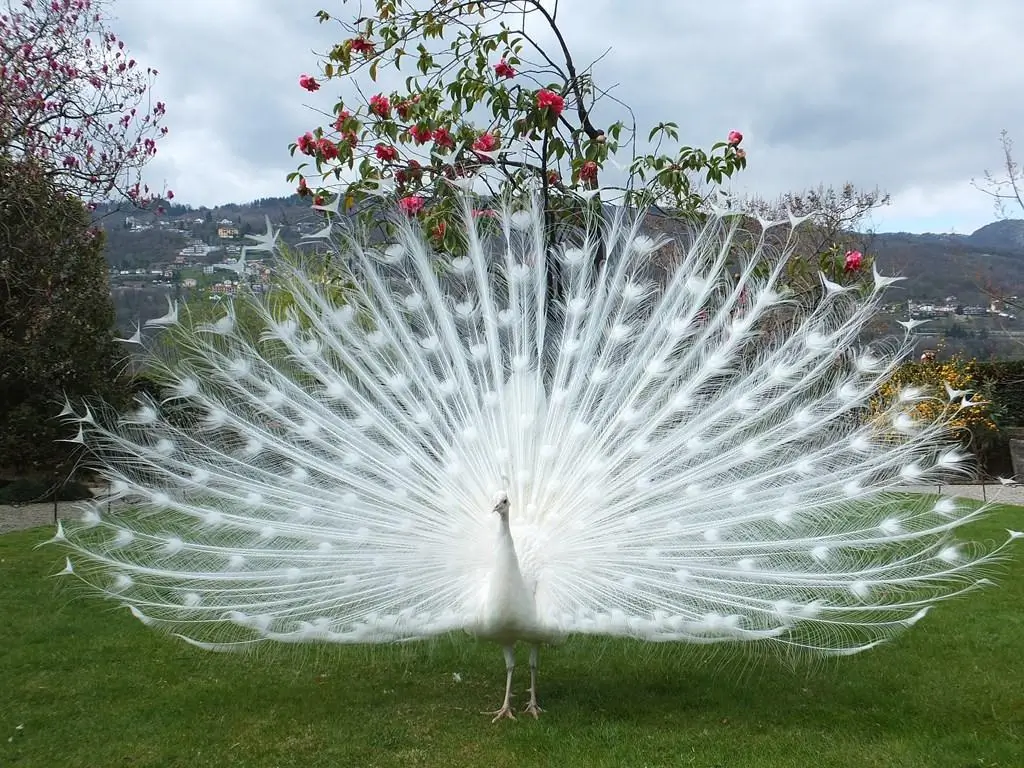
Photos genuinely do more work than description here. A few things worth looking for if you’re browsing images or trying to photograph one yourself:
- The full tail fan. In one widely shared video, a white peacock fans out around 150 feathers, and in direct sunlight the plumage shows subtle texture and shimmer even without color.
- The eyes. Look closely and you’ll see that signature blue-grey color, the clearest visual proof this bird is leucistic, not albino.
- Juveniles in transition. Photos of peachicks mid-transformation, still holding onto patches of yellow down while white feathers grow in, are some of the most striking and least commonly seen images of this bird.
- Side-by-side comparisons. Images of a white peacock next to a standard blue peacock make the “same species, different genetics” point better than any paragraph can.
Key Takeaways
- White peacocks aren’t albino, they’re leucistic, and their blue-grey eyes prove it.
- They’re not a separate species. They’re Indian peafowl with a color variation.
- They can be seen in the wild in India, but many white peacocks elsewhere are bred that way on purpose.
- Peachicks hatch yellow, not white, and transition over several weeks.
- Symbolically, they carry deep meaning across Hindu, Christian, and modern spiritual traditions, though that’s folklore layered on top of the biology, not a replacement for it.
- If one shows up in your yard, it’s most likely someone’s escaped bird, not a wild encounter.
If quirks like this are your thing, there are plenty more animal unusual facts to explore.
Not albino. Not a new species. Just one of nature’s rarer, more striking genetic quirks, wearing the same story every blue peacock has, told in a different color.