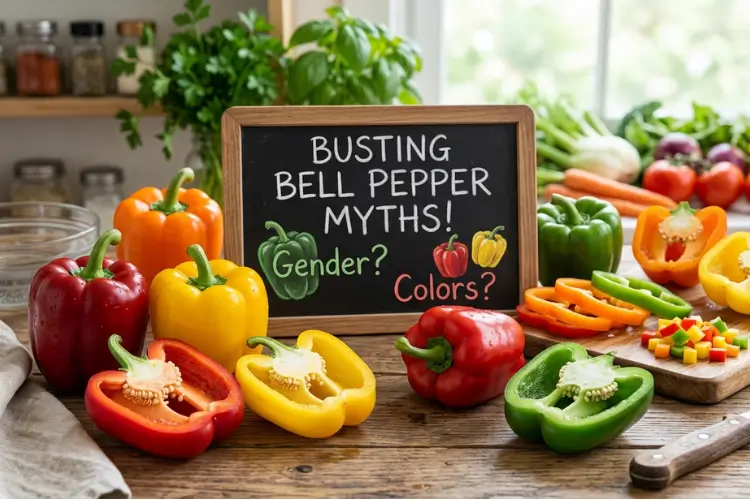
Bell peppers do not have a gender. “Male” and “female” peppers are a myth.
Lobe count (usually three or four) comes from genetics and growing conditions. It has nothing to do with sex.
Botanically, a bell pepper is a fruit. It grows from a flower and contains seeds. But in cooking and at the grocery store, it’s treated as a vegetable.
Color differences – green, yellow, orange, red come down to ripeness. They are not different varieties.
If you’ve heard any of these claims before, you’re not alone. Bell pepper folklore is everywhere: at the grocery store, in gardening forums, on social media. Below, we fact-check the most common myths against university extension research and USDA data.
Myth #1: Bell Peppers Have a Gender (Male vs. Female)
The claim: Four-lobed peppers are “female.” They’re sweeter and better for eating raw. Three-lobed peppers are “male.” They’re more bitter and better for cooking.
The reality: Plants don’t have a sex the way animals do. Their fruits don’t either.
A pepper flower has both male and female reproductive parts. It typically self-pollinates. There’s no “male pepper” or “female pepper” to sort a fruit into in the first place.
This myth seems to have spread through informal internet lists and viral social posts, not any horticultural source. It’s been repeated so often that many home cooks treat it as fact. It isn’t.
Lobe count is tied to the pepper’s variety and growing conditions. Not its sex. Not its sweetness.
Why it persists: Counting lobes is easy and visual. It feels like insider knowledge. That’s exactly why it spreads even though it doesn’t hold up.
Myth #2: More Lobes Means a Sweeter Pepper
The claim: A four-lobed pepper tastes sweeter than a three-lobed one.
The reality: Sweetness comes from ripeness, not lobe count.
As a pepper ripens on the plant, its sugar content rises. Its chlorophyll breaks down. That’s also what causes the color change from green to yellow, orange, or red.
Two peppers from the same plant can have identical lobe counts and totally different sweetness levels just picked at different times. Ripeness does the work, not anatomy.
Lobe number also varies naturally, even on the same plant. Some fruits form with two lobes, others with five. It’s a developmental quirk, not a flavor predictor.
Myth #3: Green, Yellow, Orange, and Red Peppers Are Different Varieties
The claim: Each color is a separate type of pepper, bred specifically for that color.
The reality: For most bell peppers, color marks a ripeness stage not a separate cultivar.
Every pepper starts out green on the plant. If left to fully mature, it typically turns yellow, orange, or red, depending on the variety. The same plant that gives you a green pepper today will give you a red one if that fruit stays on the vine longer.
Green peppers aren’t a “green variety” picked too early. They’re peppers of whatever color variety they are just harvested before they finished ripening.
This is also why green peppers taste more bitter and grassy, while red peppers taste noticeably sweeter. The red pepper simply had more time to develop sugars.
Nutrition by Color: What Actually Changes as a Pepper Ripens
| Nutrient (per 1 cup, raw) | Green Bell Pepper | Red Bell Pepper |
| Vitamin C | ~120 mg | ~190 mg |
| Vitamin A (beta-carotene) | Low | High |
| Sugar content | Lower | Higher |
| Flavor profile | Grassy, slightly bitter | Sweet, fruity |
Values are approximate, based on USDA nutrient data. Exact figures vary by pepper size and growing conditions.
Want the sweetest, most nutrient-dense pepper for eating raw? Reach for red, orange, or yellow.
Want a firmer, more savory pepper for sautéing or stir-fries? Green works well and it’s often cheaper, since it spends less time on the plant before harvest.
Myth #4: A Bell Pepper Is a Vegetable
The claim: Bell peppers are vegetables. Simple as that.
The reality: Botanically, a bell pepper is a fruit.
In plant biology, a fruit is the mature, seed-bearing structure that develops from a flower’s ovary. Bell peppers grow directly from a flower and contain seeds. That puts them in the same category as several other common vegetables that are actually fruits, like tomatoes, cucumbers, squash, and avocados, even though most people call them vegetables without a second thought.
So why does everyone call it a vegetable? Because “fruit” and “vegetable” aren’t botanical categories in the kitchen. They’re culinary and legal ones, based on flavor and use.
This isn’t just an informal habit, either. In 1893, the U.S. Supreme Court ruled on this exact question in Nix v. Hedden. The case involved tomatoes. The Court classified them as vegetables for tariff purposes while acknowledging they’re botanically fruits because they’re grown in gardens and eaten as part of the main meal, not as dessert.
That same culinary-versus-botanical logic is why bell peppers, squash, and cucumbers all get filed under “vegetable” at the store.
Bottom line: Science says fruit. The kitchen, the produce aisle, and the law say vegetable. Both are correct. They’re just answering different questions.
Myth #5: Bell Pepper Seeds Are Unsafe to Eat
The claim: The seeds and white pith should always be removed they’re not safe to eat.
The reality: Bell pepper seeds aren’t toxic. They’re safe to eat for most people, in normal amounts.
Most people remove them for texture or mild bitterness, not for safety. The white pith (placenta) is edible too, though it can taste more bitter than the flesh. If you have a specific pepper allergy, use caution but there’s no general health risk here.
Myth #6: All Bell Peppers Taste the Same Once Cooked
The claim: Cooking evens out the flavor differences, so the color you use doesn’t matter.
The reality: Cooking softens the differences. It doesn’t erase them.
Red, orange, and yellow peppers start out sweeter and less bitter than green. That difference carries through cooking roasted or sautéed, they keep a noticeably sweeter, more caramelized flavor. Green peppers hold onto more of their grassy, slightly bitter edge, even after heat.
That’s exactly why many fajita or stir-fry recipes call for a mix of colors. It’s not just for looks. It changes the flavor balance of the dish.
Myth #7: Bell Peppers Have Little Nutritional Value
The claim: Bell peppers are “mostly water” more of a garnish than a real source of nutrients.
The reality: Bell peppers are genuinely nutrient-dense for their calorie count.
A single red bell pepper has more vitamin C than an orange. It also delivers meaningful amounts of vitamin A, vitamin B6, folate, potassium, and fiber. Yes, they’re high in water content. But that’s part of what makes them a low-calorie way to add volume and nutrients to a meal not a sign they lack substance.
Quick-Reference: Bell Pepper Myth vs. Fact
| Myth | Reality | Why |
| Peppers have a gender (3 vs. 4 lobes) | No sex; lobe count is genetic/environmental | Plants aren’t sexed like animals; pepper flowers self-pollinate |
| More lobes = sweeter | Ripeness determines sweetness | Sugar content rises as the pepper ripens |
| Different colors are different varieties | Color usually reflects ripeness stage | Most peppers start green and change color as they mature |
| Bell peppers are vegetables | Botanically a fruit; culinarily/legally a vegetable | “Vegetable” is a culinary and legal term (see Nix v. Hedden, 1893) |
| Seeds are unsafe to eat | Seeds are edible and non-toxic | Removed mainly for texture, not safety |
| All colors taste the same cooked | Sweetness/bitterness differences persist | Riper peppers retain more sugar, even cooked |
| Peppers have little nutritional value | High in vitamin C, A, B6, folate, fiber | Nutrient-dense despite high water content |
So, Which Pepper Should You Actually Pick?
Bell peppers don’t have a gender. Lobe count doesn’t predict sweetness. Color is mostly about ripeness, not variety.
What they are, definitively: a fruit by biology, a vegetable by culinary and legal convention and either way, one of the most nutrient-dense, versatile ingredients in the produce aisle.
Next time someone tells you to pick the “female” pepper for a salad, you’ll know what’s actually worth checking: how ripe and how red it is.