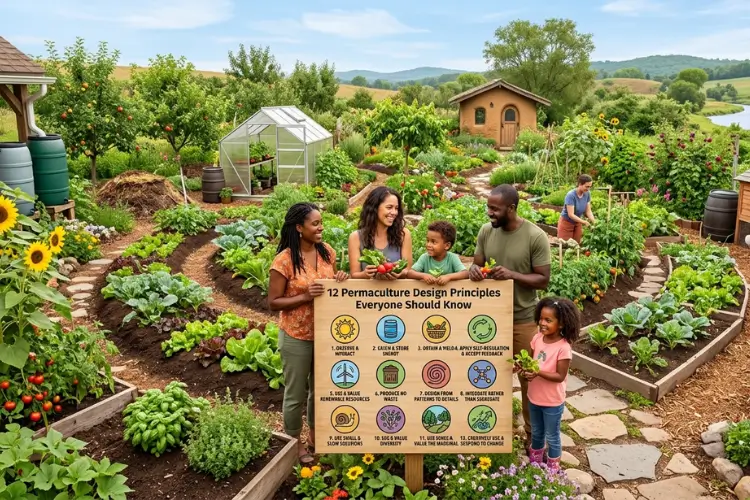
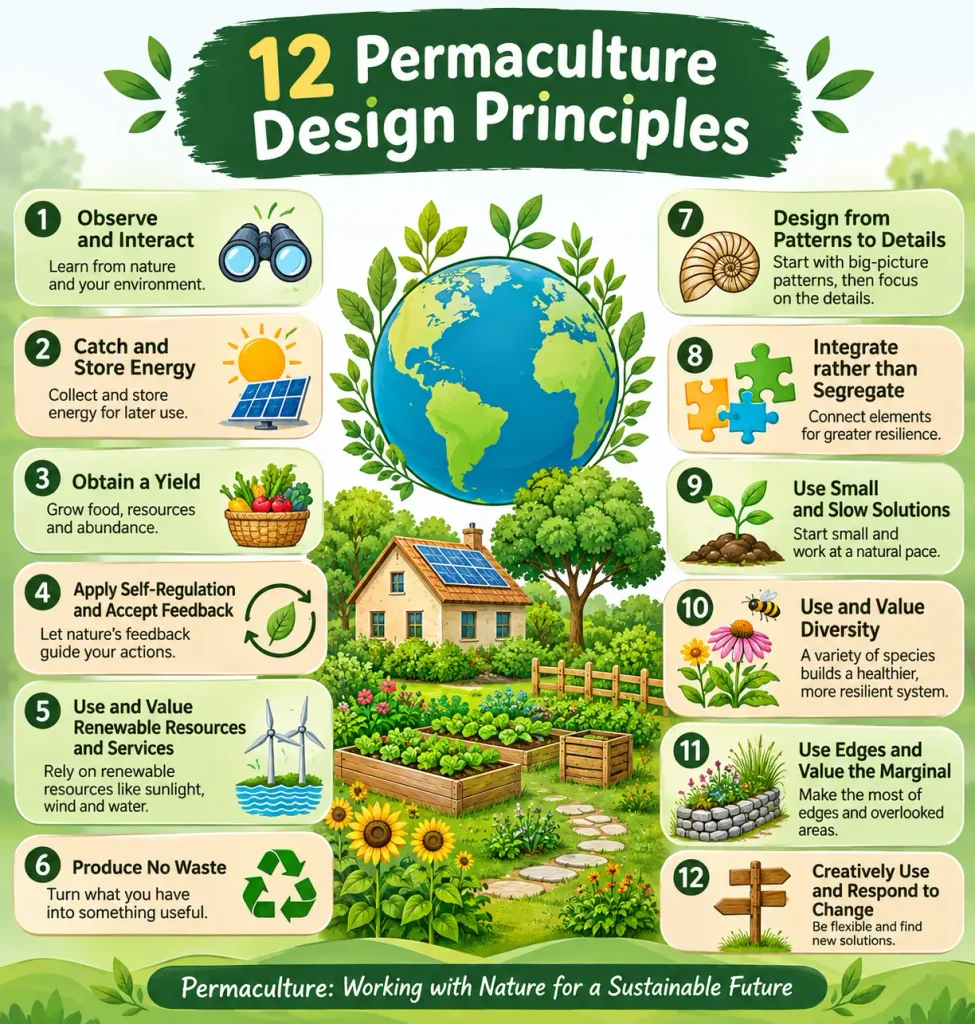
Permaculture design principles are 12 thinking tools, published by David Holmgren in 2002, for designing gardens, homes, and communities that work like natural ecosystems.
They are guided by three ethics: earth care, people care, and fair share.
Here they are, in Holmgren’s official order:
- Observe and interact
- Catch and store energy
- Obtain a yield
- Apply self-regulation and accept feedback
- Use and value renewable resources and services
- Produce no waste
- Design from patterns to details
- Integrate rather than segregate
- Use small and slow solutions
- Use and value diversity
- Use edges and value the marginal
- Creatively use and respond to change
TL;DR
- Permaculture principles are thinking tools, not rules.
- You don’t need land. They work on a balcony, in a rental, even in your kitchen.
- Start with Principle 1 (observe) before you buy or plant anything.
- Research shows permaculture sites can hold 27% more soil carbon than nearby conventional fields.
- Pick one principle this week. Small and slow wins.
When I first read that list, I’ll be honest.
It sounded like a fortune cookie collection.
“Use edges”? “Obtain a yield”? What does any of that mean when you’re standing in a patchy backyard with a bag of compost and no plan?
So I did what I always do. I tested them. One at a time, in my own space.
This guide is what actually made sense once the theory hit the dirt.
What Are Permaculture Design Principles?
Permaculture is a design system that creates sustainable human environments by copying the patterns of natural ecosystems.
The principles are the “how.” They help you make decisions.
The word itself blends “permanent” and “agriculture” (and later, “permanent culture”). It was born in Tasmania, Australia, in the 1970s, when Bill Mollison and his student David Holmgren started asking a simple question:
What if we designed farms like forests instead of factories?
Here’s the truth nobody tells you:
The principles aren’t really about gardening. They’re about noticing how nature solves problems, then borrowing those solutions for your yard, your home, and your habits.
Who Created the 12 Principles? (Holmgren vs Mollison)
David Holmgren created the 12 principles most people use today, publishing them in Permaculture: Principles and Pathways Beyond Sustainability (2002).
But: He wasn’t the first to write principles down.
Bill Mollison, the co-founder of permaculture, had his own longer list in Permaculture: A Designers’ Manual (1988). It included ideas like “every element should serve many functions” and “work with nature, not against it.”
Later, American author Toby Hemenway adapted the ideas for North American home gardeners in Gaia’s Garden.
So which list is “correct”?
All of them. As NC State Extension points out in its Extension Gardener Handbook, there’s no single official list. Each teacher frames the same core ideas a little differently.
That said, Holmgren’s 12 are the most widely taught worldwide. They’re what you’ll see in most Permaculture Design Courses (PDCs). That’s the list this guide follows.
| Feature | Bill Mollison | David Holmgren | Toby Hemenway |
| Key book | Permaculture: A Designers’ Manual (1988) | Permaculture: Principles and Pathways (2002) | Gaia’s Garden (2001, 2nd ed. 2009) |
| Number of principles | Varies (roughly 10 to 15+) | 12 | Adapted list for home gardens |
| Focus | Farm and site design | Thinking tools for any system | North American backyards |
| Best for | Designers and farmers | Everyone | Suburban beginners |
How the Principles Connect to the 3 Ethics
The three permaculture ethics are earth care, people care, and fair share.
Think of it this way:
- The ethics are your “why.”
- The principles are your “how.”
Earth care means protecting soil, water, and living systems.
People care means meeting human needs, including yours.
Fair share (sometimes called “return of surplus”) means taking only what you need and passing on the extra.
Every principle below should pass one test:
Does this choice care for the earth, care for people, and share fairly?
If not, it isn’t permaculture. It’s just gardening with a fancier name.
The 12 Permaculture Design Principles, Explained With Examples
Each principle below follows the same pattern, so you can skim:
- What it means in one sentence
- Holmgren’s proverb (every principle has one)
- Examples for a garden, a small space, and your everyday life
- Try this weekend: one small action
Let’s go.
1. Observe and Interact
Observe and interact means studying your space, ideally through all four seasons, before making big changes.
Proverb: “Beauty is in the mind of the beholder.”
This is the principle every other principle depends on.
Because:
The best plan in the world fails if it ignores where the sun actually hits, where water actually pools, and where you actually walk.
When I started, I wanted to plant everything in week one.
The simple fix? A notebook and a chair.
- In the garden: Track where sun and shade fall at 9 a.m., noon, and 4 p.m. Note where puddles form after rain.
- In a small space: Watch which windowsill or balcony corner gets 6+ hours of direct sun.
- In everyday life: Before buying anything “eco,” watch what you actually throw away for one week.
Try this weekend: Spend 20 minutes outside with a notebook. Write down 10 things you notice. No action allowed.
2. Catch and Store Energy
Catch and store energy means collecting resources when they’re abundant so you can use them when they’re scarce.
Proverb: “Make hay while the sun shines.”
In permaculture, “energy” means more than electricity.
It’s rain. Sunlight. Organic matter. Seeds. Even knowledge and community goodwill.
Here’s a number that surprised me:
One inch of rain on a 1,000 sq ft roof produces about 623 gallons of water.
Most of it rushes straight down the storm drain.
- In the garden: Install a rain barrel on a downspout. Dig a shallow swale (a level ditch on contour) to slow water and let it soak in.
- In a small space: Place thermal mass, like a dark water jug or brick, near balcony plants to store daytime heat.
- In everyday life: Preserve summer harvests by drying, freezing, or fermenting.
Try this weekend: Put a bucket under one downspout during the next rain. Measure what you catch. It’s eye-opening.
By the way: Rainwater rules vary. Most US states allow rain barrels, but some set limits. Colorado, for example, allows a maximum of two rain barrels with a combined 110 gallons per household. Check your state and city rules first.
3. Obtain a Yield
Obtain a yield means designing so your work produces something useful, and soon.
Proverb: “You can’t work on an empty stomach.”
This one is refreshingly practical.
A beautiful design that feeds no one and saves no money won’t last. You’ll get tired and quit.
A yield can be:
- Food
- Firewood or mulch
- Money saved
- Time saved
- Joy, beauty, or learning
- In the garden: Start with fast crops like radishes, lettuce, or herbs while slower fruit trees establish.
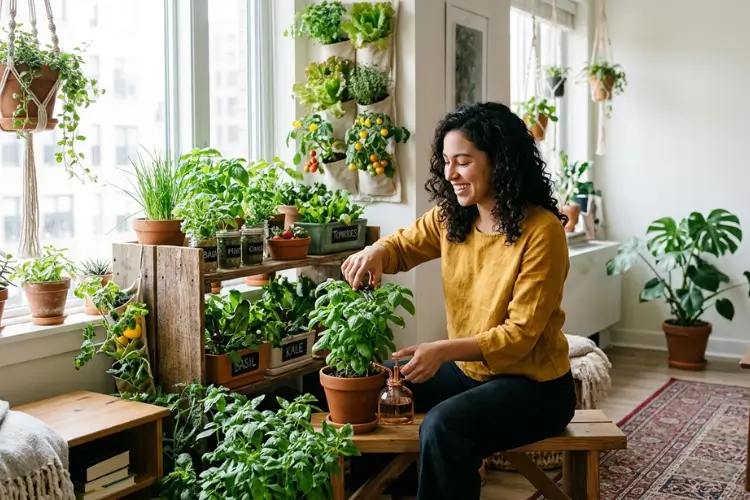
- In a small space: Grow herbs you actually buy, or start with easy urban garden vegetables like lettuce and cherry tomatoes. Basil and mint pay for themselves in weeks.
- In everyday life: Track your savings when you switch to reusables. That number is a yield too.
Try this weekend: Plant one thing you’ll harvest within 30 days.
4. Apply Self-Regulation and Accept Feedback
Apply self-regulation and accept feedback means noticing what isn’t working and adjusting before small problems become big ones.
Proverb: “The sins of the fathers are visited on the children unto the seventh generation.”
Nature runs on feedback loops.
Too many aphids? Ladybugs show up. Too much growth? Resources run out.
Your job is to notice the signals and respond, rather than override them.
- In the garden: Yellowing leaves, pest outbreaks, and dry patches are feedback. Adjust watering, planting, or soil before reaching for sprays.
- In a small space: If a pot dries out daily, move it or switch to a bigger container instead of watering twice as much.
- In everyday life: Look at your trash can. It’s the most honest feedback system in your home.
Try this weekend: Write down one thing that failed last season. Then write one reason why.
5. Use and Value Renewable Resources and Services
Use and value renewable resources means relying on things nature replaces, like sunlight, wind, plants, and animals, instead of finite resources.
Proverb: “Let nature take its course.”
Sunlight and wind are the obvious ones, and they power the best renewable energy sources we have.
But “services” is the key word here.
Chickens till soil and eat pests. Bees pollinate. Worms make fertilizer. Trees give shade that cools your house.
None of them send an invoice.
- In the garden: Use chop and drop mulching: cut plants like comfrey and leave them as mulch where they fall.
- In a small space: Start a worm bin under the sink. The worms turn food scraps into rich castings, one of the best organic fertilizers you can get for free.
- In everyday life: Line-dry clothes. The sun is the most reliable free dryer you’ll ever own, and it’s one of my favorite zero-waste laundry tips.
Try this weekend: Replace one “bought” input (fertilizer, mulch, dryer cycle) with a free natural one.
6. Produce No Waste
Produce no waste means treating every output as an input for something else.
Proverb: “Waste not, want not.” (Also: “A stitch in time saves nine.”)
This is where permaculture and zero-waste living shake hands.
In nature, there’s no such thing as trash. A fallen leaf is food for fungi. A dead log is a home for beetles.
And here’s why it matters:
According to the US EPA, food is the single largest category of material sent to American landfills, making up roughly 24% of landfilled municipal waste. There, it breaks down without oxygen and releases methane.
- In the garden: Compost your kitchen scraps. Turn fallen branches into a brush pile for wildlife or a hügelkultur bed.
- In a small space: Use a bokashi bucket or worm bin. Regrow green onions from their roots.
- In everyday life: Follow the order: refuse, reduce, reuse, repair, then recycle.
Try this weekend: Keep a bowl on your counter for food scraps for 7 days. Weigh it at the end. That’s your composting potential.
7. Design From Patterns to Details
Design from patterns to details means seeing the big picture first, then filling in specifics.
Proverb: “Can’t see the forest for the trees.”
Beginners (me included) usually start with details.
“I want blueberries here!”
But:
If blueberries sit in the wrong spot for sun, water, and soil pH, they’ll struggle forever.
Start with patterns: sun path, water flow, wind, how you move through the space. Then place plants and structures.
Two classic permaculture patterns help:
- Zones: Place things you use often closest to your door.
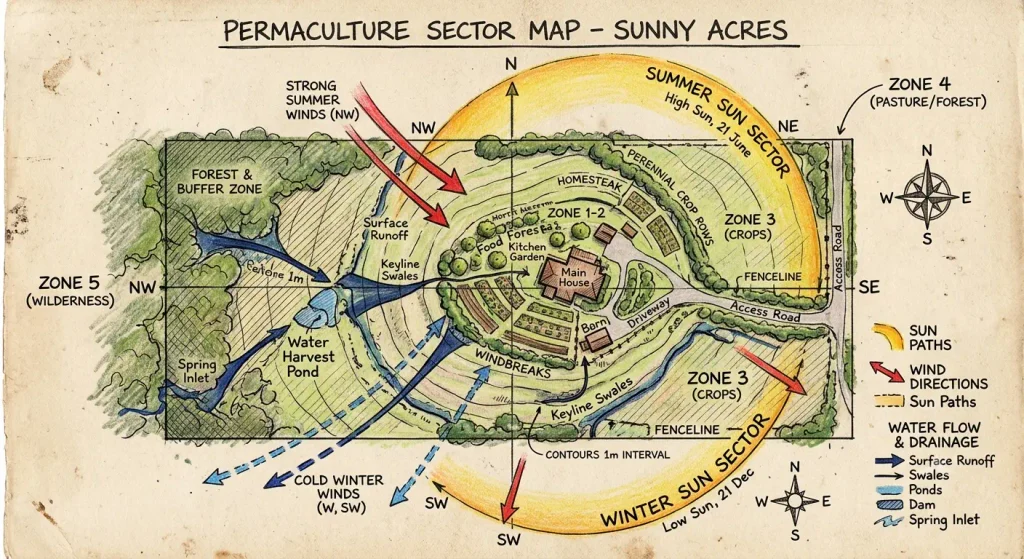
- Sectors: Map energies coming from outside (sun, wind, water, fire risk, noise, views).
- In the garden: Put herbs by the kitchen door (Zone 1), fruit trees farther out (Zone 2 or 3).
- In a small space: Keep daily-use items like a herb pot at eye level near where you cook.
- In everyday life: Plan your week’s meals before you shop, not in the aisle.
Try this weekend: Sketch your space from above. Draw an arrow for the sun path and one for where water flows.
8. Integrate Rather Than Segregate
Integrate rather than segregate means placing elements so they support each other.
Proverb: “Many hands make light work.”
Here’s a line I repeat constantly:
In permaculture, every element should serve at least three functions, and every function should be supported by at least three elements.
A chicken isn’t just an egg machine. It eats pests, makes fertilizer, turns compost, and clears weeds.
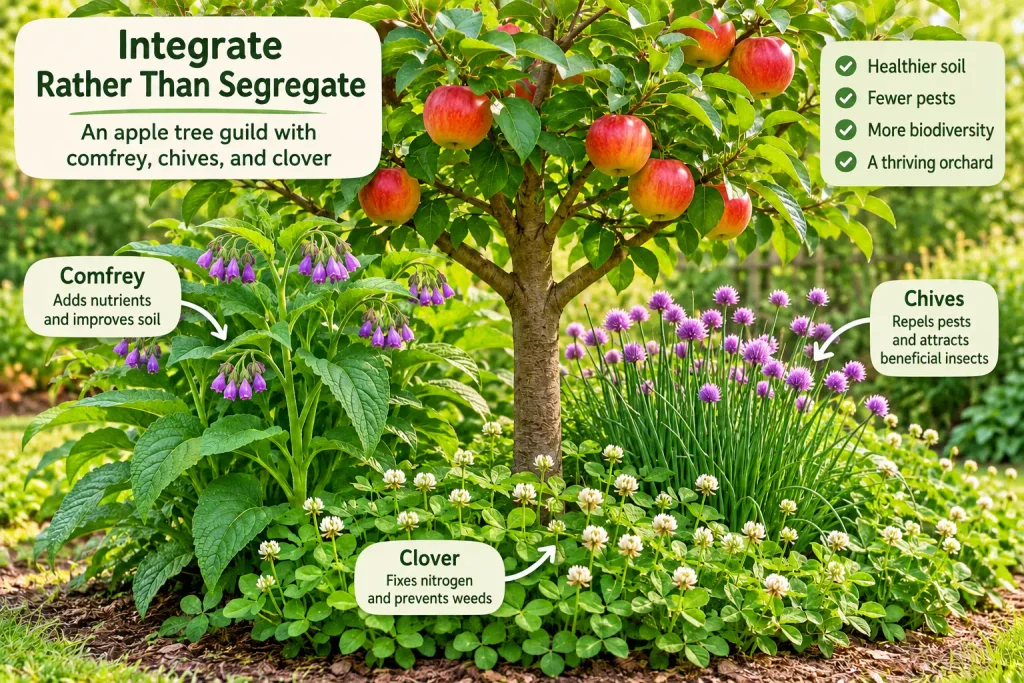
The classic example is a plant guild: a group of plants that support a central species, usually a fruit tree.
For an apple tree guild, you might plant:
- Comfrey to mine nutrients and provide mulch
- Chives to deter pests
- Clover to fix nitrogen and cover soil
- Daffodils to discourage burrowing rodents
- In the garden: Try the Three Sisters: corn, beans, and squash grown together.
- In a small space: Plant basil beside tomatoes in the same large pot.
- In everyday life: Share tools, rides, and surplus with neighbors instead of everyone owning everything.
Try this weekend: Pick one plant you already grow. Add a companion that helps it.
9. Use Small and Slow Solutions
Use small and slow solutions means starting small, learning fast, and scaling what works.
Proverbs: “The bigger they are, the harder they fall.” and “Slow and steady wins the race.”
This principle saved me money. And sanity.
My first instinct was to rip out the entire lawn in one weekend.
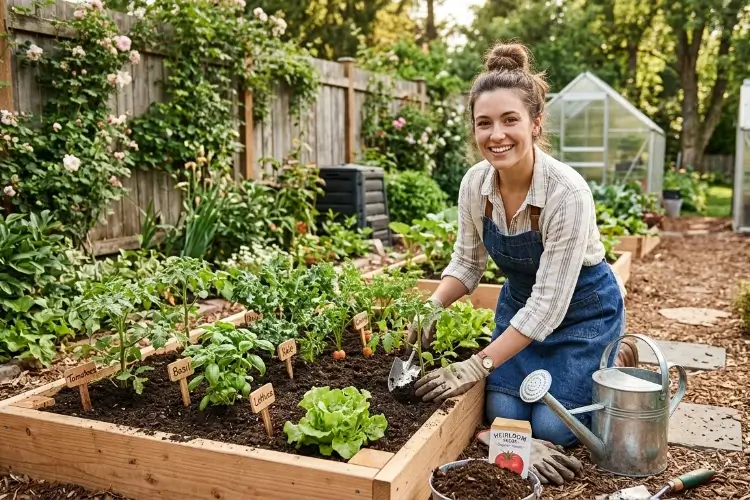
Instead, I started with one 4 x 8 ft bed.
Small and slow solutions are easier to maintain, cheaper to fix, and better at teaching you what your site wants.
- In the garden: Sheet mulch one small area with cardboard and compost instead of tilling the whole yard.
- In a small space: Master three plants before adding ten.
- In everyday life: Make one of these simple zero-waste swaps per month instead of overhauling your whole home at once.
Try this weekend: Choose a space no bigger than a door. That’s your whole project for now.
10. Use and Value Diversity
Use and value diversity means growing many kinds of things so the system can survive surprises.
Proverb: “Don’t put all your eggs in one basket.”
A lawn is a monoculture.
A permaculture garden is a designed ecosystem.
Diversity spreads risk. If one crop fails to a pest, drought, or late frost, others carry on.
And the data backs this up. In a 2024 study published in Communications Earth & Environment, permaculture sites had about three times as many bird species as nearby conventional farmland.
- In the garden: Mix annuals, perennials, shrubs, and trees. Plant native flowers for pollinators.
- In a small space: Grow several herb varieties instead of a single large plant.
- In everyday life: Diversify skills and income. Resilience applies to people too.
Try this weekend: Add one native flowering plant to your space.
11. Use Edges and Value the Marginal
Use edges and value the marginal means paying attention to borders, transitions, and overlooked spaces, because that’s where the most life happens.
Proverb: “Don’t think you are on the right track just because it’s a well-beaten path.”
Think about where a forest meets a meadow. Or where a river meets land.
These edges are usually the most productive places in any landscape. Ecologists call it the edge effect.
In your yard, “edges” include fence lines, pond borders, path sides, and wall bases.
“Marginal” means the forgotten spaces: the shady strip by the garage, the steep slope, the corner nobody uses.
- In the garden: Use wavy or keyhole-shaped beds instead of straight rectangles to increase planting edge.
- In a small space: Grow vertically on railings and walls.
- In everyday life: Listen to the quiet voices in your community. New ideas often come from the margins.
Try this weekend: Find the most ignored corner of your space. Ask what it could grow or do.
12. Creatively Use and Respond to Change
Creatively use and respond to change means designing for the future, not just today, and treating change as an opportunity.
Proverb: “Vision is not seeing things as they are but as they will be.”
Gardens change. Trees grow and shade out sun lovers. Climate shifts. Your life changes too.
Permaculture calls this succession: the natural way ecosystems evolve over time.
Your job isn’t to freeze the design. It’s to guide the change.
- In the garden: Plant sun-loving vegetables now, knowing shade-tolerant plants will replace them as trees mature.
- In a small space: Choose movable containers so you can follow the sun as seasons change.
- In everyday life: When something breaks, ask “what could this become?” before you replace it.
Try this weekend: Take a photo of your space. Set a reminder to take the same photo in 6 months.
Permaculture Principles Cheat Sheet
| # | Principle | What it means | Garden example | Home / zero-waste example |
| 1 | Observe and interact | Watch before you act | Map sun and shade | Track your trash for a week |
| 2 | Catch and store energy | Save abundance for later | Rain barrel, swale | Preserve harvests |
| 3 | Obtain a yield | Make sure work pays off | Fast crops first | Track reusable savings |
| 4 | Self-regulation and feedback | Notice signals, adjust | Read yellow leaves | Audit your bin |
| 5 | Renewable resources | Use what nature replaces | Chop and drop mulch | Line-dry laundry |
| 6 | Produce no waste | Outputs become inputs | Compost | Refuse, reduce, reuse |
| 7 | Patterns to details | Big picture first | Zones and sectors | Meal plan before shopping |
| 8 | Integrate, don’t segregate | Elements support each other | Plant guilds | Share tools with neighbors |
| 9 | Small and slow solutions | Start small, scale what works | One 4 x 8 ft bed | One swap per month |
| 10 | Use and value diversity | Spread the risk | Polyculture | Diverse skills |
| 11 | Use edges, value the marginal | Borders are productive | Keyhole beds | Grow vertically |
| 12 | Respond to change | Design for the future | Plan for succession | Repurpose before replacing |
Does Permaculture Actually Work? What the Research Says
Yes. The strongest recent evidence comes from a 2024 peer-reviewed study of nine permaculture farms in Germany and Luxembourg.
Researchers compared permaculture plots with nearby fields farmed the conventional way.
📊 What the Research Found
- 27% higher soil carbon stocks on permaculture sites
- 20% lower soil bulk density (meaning looser, less compacted soil)
- 201% higher earthworm abundance
- About 3x more bird species
Source: Reiff et al., “Permaculture enhances carbon stocks, soil quality and biodiversity in Central Europe,” Communications Earth & Environment, 2024.
The researchers linked the higher soil carbon to more organic matter going into the soil and to mulching. Sound familiar? That’s Principles 5 and 6 in action.
Now, let’s be fair.
Nine farms in one region is a small sample. More research is needed across different climates, including North America.
But:
The results line up with decades of soil science on no-till growing, cover crops, and plant diversity.
And here’s some context for your own yard:
| Fact | Why it matters for you |
| US turf grass (lawns, parks, and golf courses) covers an estimated 40 million acres | Converting even part of your lawn adds habitat and food |
| Outdoor use makes up more than 30% of US household water use on average (EPA WaterSense) | Swales, mulch, and rain barrels help you save water in the garden |
| Up to 50% of outdoor watering is lost to evaporation, wind, or runoff (EPA WaterSense) | Principle 2 exists for exactly this problem |
| Food makes up roughly 24% of landfilled US municipal waste (EPA) | Composting is Principle 6 at its simplest |
How to Apply the 12 Principles to Your Yard: A 7-Step Starter Plan
So where do you start?
Not with a shopping cart. With this.
Total time: 6 to 8 weeks (mostly observing) Estimated cost: $0 to $150
- Observe for 4 weeks. Note sun, shade, wet spots, wind, and how you use the space. (Principle 1)
- Sketch your base map. Draw your space from above, including buildings, trees, paths, and fences. (Principle 7)
- Mark your zones. Circle what you’ll visit daily (Zone 1) versus weekly or rarely. (Principle 7)
- Map your sectors. Add arrows for sun path, prevailing wind, water flow, and views. (Principle 7)
- Choose one small project. One bed, one rain barrel, or one compost bin. (Principle 9)
- Stack functions. Make sure your project does at least three jobs, like a bed that grows food, feeds pollinators, and absorbs rain. (Principle 8)
- Review monthly. What worked? What didn’t? Adjust. (Principle 4)
Zones 0 to 5 in Plain English
| Zone | What it is | What goes there |
| 0 | Your home | Kitchen scraps bin, sprouts, indoor herbs |
| 1 | Right outside the door, visited daily | Salad greens, herbs, compost |
| 2 | Visited every few days | Berry bushes, dwarf fruit trees, chickens |
| 3 | Visited weekly or seasonally | Larger fruit trees, main crops |
| 4 | Semi-wild, rarely managed | Woodlot, foraging, timber |
| 5 | Wild, left alone | Wildlife habitat, observation only |
Most suburban yards only have Zones 0 to 2. That’s completely fine.
Mapping Sectors (Sun, Wind, Water, Fire, Views)
Sectors are the outside forces that flow through your space.
- Sun: Where is the winter sun low and summer sun high?
- Wind: Which direction do cold winter winds come from?
- Water: Where does rain run and pool?
- Fire: Especially important in the western US and Australia. Where could fire approach from?
- Views and noise: What do you want to screen, and what do you want to frame?
Adapting the Principles to Your Climate
The principles are universal.
The techniques aren’t.
Cold Climates (USDA Zones 3 to 5, Canada, Northern Europe)
- Use south-facing walls (north-facing in the Southern Hemisphere) as heat traps for tender plants.
- Build hügelkultur beds. Rotting wood holds moisture and warms soil in spring.
- Choose hardy perennials like haskap, rhubarb, and sea kale.
- Look at farms like New Forest Farm in Wisconsin for proof of cold-climate perennial systems.
Dry Climates (US Southwest, Australia, Mediterranean)
- Water is everything. Use swales, basins, and deep mulch.
- Plant in sunken beds, not raised ones, to catch water.
- Use native, drought-adapted plants and shade structures.
- Consider greywater, but check your state’s rules first.
Humid and Wet Climates (US Southeast, Pacific Northwest, UK)
- Focus on drainage and airflow to prevent fungal disease.
- Use raised beds or mounds in soggy spots.
- Rain gardens turn problem puddles into habitat.
- Slugs love wet climates. Ducks love slugs. (That’s Principle 8.)
Apartments, Balconies, and Rentals
You don’t need land to practice permaculture.
- Observe balcony light through the day. (1)
- Catch rain in a container if your building allows it. (2)
- Grow herbs you already buy. (3)
- Compost with a worm bin or bokashi. (6)
- Grow vertically on railings. (11)
- Use movable pots so the garden can follow the sun. (12)
Permaculture vs Organic Gardening vs Regenerative Agriculture
These overlap, but they’re not the same.
If you’ve already started an organic garden at home, you’re closer to permaculture than you think.
| Factor | Permaculture | Organic gardening | Regenerative agriculture |
| Core focus | Designing whole systems | Avoiding synthetic inputs | Rebuilding soil health |
| Scale | Balcony to farm to community | Mostly gardens and farms | Mostly farms and ranches |
| Certification | Optional PDC for designers | USDA Organic for sellers | Some private certifications |
| Approach | Principles and ethics guide design | Rules about what you can use | Practices like no-till, grazing, cover crops |
| Covers homes and lifestyle? | Yes | No | Rarely |
| Best for | Anyone redesigning how they live | Gardeners avoiding chemicals | Farmers restoring land |
The short version:
Organic is about what you don’t use. Regenerative is about what you rebuild. Permaculture is about how you design.
7 Mistakes Beginners Make With Permaculture Principles
I made most of these. You don’t have to.
- Skipping observation. Planting in week one, then moving everything in year two.
- Going too big. Ripping out the whole lawn, then drowning in weeds.
- Copying someone else’s design. A food forest in Florida won’t work the same in Minnesota.
- Forgetting the yield. Building a beautiful system that feeds no one, then losing motivation.
- Buying “permaculture” products. You rarely need special gear. Cardboard, compost, and time do most of the work.
- Ignoring people care. Burning yourself out isn’t sustainable either.
- Treating the principles as rules. They’re questions to ask, not boxes to tick.
Best Books and Courses to Go Deeper
- Permaculture: Principles and Pathways Beyond Sustainability by David Holmgren. The source of the 12 principles.
- Gaia’s Garden by Toby Hemenway. The best starting point for North American home gardeners.
- Permaculture: A Designers’ Manual by Bill Mollison. The deep technical reference.
- Permaculture Principles website. Holmgren’s official site, with a page for each principle.
- Online Permaculture Design Course (PDC). Several universities and institutes offer these, including Oregon State University’s online program.
Key Takeaways
- Permaculture design principles are 12 thinking tools created by David Holmgren in 2002.
- They’re guided by three ethics: earth care, people care, and fair share.
- Start with observation. Everything else depends on it.
- Start small. One bed, one barrel, one bin.
- They work anywhere, from a 40-acre farm to a 4 ft balcony.
Here’s the truth nobody tells you:
You don’t need to master all 12.
You need to try one.
Pick the principle that made you nod the hardest. Try its weekend action. Then come back for the next one.