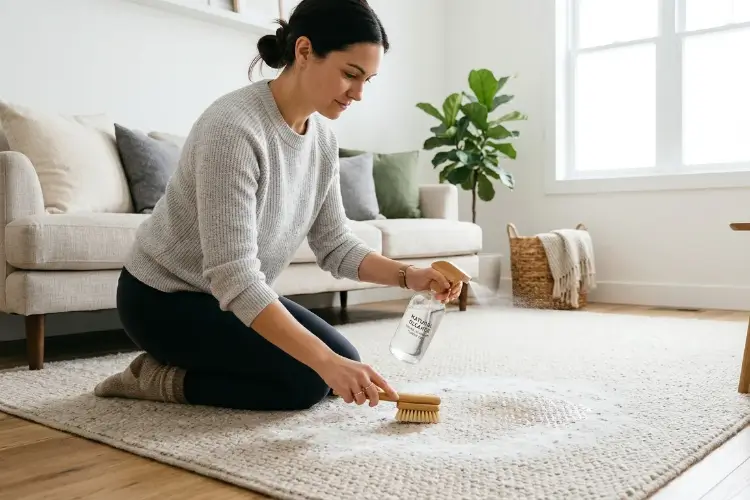
Your carpet is filthy. Maybe it’s a wine stain that’s been mocking you from the corner of the living room for two weeks. Maybe it’s just that general, tired, high-traffic dullness that creeps in over a year of shoes, spills, and a dog who does not understand the concept of “outside.”
Whatever brought you here, you don’t want to reach for a bottle of chemical carpet shampoo. Good. You shouldn’t have to.
When I started trying zero waste cleaning hacks around my home, carpets were the thing I put off longest. It felt like the one job where “natural” meant “not as good.” I was wrong. It just meant learning which ingredient does which job, and being honest about the one or two things natural methods genuinely can’t do.
That’s what this guide is. Not a single recipe. A full method.
THE QUICK ANSWER
- Vacuum thoroughly first. Always. This is the step people skip and the step that matters most.
- Treat stains with a vinegar-and-water solution or a baking soda paste, depending on the stain.
- Agitate gently with a soft brush, then blot. Never scrub. Scrubbing spreads the stain and wears down the fibers.
- Rinse with plain water, then dry fast. A carpet that stays wet too long is how you trade a stain for mold.
Keep reading for the full step-by-step, a real stain-by-stain library, and the honest truth about when natural cleaning has limits.
What you actually need
You probably already have most of this. That’s kind of the point.
- White vinegar. Your workhorse. Cuts odor and breaks down mineral and mildly acidic stains.
- Baking soda. Absorbs moisture and odor. Doesn’t lift color-based stains on its own.
- Hydrogen peroxide (3%). An oxidizer, good on set-in color stains, but only on carpet that can handle a little bleaching. More on that below.
- Castile soap or a gentle dish soap. A surfactant. Breaks the surface tension on greasy, oily messes that vinegar alone won’t touch.
- Salt. A cheap, abrasive helper for drawing out fresh wine or grease before it sets.
- A soft-bristle brush and microfiber cloths. For agitating and blotting. Not the same tool. Don’t use one for both.
- A spray bottle, and a vacuum with good suction. Preferably one with a HEPA filter, especially if allergies are part of why you’re doing this.
Here’s the truth nobody tells you: an enzymatic cleaner is the one “not fully natural” product worth keeping around anyway, specifically for pet accidents. It breaks down the biological compounds in urine at a molecular level, and nothing in your pantry does that job as well.
Do natural carpet cleaners actually work?
Mostly, yes. Sometimes, honestly, no. Let’s be straight about which is which.
Every ingredient is doing a different kind of chemistry, whether you’re cleaning with vinegar and baking soda or adding a little castile soap. Vinegar is acidic, so it dissolves mineral buildup and neutralizes the bacteria that cause a lot of carpet odor. Baking soda is alkaline and absorbent, so it pulls moisture and smell out of the fibers. Hydrogen peroxide is an oxidizer, so it breaks the molecular bonds that give a stain its color. Soap is a surfactant, so it lifts oil and grease that water alone slides right past.
The simple fix? Match the ingredient to the mess instead of reaching for whichever one is closest.
| Ingredient | Best for | How it works | Watch out for |
| White vinegar | Odor, mineral stains, general freshening | Acid breaks down odor-causing bacteria and mineral deposits | Strong smell while wet, fades as it dries |
| Baking soda | Odor, moisture absorption | Alkaline powder absorbs smell and damp | Doesn’t remove color-based stains on its own |
| Hydrogen peroxide | Set-in, color-based stains on light synthetic carpet | Oxidizes and breaks apart stain pigment | Can bleach wool, silk, and darker dyes, always patch test |
| Castile or dish soap | Grease, oil, body-oil buildup | Surfactant lifts oily residue that water can’t | Rinse fully, leftover soap attracts new dirt |
| Salt | Fresh wine, fresh grease spills | Abrasive, draws liquid up and out before it sets | Only useful on fresh spills, not old stains |
Where natural methods genuinely fall short: deep-set, years-old stains, and heavy grease that’s been ground into the pile by foot traffic. If you’re dealing with either of those, expect to repeat a treatment two or three times, or accept that a natural method gets you 80 percent of the way and a professional gets you the rest. That’s not a failure. That’s just honest expectations.
Before you start
Three checks, and they take five minutes total.
- Patch test: Pick a hidden corner, apply whatever you’re about to use, and wait a few hours. Carpet dye reacts differently than you’d expect, and this is the step that saves you from a much bigger problem.
- Know your fiber: Synthetic carpet (nylon, polyester, olefin) handles almost everything in this guide. Wool, silk, jute, and antique or hand-knotted rugs do not. More on that in the safety section below.
- Open a window: Not because these ingredients are toxic. Because faster air movement means faster drying, and faster drying is what actually protects your carpet.
How to clean a carpet naturally, step by step
This is the routine method. Use it for regular maintenance or a light overall refresh.
- Vacuum thoroughly. Go over each section slowly, more than once. This clears loose dirt so your cleaning solution can actually reach the stain instead of sitting on top of debris.
- Mix your solution. For general cleaning, combine one part white vinegar with two parts warm water in a spray bottle.
- Spray lightly. Mist the area, don’t soak it. A damp carpet cleans. A saturated one grows mildew.
- Agitate gently. Work a soft-bristle brush over the area in the direction of the pile, small circles, light pressure.
- Blot, don’t scrub. Press a clean microfiber cloth into the spot and lift straight up. Repeat with a fresh section of cloth until it comes away clean.
- Rinse with plain water. A light second pass with just water helps clear any residue.
- Dry fast. Open windows, run a fan, or point a dehumidifier at the area. Stay off it until it’s fully dry.
Deep cleaning a carpet naturally, without a machine
No carpet cleaner at home? You don’t need one for this.
- Sprinkle a generous, even layer of baking soda over the entire carpet. Let it sit for at least thirty minutes. For a genuinely deep clean, leave it overnight.
- Vacuum the baking soda up completely. You should see no visible powder left behind.
- Mix warm water with a few drops of castile soap in a spray bottle. Mist the carpet section by section, working in small areas so nothing sits wet for too long.
- Scrub gently with a soft brush, following the direction of the pile.
- Blot with dry towels, pressing hard to pull out as much moisture as you put in.
- Rinse with a second spray bottle of plain water, then blot again.
- Dry completely before walking on it. This method uses more moisture than the routine clean, so give it more time. Fans and open windows are your friend here.
It takes longer than running a machine. It also costs nothing and uses nothing you’d hesitate to have your kids or pets near while it’s drying.
Deep cleaning with a machine, the natural way
If you own or rent a carpet cleaning machine, you don’t have to fill the reservoir with commercial shampoo to use it.
- Vacuum the whole area first, same as always.
- Fill the machine’s reservoir with warm water and a natural cleaning concentrate. A mix of white vinegar and a small amount of castile soap works well for most machines. Check your machine’s manual for any specific warnings about acidic solutions.
- Start in the farthest corner of the room, so you’re not trapped standing on wet carpet.
- Push forward with the spray trigger engaged, then pull back without it, standard technique for most upright machines.
- Go over each section once. Resist the urge to repeat passes, it just adds more moisture than the carpet needs.
- Do a final rinse pass with plain water in the reservoir, if your machine allows it.
- Let the room air out and the carpet dry fully, four to six hours minimum, before furniture goes back.
Natural stain removal library
Different stain, different fix. Here’s what actually works for the messes that show up most.
Pet stains and pet odor
Blot up as much liquid as possible first, don’t rub. For odor and light staining, a vinegar-and-water mix (equal parts) sprayed and blotted works well. For a genuine accident, especially urine, an enzymatic cleaner is worth keeping in the house. It breaks down the compounds vinegar can’t fully reach, and it’s the one exception worth making to an otherwise all-natural routine.
Red wine
Blot immediately, as much as you can, as fast as you can. Then cover the spot generously with salt or baking soda and let it sit for a few minutes before vacuuming. If color remains, a vinegar solution followed by a gentle scrub usually finishes the job.
Blood
Cold water only, never hot, heat sets blood stains permanently. Blot with cold water and a little dish soap, or mix equal parts cold water and white vinegar and soak the spot for a few minutes before blotting.
Coffee and tea
Blot first, then apply a vinegar-and-water solution and let it sit for a few minutes. Follow with a light scrub and blot dry. Older, set-in stains respond well to a short soak with the same solution before treating again.
Grease and oil
Sprinkle baking soda or cornstarch directly onto the spot and let it absorb the oil for fifteen to twenty minutes before vacuuming. Then treat with a castile soap and warm water mix, soap is the ingredient built for oil, vinegar alone won’t cut it.
General dirt and high-traffic grime
This is less a stain problem than a buildup problem. A full baking soda treatment (see the deep-clean section above), done every few months, keeps high-traffic areas from developing that dull, gray look before it ever sets in.
Is it safe? Kids, pets, and different carpet materials
Natural doesn’t automatically mean safe for every surface. Here’s what to actually watch for.
FIBER WARNING
Skip hydrogen peroxide entirely on wool, silk, jute, or any antique or hand-knotted rug. It can bleach and fade natural fibers, and there’s no undoing that. These materials also don’t handle heavy steam or saturation well. When in doubt, treat delicate or natural-fiber rugs with a professional who specializes in them.
For synthetic carpet, nylon, polyester, and olefin all hold up well to everything in this guide.
Around kids and pets, the core ingredients here are about as low-risk as cleaning gets. The real hazard is essential oils. Concentrated tea tree oil is a documented poison for cats and dogs, with serious cases reported after exposure to the 100 percent oil.¹ Diluted commercial products are considered much lower risk.
The simple fix? Leave essential oils out of your carpet cleaner if pets live in your home. You don’t need them. The vinegar smell fades as the carpet dries.
The bigger safety issue, honestly, isn’t the ingredients. It’s moisture. A carpet that stays damp too long can grow mold underneath, in the padding, where you won’t see it until it’s a real problem. The EPA’s guidance is to dry wet carpet and backing within 24 to 48 hours, because mold generally won’t grow if you beat that window.² That’s worth taking seriously.
How often should you clean your carpet naturally?
- Vacuum weekly, or twice a week in high-traffic homes. This is the single habit that does the most work, more than any deep clean.
- Do a full natural deep clean every three to four months for average households. If you have pets, kids, or light-colored carpet, closer to every six to eight weeks keeps things from building up to the point where you need something stronger than baking soda and vinegar.
- Treat stains immediately. Every method in this guide works better on a fresh spill than a three-week-old mystery stain. There’s no getting around that one.
Common mistakes that ruin a natural carpet clean
- Using too much liquid. This is the mistake behind most bad results. Mist, don’t soak. Every time.
- Scrubbing instead of blotting. Scrubbing spreads the stain outward and roughs up the fibers. Blot, always.
- Skipping the patch test. Takes five minutes. Skipping it can cost you a very visible bleached spot in the middle of your living room.
- Reaching for hydrogen peroxide on the wrong fiber. Great on synthetic carpet. A real risk on wool and silk. Check before you spray.
- Not drying fast enough. Open a window. Run a fan. A carpet that dries slowly is a carpet that starts smelling like mildew instead of clean.
The bottom line on cleaning your carpet naturally
A clean carpet doesn’t have to come from a bottle with a warning label. It takes a little more patience, a little more elbow grease, and knowing which ingredient is actually built for the mess in front of you.
Start with what’s already in your kitchen. Your carpet, and the clean air in your home, will both be better for it.